Have you ever wanted to ask someone a simple question in British Sign Language (BSL) but weren’t sure where to begin? Perhaps you want to ask their name, find out where they live or check how they’re feeling. Learning how to ask questions in BSL can help you take part in everyday conversations and communicate more confidently with Deaf people who use the language.
To ask questions in BSL, you need to combine the correct signs, facial expressions, eye contact and sentence structure. Unlike spoken English, BSL uses visual grammar. Your eyebrows, head movements and facial expressions help show whether you’re asking a yes/no question or requesting specific information.
In this guide, you’ll learn how BSL questions work, the difference between question types, common question words and practical ways to improve your signing.
How Do You Ask Questions in BSL?
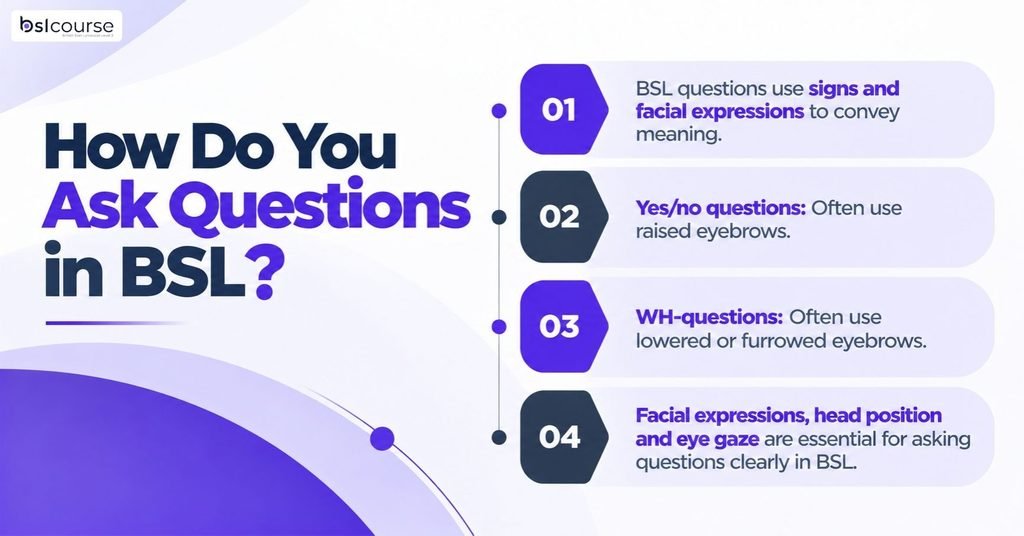
Questions in BSL are formed using manual signs and non-manual features, such as eyebrow movements, facial expressions and head position.
The way you ask a question depends on whether you expect a yes/no answer or need specific information.
There are two main types of questions beginners should learn:
- Yes/no questions: Questions that can be answered with yes or no, such as “Are you happy?” or “Do you like coffee?”
- WH-questions: Questions that ask for information, such as “What is your name?”, “Where do you live?” or “Why are you learning BSL?”
In both cases, facial expressions play a grammatical role. They aren’t simply added to make your signing more expressive.
Why Are Facial Expressions Important in BSL Questions?
Facial expressions help distinguish a question from a statement and can indicate the type of question being asked.
For example, raised eyebrows are commonly associated with yes/no questions, while lowered or furrowed eyebrows are commonly associated with WH-questions.
Head position, eye gaze and timing also contribute to the meaning. A signer may use these features across part or all of the question, depending on its structure.
This is why learning vocabulary alone isn’t enough. To communicate clearly, you need to practise the signs and the facial grammar together.
How to Ask Yes/No Questions in BSL?
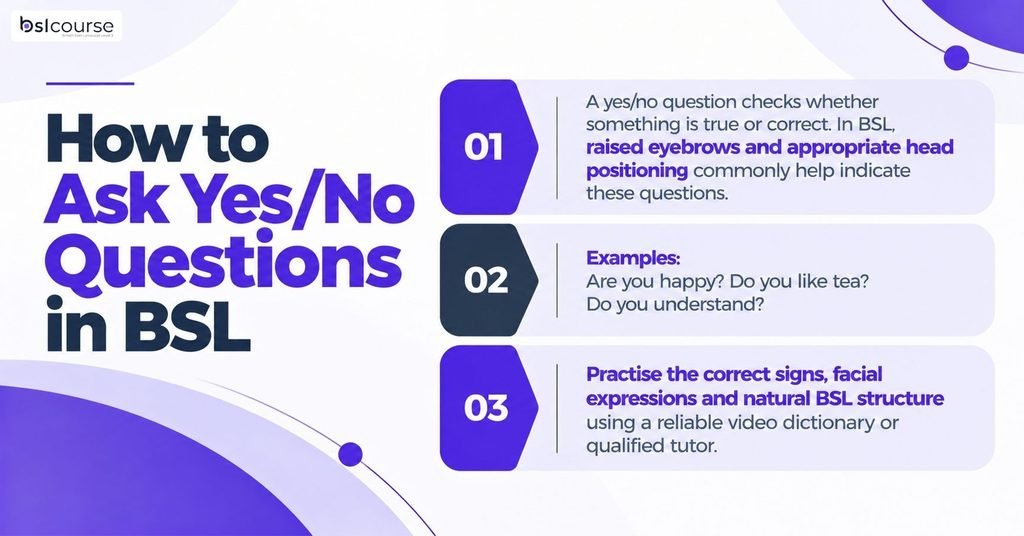
A yes/no question asks whether something is true, possible or correct. These questions are useful when meeting someone, discussing preferences or checking information.
In BSL, yes/no questions commonly involve raised eyebrows, appropriate head positioning and an attentive facial expression.
Examples of Yes/No Questions in BSL
| English question | Meaning to practise in BSL |
| Are you happy? | Ask about someone’s feelings |
| Do you like tea? | Ask about a preference |
| Are you Deaf? | Ask whether someone is Deaf |
| Do you understand? | Check understanding |
| Are you learning BSL? | Ask about someone’s learning |
| Do you work here? | Confirm someone’s workplace |
These are English meanings, not exact BSL translations. Natural BSL word order and sign choices may differ.
Step-by-Step: Practising a Yes/No Question
- Choose a simple question, such as “Do you like tea?”
- Learn the appropriate BSL signs from a reliable video dictionary or qualified tutor.
- Arrange the signs in a natural BSL question structure.
- Raise your eyebrows appropriately while signing the question.
- Maintain an attentive expression and allow the other person time to respond.
Practise in front of a mirror or record a short video. Watch whether your facial expression matches the question and whether your signs remain clear.
How to Ask WH-Questions in BSL
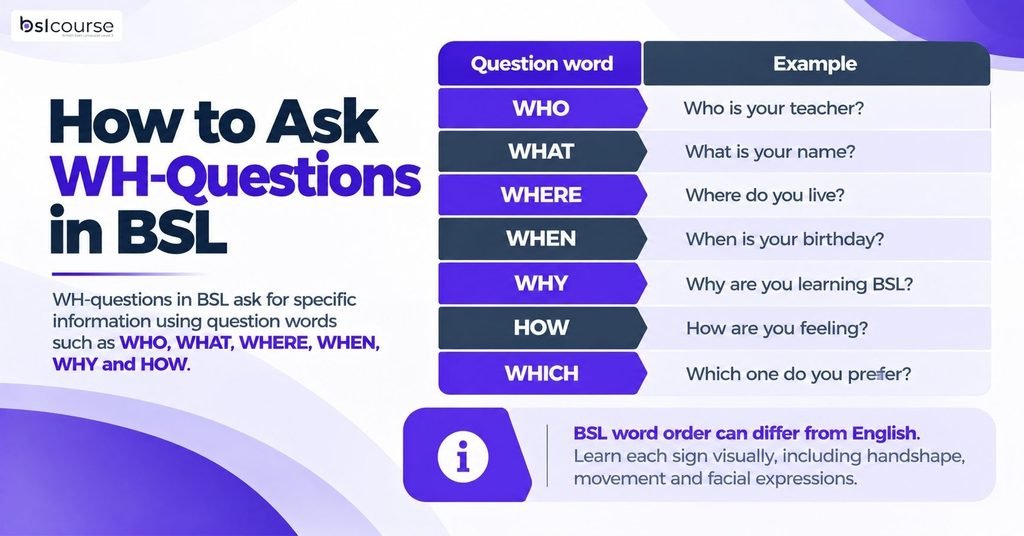
WH-questions are used when you want more information than a simple “yes” or “no” BSL sign. They are essential for introductions, everyday conversations, learning and social interactions.
Common WH-question words in BSL include WHO, WHAT, WHERE, WHEN, WHY and HOW.
In many BSL question structures, the question sign appears towards the end. However, BSL does not follow one fixed word order for every WH-question. Topic, context, emphasis and regional variation can affect how a question is expressed.
Common BSL Question Words and Their Uses
| Question word | What it asks about | English example |
| WHO | A person’s identity | Who is your teacher? |
| WHAT | An object, activity or information | What is your name? |
| WHERE | A place or location | Where do you live? |
| WHEN | A time or event | When is your birthday? |
| WHY | A reason or explanation | Why are you learning BSL? |
| HOW | A method, condition or manner | How are you feeling? |
| WHICH | A choice between options | Which one do you prefer? |
Each question word has a BSL sign or expression that should be learnt visually. Written descriptions cannot fully show the handshape, orientation, movement and facial grammar needed to produce a sign accurately.
How to Use Eyebrows in WH-Questions
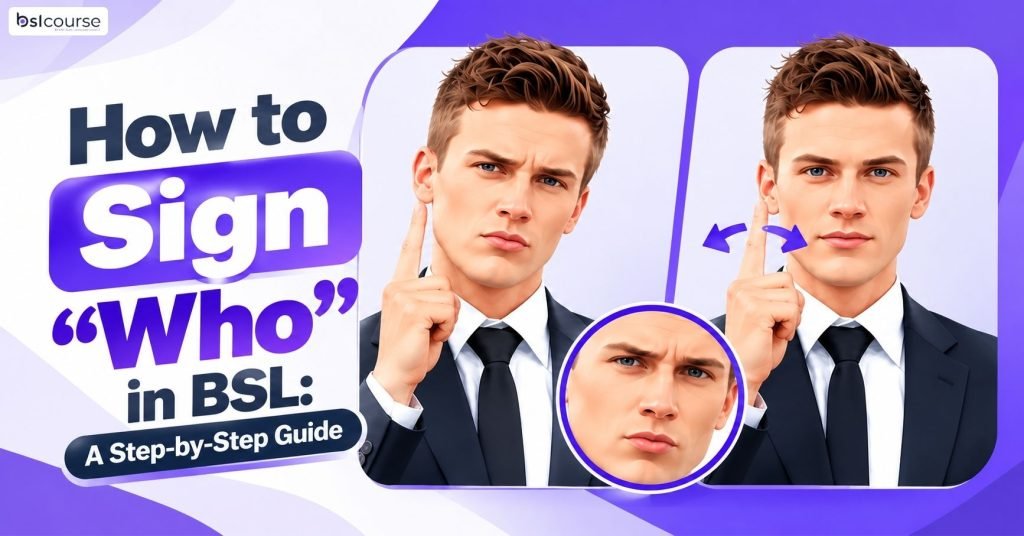
When asking WH-questions in BSL, signers commonly lower or furrow their eyebrows to show that specific information is being requested.
For example, when asking “Where do you live?”, your expression should communicate that you’re expecting the other person to identify a location.
Practise your facial grammar alongside the signs rather than adding it after you’ve finished the question.
10 Common Questions to Learn in BSL
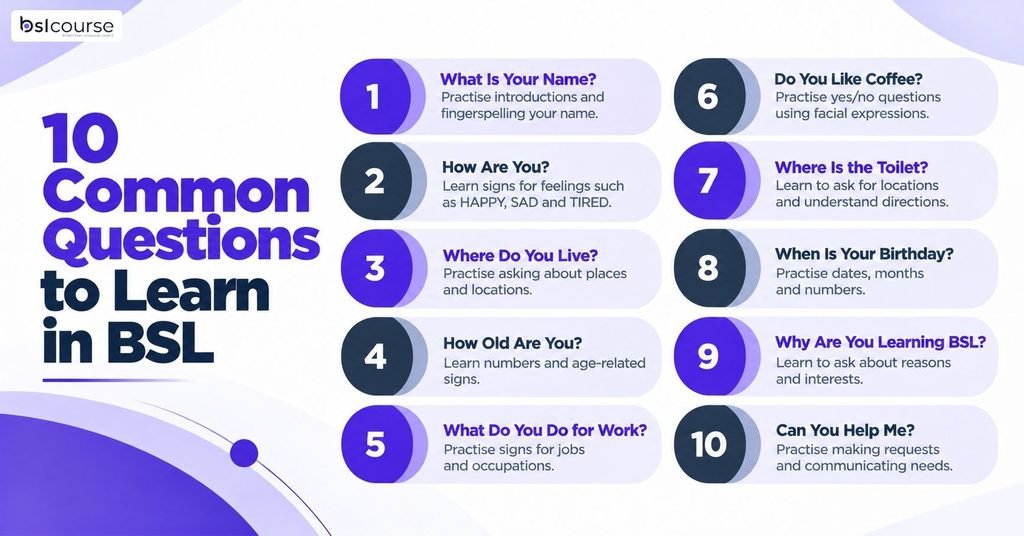
Learning everyday questions helps you move beyond individual signs and begin building conversations.
Here are ten useful questions to practise.
1. What Is Your Name?
This is one of the first questions beginners often learn. It’s useful when introducing yourself to someone new. Learn the BSL signs and structure for asking someone’s name, including the correct facial expression.
You can practise asking the question and responding by fingerspelling your name. Also, you can read our blog- How to say “my name is” in BSL.
2. How Are You?
Asking how someone is feeling is a natural way to begin a friendly conversation.
Learn how to ask “how are you” question in BSL and practise responding with signs for feelings such as HAPPY, SAD, TIRED or FINE.
3. Where Do You Live?
This question helps you learn more about someone’s location or background.
Practise the sign for WHERE and learn how to discuss towns, cities and places. You may also need fingerspelling for unfamiliar place names.
4. How Old Are You?
Age-related questions can be useful when discussing family, birthdays or personal information.
To practise, learn BSL numbers alongside the natural question structure used to ask someone’s age.
5. What Do You Do for Work?
This question can help you discuss jobs, careers and everyday routines.
Learn vocabulary related to WORK and common occupations. Remember that BSL may organise the information differently from English.
6. Do You Like Coffee?
Questions about food and drink are useful for practising yes/no questions.
Learn the appropriate signs for LIKE and COFFEE, then combine them with raised eyebrows and the correct question structure.
You can replace coffee with other familiar foods and drinks to develop your vocabulary.
7. Where Is the Toilet?
This is a practical question for visiting unfamiliar places.
Learn how to ask for a location and how to understand a response that may include pointing, directional signs or spatial information.
8. When Is Your Birthday?
This question introduces time-related vocabulary.
Practise the signs used for birthdays, months, dates and numbers. Learning how BSL expresses time will help you understand the response.
9. Why Are You Learning BSL?
This is a useful question when speaking with other learners or discussing your interest in sign language.
It also provides an opportunity to practise giving reasons and explaining personal interests.
10. Can You Help Me?
Knowing how to request assistance is useful in everyday situations.
Practise the appropriate BSL construction for requesting help, including polite facial expressions and clear signing.
These ten examples provide a starting point. For accurate sign production, use video demonstrations from reliable BSL teaching resources and seek feedback from a fluent signer or qualified tutor.
BSL Question Structure: Is It Different from English?
Yes. British Sign Language has its own grammatical structure, so questions do not always follow the same word order as spoken English.
In English, we often begin a question with words such as “what”, “where” or “why”. In BSL, the question word frequently appears towards the end of the sentence.
For example, consider the English question:
“Where do you work?”
A possible BSL-style gloss for learning purposes is:
YOU WORK WHERE?
A gloss is a written representation of signs, usually shown in capital letters. It helps learners discuss sign sequences, but it does not fully represent BSL grammar, movement or facial expressions.
The University of Surrey’s BSL learning resources explain that WH-question words commonly appear at the end of sentences and highlight the importance of eyebrow and head movements.
English Questions vs BSL Question Patterns
| English sentence | Illustrative BSL gloss |
| Where do you work? | YOU WORK WHERE? |
| What is your name? | YOUR NAME WHAT? |
| Where do you live? | YOU LIVE WHERE? |
| Who is your teacher? | YOUR TEACHER WHO? |
| What do you want? | YOU WANT WHAT? |
These glosses illustrate a common learning pattern. They are not universal translations or a substitute for watching natural BSL. Actual phrasing and question structure should be checked with a fluent BSL signer.
What Are Non-Manual Features in BSL?
Non-manual features are grammatical elements expressed without the hands. They include facial expressions, eyebrow movements, eye gaze, head position and movements of the upper body.
These features are essential when asking questions because they provide information that manual signs alone may not communicate.
For beginners, three areas deserve particular attention.
1. Eyebrow Movement
Eyebrow movement is one of the clearest differences between common BSL question types.
| Question type | Common eyebrow position | Example |
| Yes/no question | Raised eyebrows | Do you like tea? |
| WH-question | Lowered or furrowed eyebrows | Where do you live? |
These patterns are useful starting points, although facial grammar is more complex than a simple raised-or-lowered rule.
2. Head Position and Movement
Head position can help signal that a question is being asked. A signer may slightly adjust their head or upper body while producing a question.
However, not every question requires the same movement. It is better to observe fluent signers than to apply a fixed head movement to every sentence.
3. Eye Gaze and Facial Expression
Eye gaze helps manage attention and interaction. Facial expression can also show interest, uncertainty or the expectation of an answer.
When asking questions, make sure the person can see your signing clearly. Avoid looking away repeatedly or covering your face while signing.
You can explore examples of these features through the University of Surrey’s BSL non-manual features lessons.
Common Mistakes Beginners Make When Asking Questions in BSL
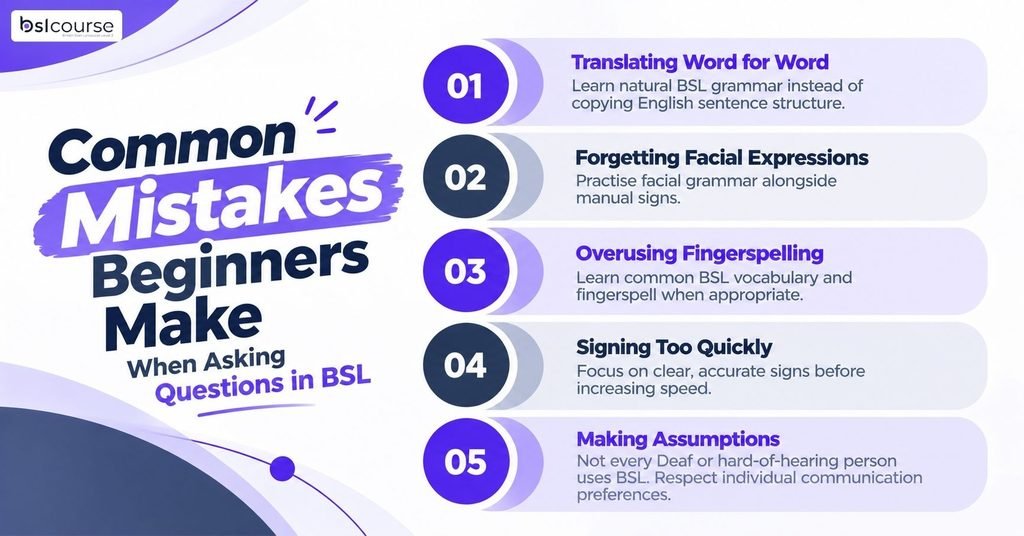
Learning how to ask questions in British Sign Language takes practice. Several common BSL mistakes can make communication less natural or harder to understand.
Translating English Word for Word
BSL has its own grammar, so translating every English word into a separate sign may produce an unnatural sentence.
Instead, learn complete BSL question patterns and observe how fluent signers organise information.
Forgetting Facial Expressions
Using the correct manual signs without the appropriate facial grammar can make a question less clear.
Practise your eyebrow movements and other non-manual features at the same time as your vocabulary.
Fingerspelling Every Word
Fingerspelling is useful for names, unfamiliar terms and certain other words. However, it is not a replacement for learning BSL vocabulary.
Focus on commonly used signs and use fingerspelling when appropriate.
Signing Too Quickly
Beginners sometimes rush through signs because they want to appear confident.
Prioritise clear hand movements, accurate sign formation and a comfortable pace. Speed can develop naturally with practice.
Assuming Every Deaf Person Uses BSL
Not all Deaf or hard-of-hearing people use British Sign Language. Some prefer spoken English, lipreading, written communication or other methods.
Ask people about their communication preferences rather than making assumptions.
How Can Beginners Practise Asking Questions in BSL?
The most effective and fastest way to improve in BLS is to combine visual learning with regular practice and feedback.
You don’t need to memorise dozens of questions immediately. Start with a small number and build your confidence through repetition.
A Simple 7-Day BSL Question Practice Plan
| Day | Practice activity | Learning goal |
| Day 1 | Learn WHO, WHAT and WHERE | Recognise basic question words |
| Day 2 | Learn WHEN, WHY and HOW | Expand question vocabulary |
| Day 3 | Practise three yes/no questions | Use raised eyebrows appropriately |
| Day 4 | Practise three WH-questions | Use question signs and facial grammar |
| Day 5 | Record yourself asking five questions | Review signing clarity |
| Day 6 | Practise a short conversation | Connect questions with answers |
| Day 7 | Review with a fluent signer or tutor | Identify areas for improvement |
Try spending 10 to 15 minutes on each activity. This is a suggested learning routine, not a fixed requirement.
Where Can You Find Reliable BSL Signs?
The BSL SignBank dictionary from University College London is a useful resource for exploring BSL vocabulary.
It allows learners to search for signs using English keywords and provides information about different sign variation. Its content draws on the BSL Corpus and established dictionary research.
For more complete language learning, use structured lessons that demonstrate full sentences, question patterns and interaction between signers.
How Do You Ask Questions Politely in BSL?
Politeness in BSL involves more than learning signs for PLEASE and THANK YOU. It also depends on how you approach someone, respect their attention and respond during a conversation.
Before asking a question, make sure the person knows you want to communicate. A small wave within their field of vision is often appropriate.
Keep your face and hands visible, and give the other person enough time to respond.
If you don’t understand an answer, it’s perfectly acceptable to ask the person to repeat or clarify it. Learning signs for AGAIN, SLOW and UNDERSTAND can be particularly useful.
Respectful communication also means recognising that Deaf people have different experiences and preferences. Some people may be happy to help you practise, while others may not have the time or interest.
Frequently Asked Questions
How do you ask a question in BSL?
You ask a question in BSL by combining manual signs with appropriate facial expressions and grammatical structure. Yes/no questions commonly use raised eyebrows, while WH-questions often involve lowered or furrowed eyebrows.
How do you ask “What is your name?” in BSL?
You need to learn the appropriate signs for YOUR, NAME and WHAT, together with the natural BSL question structure and facial grammar. An illustrative learning gloss is YOUR NAME WHAT?, but you should follow a fluent signer’s video demonstration for accurate signing.
How do you ask “How are you?” in BSL?
BSL has natural ways to ask about someone’s wellbeing. The signs and expression used may differ from a word-for-word English translation. Learn the complete question through a reliable BSL video lesson.
Do you raise your eyebrows when asking questions in BSL?
You commonly raise your eyebrows when asking yes/no questions. For WH-questions, signers often lower or furrow their eyebrows. These are important grammatical patterns rather than optional expressions.
Does BSL use the same grammar as English?
No. BSL is an independent language with its own grammar and sentence structures. Question words, topic placement, facial grammar and spatial features can work differently from spoken English.
Can you learn BSL questions online?
Yes. Online BSL lessons, video dictionaries and guided practice can help you learn question vocabulary, facial expressions and sentence structures. Feedback from fluent signers or qualified tutors can improve your accuracy.
How long does it take to learn basic BSL questions?
The time varies depending on your experience, practice and access to feedback. You may begin recognising simple questions after several lessons, but using them naturally in conversations requires continued practice.
Is British Sign Language the same as American Sign Language?
No. British Sign Language (BSL) and American Sign Language (ASL) are different languages with distinct vocabulary and grammatical features. Learning ASL signs does not automatically teach you how to ask questions in BSL.
Final Thoughts
Learning how to ask questions in BSL is an important step towards meaningful conversations. Once you understand the difference between yes/no questions and WH-questions, you can begin using everyday vocabulary with the correct facial grammar.
Start with familiar questions, practise your expressions and learn from fluent signers. Most importantly, remember that BSL is a complete language, not a collection of gestures or direct English translations.
Ready to develop your signing skills? Explore a structured British Sign Language course to learn essential vocabulary, question patterns and practical conversation skills at your own pace.
Explore More Blog Posts
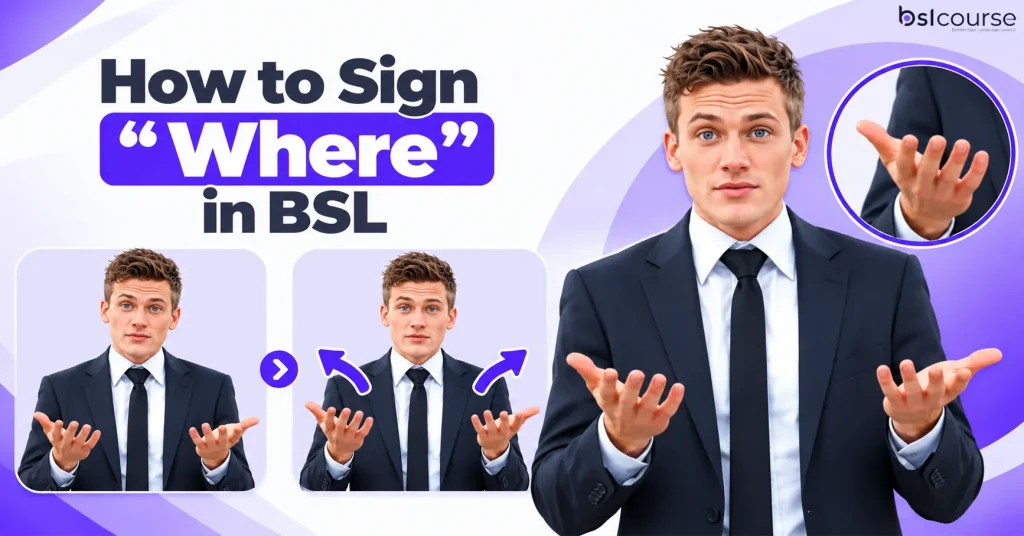
- How to Sign “Where” in BSL
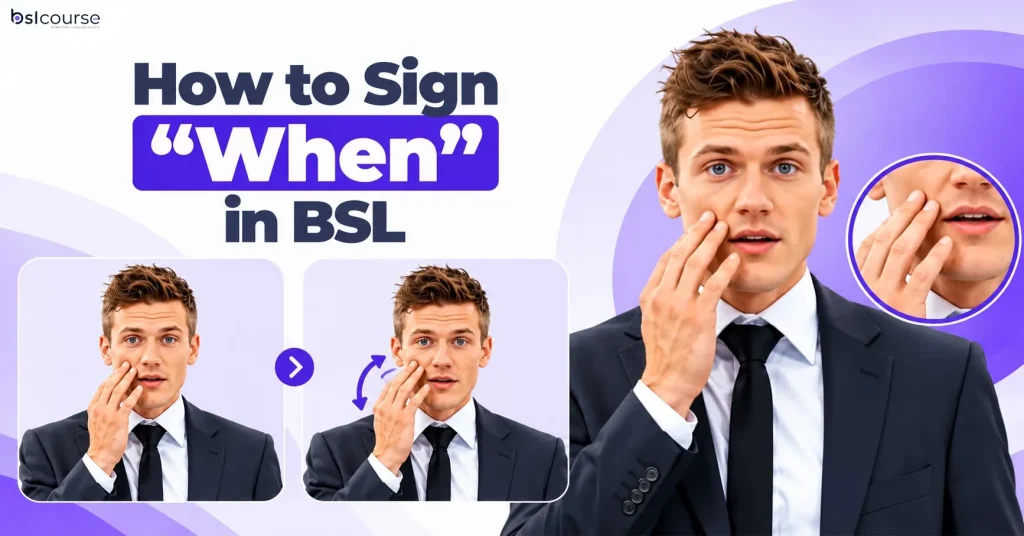
- How to Sign “When” in BSL ( With Video)
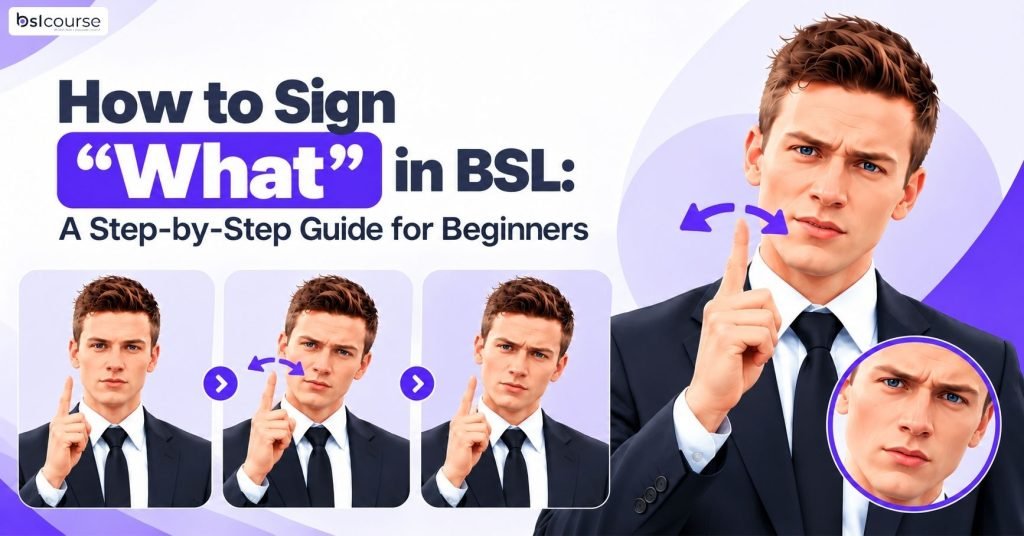
- How to Sign “What” in BSL: A Step-by-Step Guide for Beginners
- Paid Online course vs Free YouTube tutorials: Best Approach for Learning BSL

- How to Sign “No” in BSL? A Simple Guide for Beginners

- How to Sign “Who” in BSL: A Step-by-Step Guide