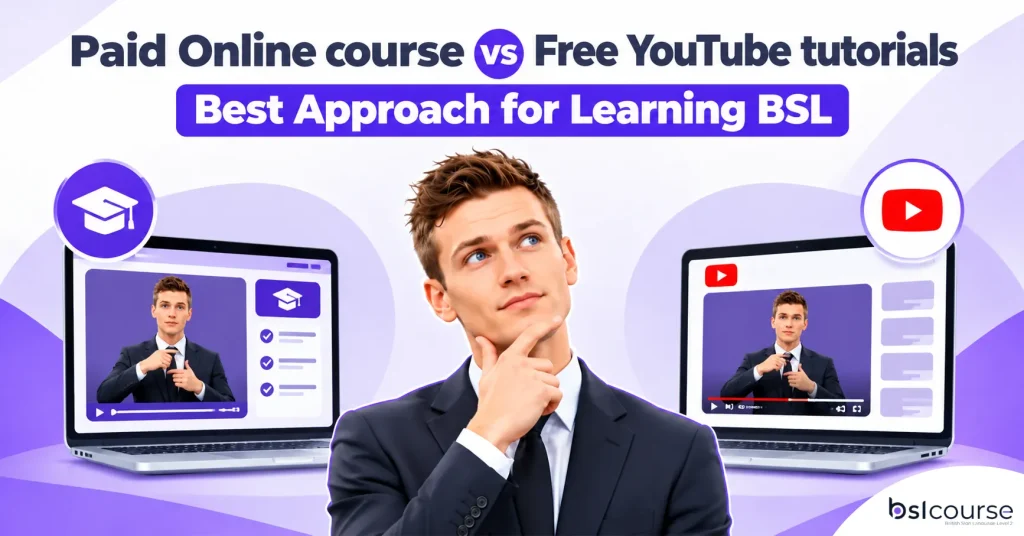
Imagine practising a BSL sign for months, only to discover you have been using the wrong handshape. Without proper feedback, small mistakes can easily become habits. That is why choosing between a paid online course vs free YouTube tutorials matters when finding the best approach for learning BSL (British Sign Language).
Both options have their benefits. A paid BSL course can offer structured lessons, tutor feedback and a recognised qualification if it is delivered through an approved provider. Free YouTube tutorials are useful for learning everyday signs, expanding your vocabulary and practising at your own pace.
However, BSL is more than a collection of hand gestures. It is a complete visual language with its own grammar, facial expressions, handshapes and movements. Learning these elements correctly is essential for effective communication.
So, which learning method should you choose? This article compares paid BSL courses and free YouTube tutorials based on cost, learning structure, feedback and qualifications. You will also discover how to combine both methods to build your signing skills with greater confidence.
Should you learn BSL from a paid online course or YouTube?
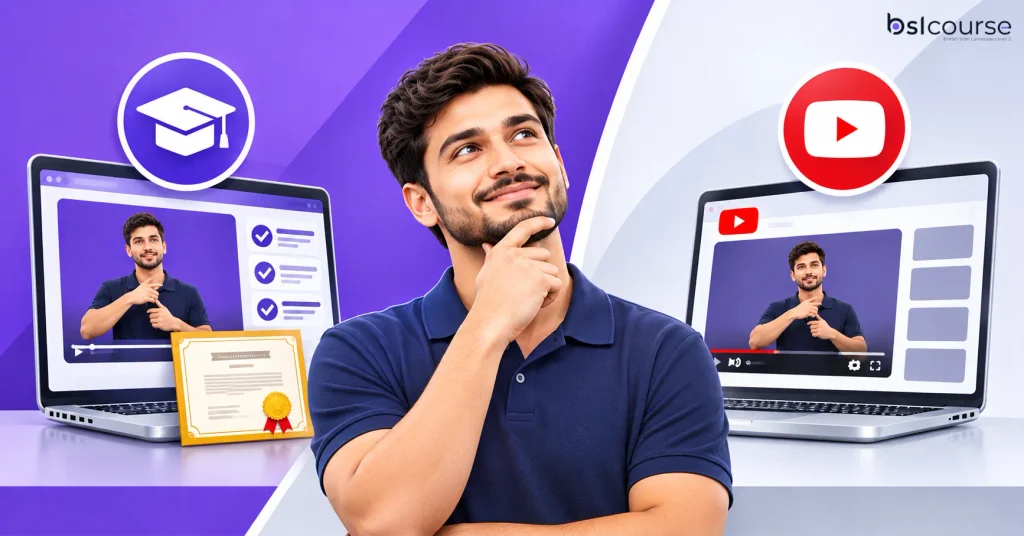
A paid, accredited online course is the better main route if you want a qualification, live feedback and a clear path from beginner to confident signer. Free YouTube tutorials are excellent for vocabulary, revision and exposure to real signing, but they cannot correct your mistakes.
For most learners, the best approach is a course as the backbone, with YouTube as free daily practice on top.
That answer matters because British Sign Language is not English on the hands. It is a visual language with its own grammar, and it uses handshape, movement, facial expression and the space around you to carry meaning. Learn a sign slightly wrong and you may not notice, because nobody is there to tell you.
In this guide you will see how the two options compare on cost, feedback, structure and recognition. You will also get a simple way to decide, and a combined plan you can start this week.
What is the difference between a paid BSL course and YouTube tutorials?
A paid BSL course is a structured programme with a tutor, a syllabus, set learning hours and often an assessment. Some lead to a regulated qualification, such as those offered by Learndrive, a well-known awarding body for BSL in the UK.
YouTube tutorials are free videos made by a wide range of creators, from Deaf educators to hobbyists, with no set order and no assessment.
Both can teach you signs. Only one is designed to take you from zero to a recognised level.
How do they compare side by side?
Paid online BSL courses offer structured learning and potential certification, while free YouTube tutorials provide flexible, self-paced practice without formal qualifications.
| Factor | Paid online course | Free YouTube tutorials |
| Cost | Fees vary by provider | Free |
| Structure | Planned syllabus and progression | You build your own order |
| Feedback on your signing | Yes, from a tutor | None |
| Live conversation practice | Often included | Not available |
| Qualification | Possible, if the course is accredited | No |
| Quality control | Varies, but usually checked | Varies widely |
| Flexibility | Fixed or flexible, depending on the course | Fully flexible |
| Best for | Qualifications, work, steady progress | Vocabulary, revision, casual interest |
How much does each option really cost?
YouTube costs nothing but your time. Paid courses cost money, and the price depends on the provider, so check the fee on the centre’s own page before you commit. However, you can take your signing skills further with this CPD-accredited Level 2 British Sign Language (BSL) Course, available from just £50, with certificate packages ranging from £50 to £60.
Free is not always cheaper in practice. If you spend months practising a sign incorrectly, you will need time to unlearn it. That hidden cost is easy to overlook.
What does a paid BSL course give you that YouTube cannot?
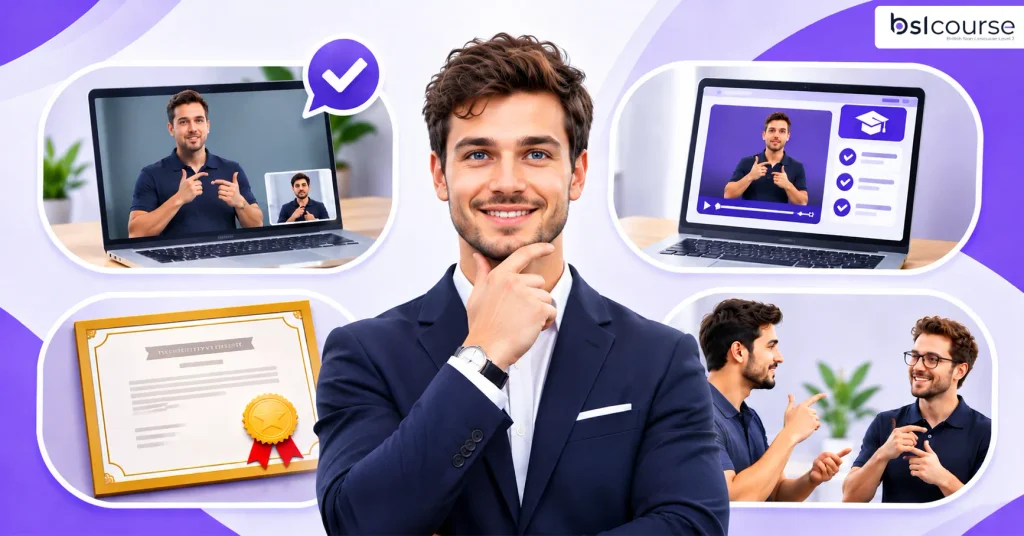
Let’s see the things you will get from a self-paced paid BSL course.
- Feedback: This is the biggest gap. A tutor can see that your handshape is off, that your facial expression changes the meaning, or that you are using English word order. A video cannot see you.
- Structure: A syllabus decides what to learn next, so you do not drift between random videos. For example- Learndrive’s expertly designed British Sign Language (BSL) course offers 3 hours of structured learning, helping you build essential signing skills at your own pace. You’ll also receive a CPD-accredited eCertificate upon successful completion.
- A recognised qualification: If you need BSL for work, study or a career in Deaf services, a regulated CPD qualification from any authorised CPD provider is usually what employers and colleges look for. YouTube cannot give you one.
- Practice with real people: Many courses include live sessions, so you learn to hold a conversation rather than copy a video.
What are YouTube tutorials genuinely good for?
YouTube is a strong tool when you use it for the right job.
- Vocabulary building: you can look up a sign in seconds and watch it several times.
- Revision: replay a lesson after class without paying for extra tuition.
- Receptive practice: watching Deaf signers at natural speed trains your eye for real conversation.
- Testing your interest: you can try BSL before spending any money.
- Topic-specific signs: hobbies, work terms or family vocabulary that a general course may not cover.
What are the risks of learning BSL only from YouTube?
There are four main risks, and they are worth knowing before you rely on free videos alone.
- No one corrects you. Errors become habits.
- Quality varies. Not every creator is a fluent signer or a trained teacher. Look for Deaf presenters and clear credentials.
- Regional variation. BSL has regional signs, and a video from one area may not match what people use near you.
- Gaps in grammar and culture. Videos often teach isolated signs. Grammar, fingerspelling in context and Deaf culture need deliberate, ordered teaching.
None of these means YouTube is bad. They mean it works best as a supplement.
Which should you choose? A simple decision guide
Choose a paid course if you:
- need a qualification for work or study
- want a clear route through Levels 1, 2 and 3
- want a tutor to correct your signing
- find it hard to stay motivated without deadlines
Choose YouTube first if you:
- are only curious and want to test the water
- have no budget right now
- want to learn a small set of signs, such as a few phrases for a friend or neighbour
Choose both if you want the fastest, most reliable progress. This is the best choice for most people.
What is the best combined approach to learning BSL?
Here is a practical plan you can follow.
- Enrol on an accredited course that suits your level, and check that the tutor is qualified and, ideally, Deaf.
- Use YouTube for 10 to 15 minutes a day to revise the signs from your last lesson.
- Watch Deaf signers without learning anything, just to train your eye for speed and facial expression.
- Record yourself signing, then compare it with your tutor’s model and bring questions to class.
- Find real conversation. Join a local Deaf club or a community group, where you can practise with fluent signers.
- Review monthly. Check what you can now do that you could not a month ago.
FAQs
Can you learn BSL completely free?
You can learn a lot of vocabulary for free, but you will struggle to get feedback, structure or a qualification without paying for a course.
How long does it take to learn BSL?
You can learn basic BSL signs and greetings within a few weeks. Simple conversational skills may take 3–6 months, while fluency can take several years. Practising for 15–30 minutes daily can help you build confidence and improve your signing skills.
Is an online BSL course as good as a classroom?
Yes, an online BSL course can be just as effective as classroom learning, especially for beginners. Online courses offer flexibility, self-paced lessons and the ability to replay demonstrations. However, classroom courses provide real-time feedback and conversation practice. The best choice depends on your learning goals and preferred learning style.
Do I need a qualification to learn BSL?
No, you do not need any previous qualifications to learn British Sign Language (BSL). Beginners can start with basic signs, greetings and everyday expressions. However, a recognised BSL qualification may be beneficial if you want to use BSL professionally or pursue a career as a sign language interpreter.
Which is better for complete beginners?
A structured course is usually the safest start, with YouTube as a free helper. If you are unsure, try a few free videos first to confirm your interest.
Are There Any Free Apps to Learn British Sign Language (BSL)?
Yes, several free apps can help you learn British Sign Language (BSL), including Sign BSL and Intersign. You can also try our free Learn BSL Colours interactive tool to practise common colour signs. These resources make learning BSL easier, more engaging and accessible for beginners.
Conclusion
Choosing between a paid online course and free YouTube tutorials is not really an either/or decision. The best approach for learning BSL uses each for what it does well.
A paid, accredited course gives you tutor feedback, a clear structure and a recognised qualification, while YouTube is free and ideal for vocabulary, revision and training your eye on natural signing.
Learning from videos alone risks habits that nobody corrects, so a course as your core, plus short daily YouTube practice, suits most learners best. Conversation with fluent Deaf signers will then speed up your progress more than either tool on its own.
Use free YouTube videos between lessons to keep your signs fresh, and check the course page for current fees, entry requirements and how the course is taught before you enrol.

