Someone mentions a party, a lesson or a meeting, and you want to know the time. In British Sign Language (BSL), you can ask “when” with one small movement on your cheek.
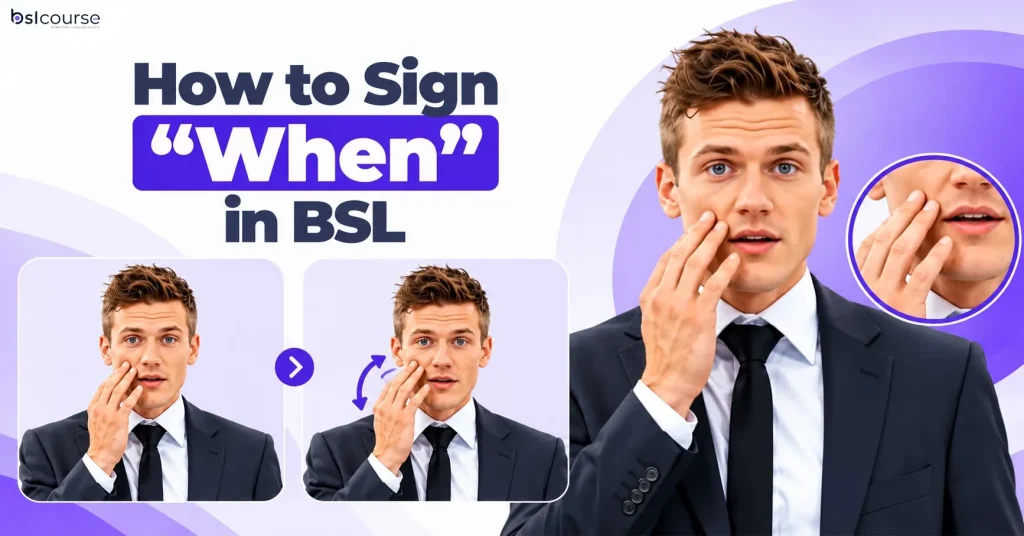
To sign “when” in BSL, rest the fingertips of your dominant open hand on your cheek and flutter them lightly. Silently mouth the word “when” and let your facial expression show that you are asking a question. In a sentence, “when” usually comes last.
Learning how to sign “when” in BSL involves understanding the correct hand position, finger movement, mouth pattern and facial expression. This guide breaks the sign into hand, mouth and face, shows where “when” fits in a sentence, and helps you avoid common mistakes that could make the sign look like something else.
What does the sign for “when” look like at a glance?
| Part of the sign | What to do |
| Hand | Dominant hand, open, fingers loose and slightly apart |
| Location | Fingertips on the cheek, beside the nose and cheekbone |
| Movement | Small, quick flutter of the fingers while the hand stays in place |
| Mouth | Silently shape the word “when” |
| Face | A clear questioning expression |
| Sentence position | Usually at the end |
How do you sign “when” step by step?
Think of the sign as three parts that happen together: the hand, the mouth and the face.
The hand
- Lift your dominant hand from your side towards your face. This is the hand you sign with most. In the demonstration video, the lift takes about a second.
- Open your hand, with your palm turned towards your cheek.
- Rest your fingertips on your cheek.
- Flutter your fingers in small, quick movements. Your hand stays on your cheek while your fingers move.
The mouth
Shape the English word “when” with your lips, but keep your voice off. In the video, the signer’s lips stay slightly parted throughout.
The face
Look at the person you’re asking and show that you expect an answer.
Why do your mouth and face matter?
In BSL, mouth patterns and facial expressions are part of the grammar. Researchers call them non-manual features.
A study in the journal Linguistics found that mouthed English question words and manual question signs are the strongest markers of content questions in BSL. That’s why the silent mouthing matters as much as the hand.
For the face, the University of Surrey’s BSL course notes say eyebrows tend to be furrowed or lowered, with the head tilted slightly forward, in questions such as “when”.
The signer in the video shows a slightly different look, with wide eyes and raised brows. Signers vary, so aim for an expression that clearly asks a question rather than copying one exact face.
One practical tip comes from the video. In the first moments, the fingers pass close to the nose and the corner of the mouth. Keep your hand to the side of your face, so people can still read your lips.
Where does “when” go in a BSL sentence?
BSL isn’t English on the hands, so you can’t sign it word for word. Access BSL explains that the question sign normally closes the sentence. “Where is the ball?” becomes “ball – where?”
The same rule applies to “when”. The examples below use glosses, which are capital-letter labels that show sign order. They’re simplified illustrations, and a BSL tutor may sign the same ideas differently.
| English | Simplified BSL order |
| When is the party? | PARTY – WHEN? |
| When is the meeting? | MEETING – WHEN? |
| When is your birthday? | YOUR BIRTHDAY – WHEN? |
Sign the topic, pause briefly, then ask “when?” with your hand, mouth and face together.
How can you tell “when” from “time” and the other question signs?
Learners often mix up “when” and “time”. The easiest way to separate them is by where on your body you sign.
| Sign | How it’s made | Where |
| When? | Fingers flutter against the cheek | Cheek |
| Time | Index finger of the dominant hand taps the non-dominant wrist twice | Wrist |
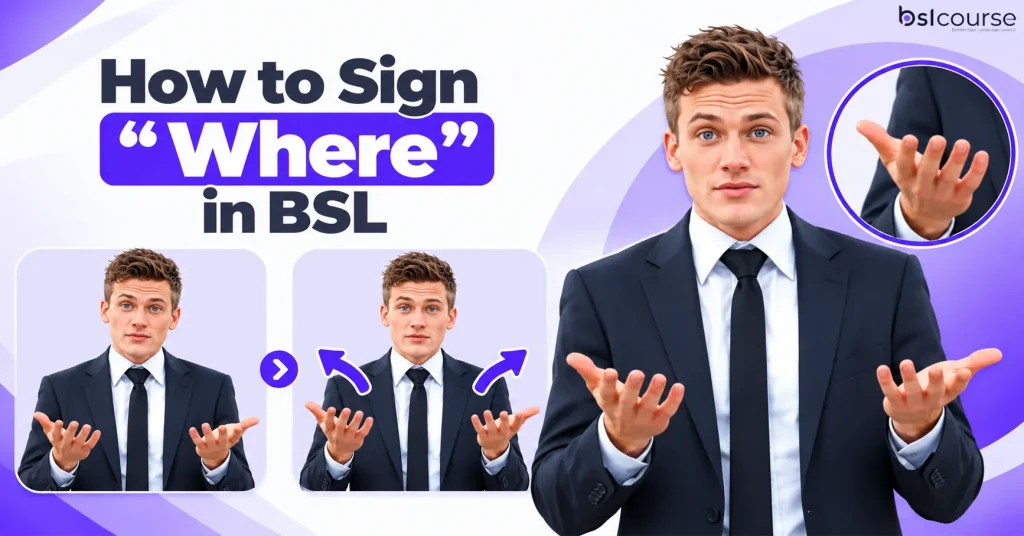
| Where? | Both flat hands, palms up, make circles in front of the body | In front of the body |
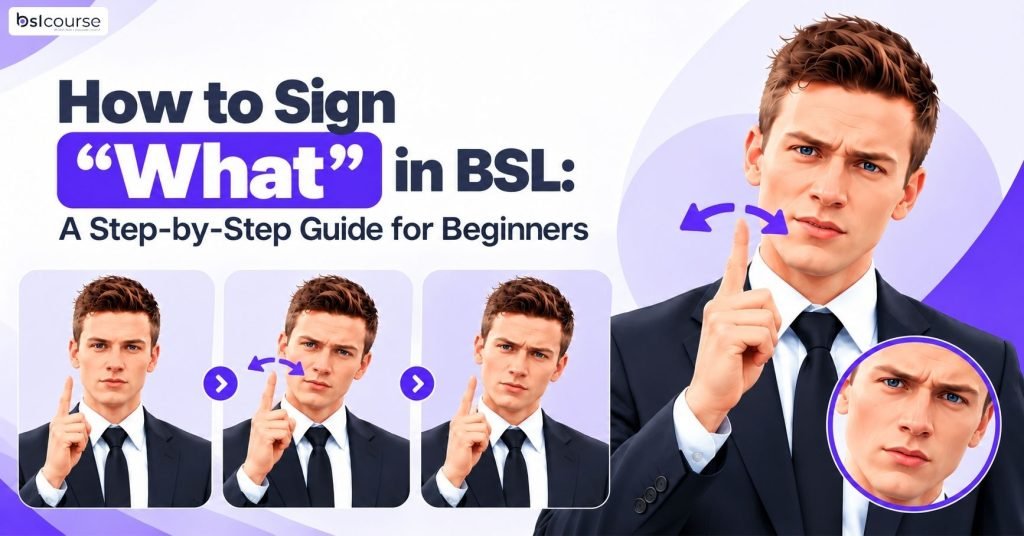
| What? | Index finger makes short side-to-side movements in front of the body | In front of the body |
| Who? | Upright index finger beside the head makes small circles | Beside the head |
What mistakes should you avoid?

- Signing in the air. Keep your fingertips in contact with your cheek.
- Covering your mouth. Your lips carry the word and help mark the question.
- Speaking aloud. Mouth the word silently.
- Using a blank face. Without a questioning expression, the sign can read as a statement.
- Following English word order. Put “when” last.
- Swapping “when” and “time”. Cheek means “when”, and wrist means “time”.
How can you practise signing “when”?
- Watch the video three times. Look at the hand first, then the mouth, then the eyes and brows.
- Copy the sign slowly in a mirror. Check that your fingertips touch your cheek and your lips stay visible.
- Sign “PARTY – WHEN?” and “MEETING – WHEN?” with the question last.
- Ask a fluent signer or tutor for feedback.
Access BSL notes that question signs are taught in the first module of BSL Level 1, so a beginner course is a natural next step.
Frequently asked questions
Which hand do you use to sign “when” in BSL?
Use your dominant hand to sign “when” in BSL. Place the fingertips of your open hand against your cheek and make a gentle fluttering movement. Keep your fingers relaxed and your movements small and controlled.
Do you say “when” aloud while signing?
No, you do not need to say “when” aloud. Instead, silently mouth the word while making the sign. Combine the mouth pattern with a natural questioning facial expression to communicate your meaning clearly.
Does “when” come first or last in a BSL question?
In BSL, “when” usually comes at the end of a question. You introduce the topic first and then sign “when”. For example, you might sign “MEETING WHEN?” rather than following English word order. However, sentence structure can vary depending on context.
How do you sign “No” in BSL?
To sign “no” in BSL, raise your dominant hand to chest height with your fingers extended and your palm facing forwards. Move your hand gently from side to side while keeping your arm relaxed. Facial expressions can help communicate the negative meaning.
Key takeaways
- Flutter the fingertips of your dominant open hand on your cheek.
- Mouth “when” silently and show a clear question with your face.
- Keep your lips visible.
- Put “when” at the end of the sentence.
- Remember: cheek for “when”, wrist for “time”.
Next step: book a beginner BSL course accredited by Signature, such as a Level 1 course, and have a tutor check your “when” in person.