
BSL word order is different from English because British Sign Language (BSL) has its own grammar and sentence structure. While English commonly follows a Subject-Verb-Object pattern, BSL often uses a Topic-Comment structure, with time introduced near the beginning.
For example, the English sentence “Yesterday, the weather was awful” can be expressed in BSL gloss as “YESTERDAY WEATHER AWFUL.” However, BSL sentence structure is flexible and can change depending on context, meaning and emphasis.
Understanding BSL word order is essential for anyone learning British Sign Language. Rather than translating English word for word, BSL uses signs, facial expressions, body movements and visual space to communicate meaning.
In this guide, you will learn how BSL sentence structure works, how it differs from English grammar and how to use common word order patterns through simple, practical examples.
What Is the Word Order in BSL?
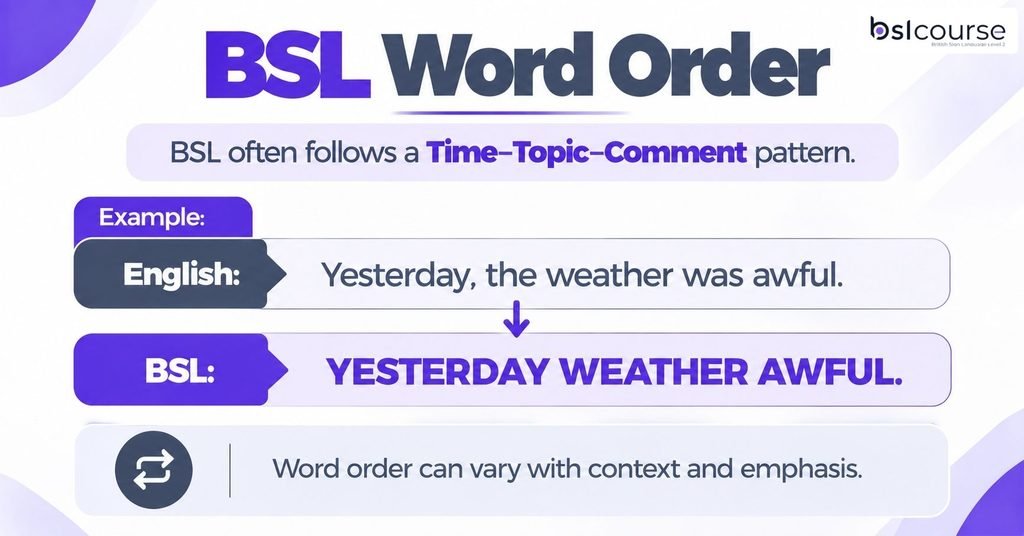
The word order in BSL describes how signs are arranged to form a meaningful sentence. Unlike English, which commonly uses Subject-Verb-Object (SVO) order, BSL often uses a Topic-Comment structure.
In simple terms, you introduce the topic first and then explain something about it.
A useful starting pattern for beginners is:
TIME
When?
TOPIC
What or who?
COMMENT
What about it?
A common BSL sentence pattern, not a fixed rule for every sentence.
Consider this example:
English: Yesterday, the weather was awful.
BSL gloss: YESTERDAY WEATHER AWFUL.
Here is how the sentence works:
- Time: YESTERDAY tells us when it happened.
- Topic: WEATHER tells us what we are talking about.
- Comment: AWFUL explains what the weather was like.
The sentence communicates the main idea without copying every word from English.
However, BSL word order is flexible. The arrangement of signs can change depending on context, emphasis and what the signer wants to communicate. A single fixed pattern cannot describe every BSL sentence.
A BSL grammar teaching resource from Deaf Support also explains that time-topic-comment is a common pattern, but other arrangements are possible.
How Is BSL Word Order Different from English?
The main difference between BSL and English word order is how each language organises information.
English usually follows a Subject-Verb-Object structure. BSL can place the topic first and use space, movement and facial expressions to communicate relationships.
| Feature | English | BSL |
| Common structure | Subject-Verb-Object | Often Topic-Comment |
| Time | Can appear in different positions | Often established early |
| Grammar | Relies heavily on words and word order | Uses signs, space, movement and facial expressions |
| Questions | Often change word order or use helping verbs | Use question signs and facial expressions |
| Verbs | Often change form to show tense | Can use time signs and other grammatical features |
| Visual space | Not part of written English grammar | Can show people, locations and actions |
For example:
English: I am going to London tomorrow.
Illustrative BSL gloss: TOMORROW LONDON I GO.
The time and place are introduced before the action.
This is a helpful example of how information might be organised, but it is not the only possible BSL sentence. Natural signing may use different structures or directional movement.
The UK government’s BSL GCSE subject content confirms that BSL has its own syntax and grammar and that its sign order can differ from English.
What Is Topic-Comment Structure in BSL?

Topic-comment structure is a common way of organising information in BSL. The topic introduces what the sentence is about, while the comment tells us something about that topic.
Think of it as answering two simple questions:
Topic: What am I talking about?
Comment: What do I want to say about it?
For example:
English: The dog is sleeping.
Illustrative BSL gloss: DOG SLEEP.
In this example, DOG introduces the topic and SLEEP tells us what the dog is doing.
Another example:
English: The house is big.
Illustrative BSL gloss: HOUSE BIG.
Here, HOUSE is the topic and BIG describes it.
The topic does not always have to be the grammatical subject. A signer may introduce an object, person, place or event as the main topic before adding more information.
That is why learning BSL involves understanding the message, not just memorising a list of signs.
What Is the Subject-Object-Verb Order in BSL?
Subject-Object-Verb (SOV) is a sentence pattern where the subject comes first, followed by the object and then the action.
For example, English often uses:
Subject + Verb + Object
I + EAT + APPLE.
An illustrative BSL arrangement could be:
Subject + Object + Verb
I + APPLE + EAT.
BSL can also use an Object-Subject-Verb (OSV) arrangement when the object is introduced as the topic:
APPLE I EAT.
Both examples help show how BSL can organise information differently from English. However, SOV and OSV are not universal BSL rules.
The choice of sign order depends on the type of verb, the context and how information has already been introduced.
Why Does Time Often Come First in BSL Sentences?
In BSL, time is often established near the beginning so the person watching understands when an event happened.
For example:
English: I worked yesterday.
Illustrative BSL gloss: YESTERDAY I WORK.
Or:
English: I will study tomorrow.
Illustrative BSL gloss: TOMORROW I STUDY.
The time signs help establish when the action takes place.
This matters because BSL does not use English verb endings such as “-ed” to show the past tense. Instead, it has its own ways to express time, including time signs and other grammatical features.
Common time signs include:
| Time sign | Meaning |
| YESTERDAY | The previous day |
| TODAY | The current day |
| TOMORROW | The following day |
| LAST-WEEK | The previous week |
| NEXT-WEEK | The following week |
| NOW | The present moment |
Time does not always have to appear first. Once the time has been established, it may not need to be repeated in every sentence.
BSL Word Order Examples for Beginners
The best way to understand BSL word order is to compare simple English sentences with possible BSL sign arrangements.
The examples below use BSL gloss, which means writing sign labels in capital letters. They show possible sentence patterns for learning purposes, not a full record of how a fluent signer would produce each sentence.
| English sentence | Illustrative BSL gloss |
| I like tea. | TEA I LIKE |
| My sister lives in London. | MY SISTER LONDON LIVE |
| I went shopping yesterday. | YESTERDAY I SHOP |
| The weather is cold today. | TODAY WEATHER COLD |
| I will work tomorrow. | TOMORROW I WORK |
| The house is big. | HOUSE BIG |
| I like football. | FOOTBALL I LIKE |
| I am studying BSL. | BSL I STUDY |
Remember that facial expressions, sign movement and spatial grammar are missing from these written examples. A written gloss is a learning aid, not a complete BSL translation.
How Do You Ask Questions in BSL?
Questions in BSL use both sign order and facial expressions. Some questions include a question sign, such as WHAT, WHERE or WHO. Others can be formed through facial expressions without changing the signs.
There are two common types of questions.
1. WH-questions
WH-questions ask for information, such as who, what, where, when or why.
In BSL, the question sign often appears at the end of the sentence.
For example:
| English question | Illustrative BSL gloss |
| What is your name? | NAME YOU WHAT? |
| Where do you live? | LIVE YOU WHERE? |
| What is your job? | WORK YOU WHAT? |
| How old are you? | AGE YOU WHAT? |
When asking these questions, signers often lower or furrow their eyebrows. Head position and eye gaze also help show that a question is being asked.
2. Yes-or-no questions
Yes-or-no questions are questions that can be answered with YES or NO.
For example:
English: Do you like coffee?
Illustrative BSL gloss: COFFEE YOU LIKE?
The signer may raise their eyebrows and lean slightly forward to show that they are asking a question.
These facial features are part of BSL grammar. They are not simply expressions of emotion.
The University of Surrey’s BSL learning resource explains how eyebrow movement and head position help distinguish different types of questions.
How Do Facial Expressions Affect BSL Sentence Structure?
Facial expressions play an important role in BSL grammar. They can show questions, emphasis, attitudes and other types of meaning.
In spoken English, we often change our tone of voice to express a question or feeling. In BSL, facial expressions, head movements and body position can perform similar functions.
For example, a signer may:
- Raise their eyebrows when asking a yes-or-no question.
- Furrow their eyebrows when asking a WH-question.
- Use facial expression and head position to highlight a topic.
- Change mouth patterns and facial expression to describe size, intensity or manner.
These features are called non-manual features because they are produced without the hands.
They work alongside handshapes, movements and signs to form complete sentences.
This is why learning vocabulary alone is not enough. You also need to understand how facial expressions contribute to meaning.
Does BSL Use the Same Grammar as English?
No. BSL has its own grammar, which is different from English grammar.
Although both languages can express the same ideas, they do not always use the same sentence patterns.
For example, English uses articles such as “a”, “an” and “the”. It also uses helping verbs such as “am”, “is” and “are”.
BSL does not need a separate sign for every English word. Instead, meaning may be expressed through signs, their arrangement, movement, direction and context.
Consider this example:
English: The children are playing outside.
Illustrative BSL gloss: CHILDREN OUTSIDE PLAY.
The written BSL gloss focuses on the main information. However, actual BSL signing could also use depicting signs and movement to show how the children are playing.
The important lesson is that BSL is not simply English with fewer words. Its grammar works through a visual language system.
How Does BSL Use Space to Show Meaning?
BSL uses the space around the signer to show people, places, objects and relationships.
For example, a signer may establish one person on their left and another person on their right. They can then point towards those locations or use a directional verb to show an action between the two people.
This helps communicate who is doing something and who is receiving the action.
Imagine you want to express:
“I gave a book to my friend.”
Rather than translating each English word, BSL may use the position and movement of signs to help show who gives the book and who receives it.
This is called spatial grammar.
Space is especially useful when discussing several people, giving directions or describing movement.
As learners become more confident, understanding spatial grammar helps them move beyond simple word-order patterns.
Is BSL Word Order Always the Same?
No. BSL does not follow one fixed word order in every sentence.
Topic-comment structures are common, but the order of signs can change based on the meaning, context and information being highlighted.
Several factors can affect BSL sentence structure:
- Topic: What the conversation is mainly about.
- Context: What the signer and viewer already know.
- Time: When an event takes place.
- Emphasis: Which information the signer wants to highlight.
- Verb type: Whether the verb uses a fixed sign, directional movement or depicting features.
- Visual space: How people, places or objects have been established.
For example, a signer discussing a particular car may introduce the car first because it is the focus of the conversation.
If the time of an event is important, they may establish that first instead.
Signature, a UK awarding organisation for BSL qualifications, includes topic-comment structure, topicalisation and emphasis among its descriptions of BSL grammar.
The key is to understand how the sentence communicates meaning rather than trying to force every sentence into the same pattern.
What Are the Common Mistakes in BSL Word Order?
Many beginners make mistakes because they try to use English grammar when signing BSL.
Here are some common mistakes to avoid.
1. Translating English word for word
BSL is not a direct translation of English. Copying English word order and simply replacing words with signs can produce Signed Supported English (SSE) rather than natural BSL.
What to do: Focus on the meaning of the sentence and learn how fluent BSL users organise that information.
2. Assuming every sentence follows one formula
Time-topic-comment is a useful beginner pattern, but it is not suitable for every sentence.
What to do: Learn different sentence structures and observe how signers change the order to suit the context.
3. Ignoring facial expressions
A sentence may be unclear if you use the correct hand signs but miss the facial features needed to express a question or other grammatical meaning.
What to do: Practise facial expressions alongside the signs from the beginning.
4. Forgetting to establish context
BSL often relies on information introduced earlier in the conversation.
What to do: Make the topic, people and time clear when needed. This helps the viewer follow the message.
5. Learning from written examples alone
Written BSL glosses cannot fully represent hand movements, eye gaze or spatial grammar.
What to do: Use videos, lessons and feedback from qualified BSL teachers, particularly Deaf teachers.
How Can Beginners Practise BSL Word Order?
You can improve your BSL sentence structure through regular practice and careful observation.
Step 1: Start with simple sentences
Choose short English sentences such as “I like tea” or “The dog is sleeping”. Identify the topic and what you want to say about it.
Step 2: Practise adding time
Try adding YESTERDAY, TODAY or TOMORROW to your sentences. Notice how establishing the time helps explain when an action happens.
Step 3: Watch fluent BSL signers
Watch real conversations and pay attention to how signers introduce topics, ask questions and use facial expressions.
Step 4: Practise in front of a mirror
Check your hand movements, facial expressions and head position. Recording yourself can also help you review your signing.
Step 5: Get feedback from a BSL teacher
A qualified teacher can help you understand when to change sign order and how to make your sentences more natural.
Test Your Understanding of BSL Word Order
Try this short exercise to check what you have learnt.
1. Which sentence pattern is commonly used in BSL?
Subject-Verb-Object in every sentence
Topic-Comment
Alphabetical sign order
2. Which feature can help show a yes-or-no question in BSL?
Raised eyebrows
Speaking louder
Fingerspelling every word
3. Where is the time often established in a BSL sentence?
Only at the end
Near the beginning
It must appear twice
Check my answers
FAQs
BSL can use Subject-Verb-Object order in some contexts, but it is not the single standard pattern for every sentence. BSL also uses topic-comment structures and other sign arrangements depending on the meaning. BSL grammar is different from English rather than inherently harder. English speakers may find it unfamiliar at first because it uses visual space, facial expressions and sign movement. Regular practice helps learners understand these differences. No. BSL has its own grammar and does not require a separate sign for every English word. The focus is on conveying the complete meaning through natural BSL structures. Question signs such as WHAT, WHERE and WHY often appear at the end of BSL questions. However, their position can vary. Facial expressions also help show the type of question being asked. Yes. You can begin by learning how topics, comments and time references work. However, you will need to build your vocabulary and learn the visual features of BSL to form natural sentences.Does BSL use Subject-Verb-Object order?
Is BSL grammar harder than English grammar?
Do you need to sign every English word in BSL?
Do question words go at the end in BSL?
Can you learn BSL word order without knowing many signs?
Final Thoughts
Understanding BSL word order is an important step towards communicating confidently in British Sign Language.
Start by remembering three key points: BSL often uses topic-comment structures, time is frequently introduced early, and facial expressions and visual space are essential parts of grammar.
Most importantly, avoid translating English word for word. Focus on the meaning you want to share and observe how fluent signers communicate it.
With practice, you will become more comfortable recognising BSL sentence patterns and using them in everyday conversations.
Ready to improve your British Sign Language skills? Explore a structured BSL course with video demonstrations, practical examples and guided activities to build your confidence step by step.
Our Latest Blogs
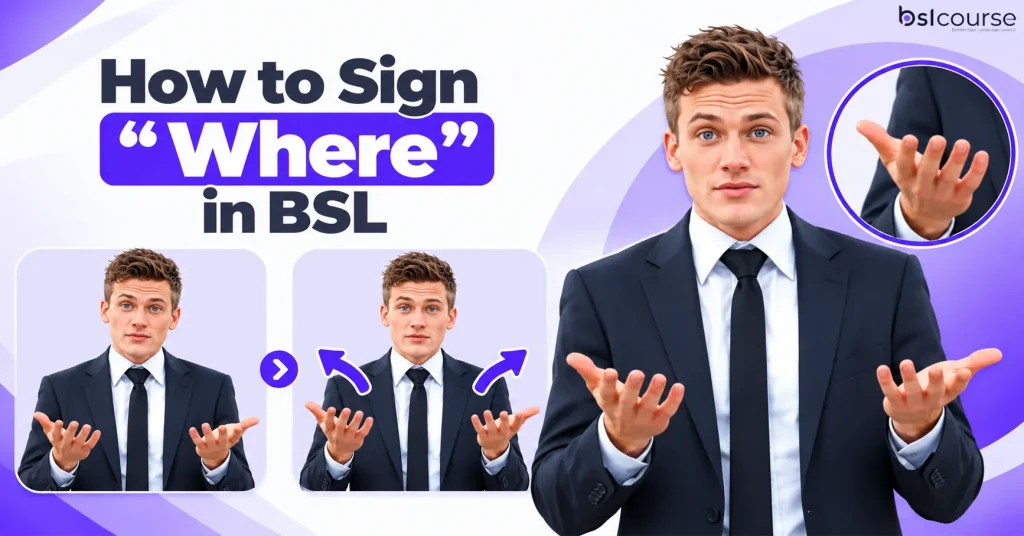
- How to Sign “Where” in BSL
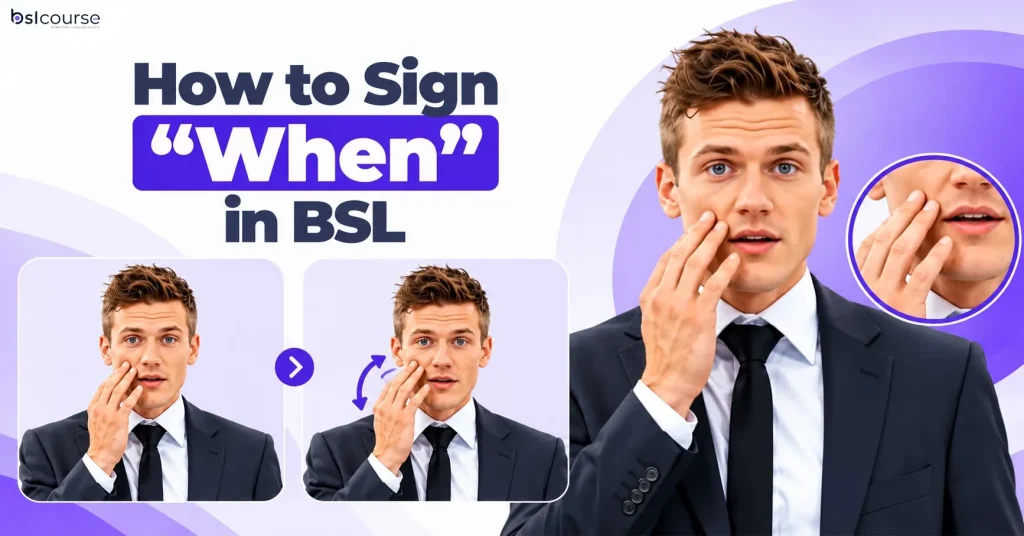
- How to Sign “When” in BSL ( With Video)
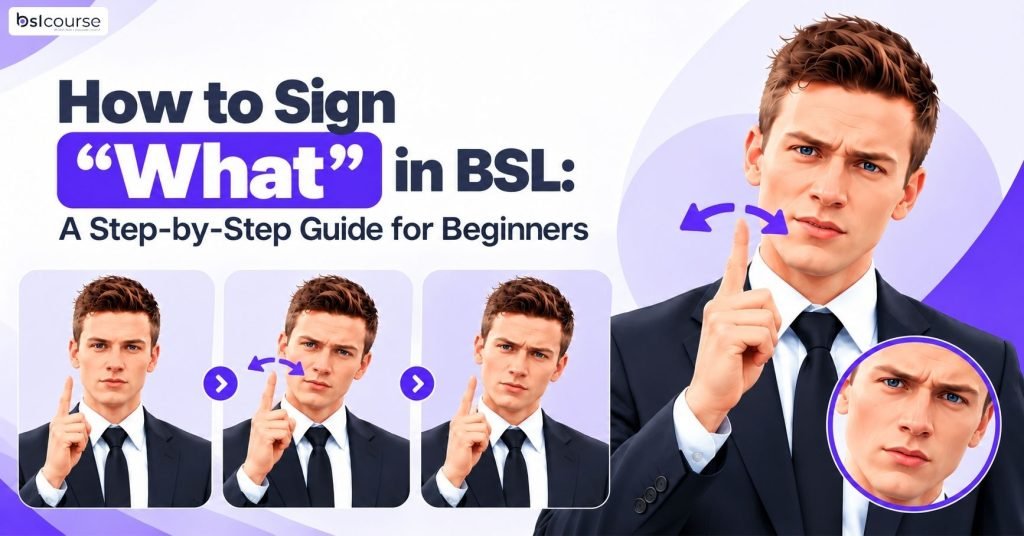
- How to Sign “What” in BSL: A Step-by-Step Guide for Beginners
- Paid Online course vs Free YouTube tutorials: Best Approach for Learning BSL

- How to Sign “No” in BSL? A Simple Guide for Beginners

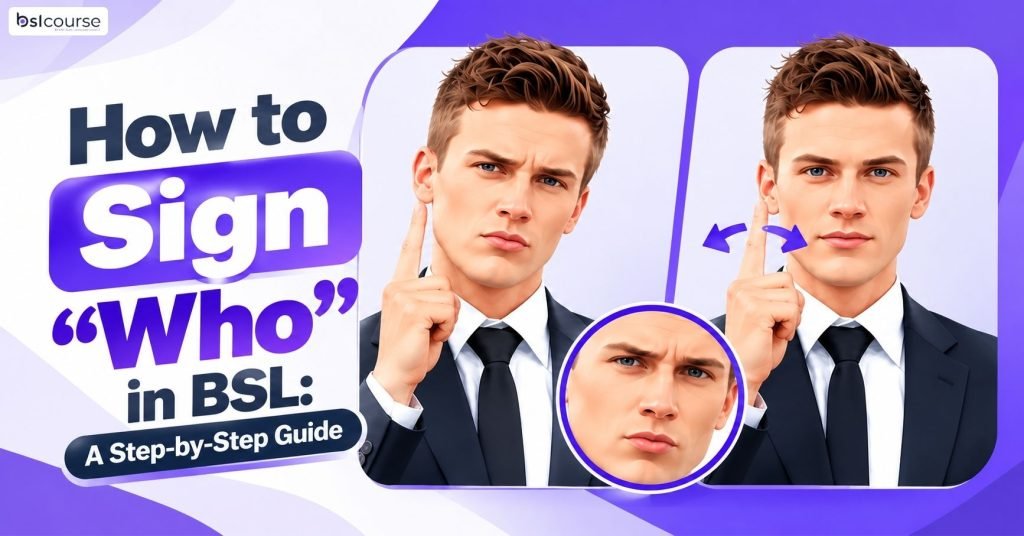
- How to Sign “Who” in BSL: A Step-by-Step Guide