

Have you ever learnt a British Sign Language (BSL) sign, only to see someone use a completely different sign for the same word?
It can be confusing, especially when you are new to BSL. You might wonder which sign is correct or whether you have learnt the wrong one.
One BSL word can have different signs because of regional differences, Deaf community traditions, age, and the meaning of the word. Just as spoken English has different words and accents across the UK, BSL has its own regional forms.
These differences are a natural part of the language. Understanding them can help you communicate with more confidence and connect with Deaf people from different backgrounds.
Why Are There Different Signs for the Same Word in BSL?
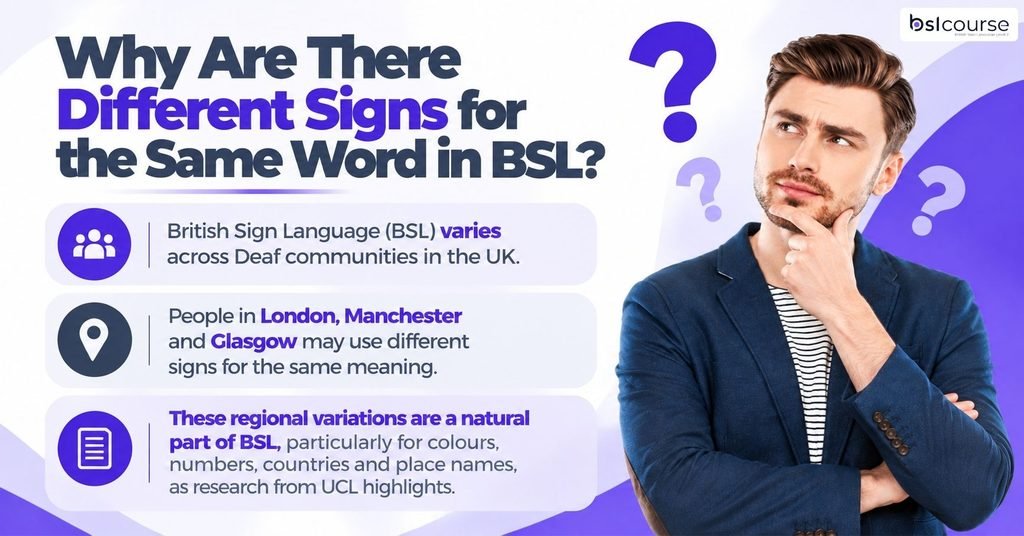
British Sign Language is a living language. It has developed through Deaf communities across the UK, with different places building their own ways of signing.
For example, someone from London may use a different sign from someone in Manchester or Glasgow, even when they want to express the same idea.
These differences are known as BSL variations. They are not always mistakes or signs that need correcting.
Research from University College London (UCL) shows that signs for colours, numbers, countries and place names can vary across the UK.
Why Do BSL Signs Vary Across the UK?
British Sign Language (BSL) varies due to regional dialects, Deaf community traditions, generational changes and differences in meaning. Context, facial expressions and body movements also shape how signers communicate.
1. Regional Differences in British Sign Language
One of the main reasons for different BSL signs is where people live or where they learnt the language.
BSL has regional dialects, much like spoken English.
Think about how people in different parts of Britain use different words for everyday things. A similar pattern exists in sign language.
For example, the sign for a particular colour might be different in London and Manchester. Both signs can express the same meaning.
Examples of regional BSL variations
| Word or concept | How it varies |
| Green | Different regional signs are used across the UK. |
| Purple | Several regional versions have been recorded. |
| Seventeen | Different number signs exist in different communities. |
| Birmingham | More than one sign is used for this place name. |
| America | Regional variations exist for the country’s name. |
These are documented examples from UCL’s BSL SignBank regional database.
2. Deaf Communities Have Their Own Signing Traditions
BSL has a strong connection to Deaf culture and identity.
For many years, Deaf people developed and shared signs through families, schools, friendships and local communities.
As a result, some communities have kept signs that are less common in other parts of the country.
These traditional signs are an important part of Deaf history.
For example, a Deaf person who grew up in Liverpool may use a local sign that someone from another region has never seen.
That does not automatically make either sign incorrect.
The British Deaf Association highlights regional differences in Liverpool BSL and explains how these forms reflect local Deaf identity.
3. Age and Generational Differences Can Change BSL Signs
Language changes over time, and BSL is no exception.
Older Deaf people may use traditional signs that they learnt during childhood. Younger signers may prefer signs that are more common across the country.
For example, a grandparent and grandchild might use different signs for the same colour.
Both may understand each other, even if their preferred signs are different.
A study published in PLOS ONE found that age, school location and language background influenced the use of regional BSL signs. It also found that younger signers tended to use fewer distinct regional variants.
4. One English Word Can Have Different Meanings in BSL
Sometimes, different BSL signs are not regional variations at all.
Instead, they represent different meanings of the same English word.
This happens because BSL is a language in its own right, not a word-for-word version of English.
Consider the English word right.
It can mean:
- The opposite of left.
- Something that is correct.
- A legal or moral entitlement.
These are three different ideas, even though English uses the same word.
When signing, you need to express the intended meaning, rather than automatically choosing a sign based on the English spelling.
Another example: Run
The English word run can describe several actions.
Someone might say:
- I run every morning.
- She runs a business.
- The machine is running.
The word is the same, but its meaning changes in each sentence.
In BSL, these ideas may need different signs or expressions to communicate the correct meaning.
This is why learning a sign without understanding its context can lead to confusion.
5. The Situation Can Influence How Someone Signs
The context of a conversation can also affect how a person communicates in BSL.
For example, the way someone explains an idea to a close friend may differ from the way they present the same information during a formal meeting.
BSL uses much more than hand movements.
Facial expressions, body movement, signing space and sentence structure all help communicate meaning.
A person may also choose a different sign depending on who they are talking to and which regional forms their conversation partner understands.
However, a change in facial expression or movement does not always mean that a completely different word is being used. These features can also be part of BSL grammar.
Understanding this distinction is important for developing natural communication skills.
Are Different BSL Signs All Correct?
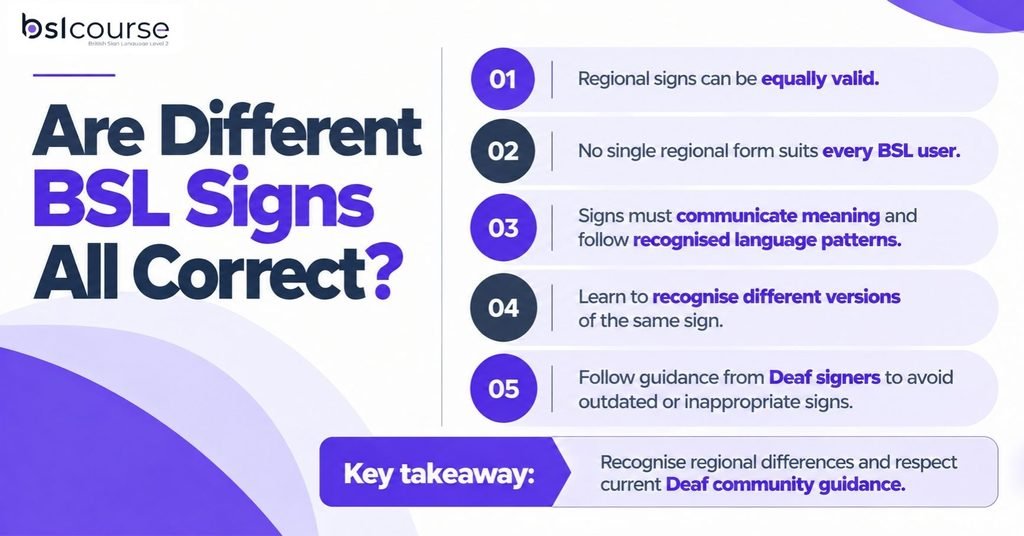
Different BSL signs can be correct when they are recognised and used by Deaf communities.
There is no single regional form that every BSL user must follow.
However, this does not mean that any hand movement can be treated as a valid sign.
A sign still needs to communicate the intended meaning and follow the language patterns recognised by its users.
For example, if you learn one regional sign for green and later discover another version, you do not necessarily need to replace the first one.
Instead, learn to recognise both.
It is also worth remembering that some signs may be considered outdated or inappropriate. When this happens, it is best to follow current guidance from Deaf signers and trusted BSL resources.
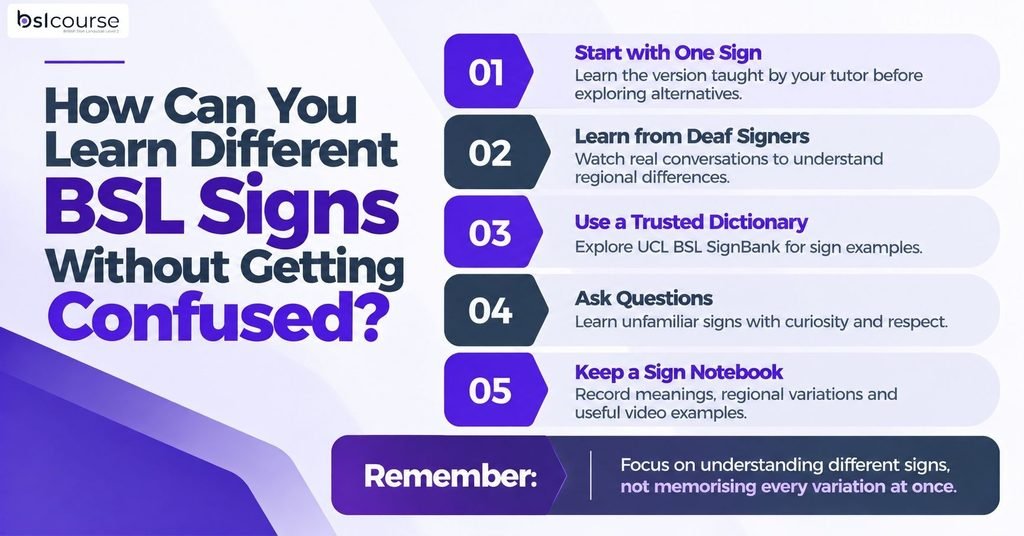
How Can You Learn Different BSL Signs Without Getting Confused?
At first, seeing several signs for one word can make learning feel harder.
However, you do not need to memorise every regional variation at once.
A few simple habits can help.
Start with one commonly used variation
When learning a new word, focus on the sign taught by your course or tutor.
Practise its handshape, movement, position and meaning until you feel comfortable using it.
Once you understand the sign, you can begin exploring other variations.
Learn from Deaf BSL users
Watching fluent Deaf signers is one of the most useful ways to build your understanding.
You can observe how people use signs in real conversations, including facial expressions and regional differences.
Try watching BSL videos from signers in different parts of the UK.
Use a trusted BSL dictionary
A reliable dictionary can help you compare signs and understand their meanings.
Recommended resource: BSL SignBank by UCL.
It includes examples of regional signs and information about how they are used.
Ask which variation someone uses
If you see an unfamiliar sign, it is fine to ask what it means.
You can also ask whether it is a regional variation.
Approach the conversation with curiosity rather than assuming the other person is signing incorrectly.
Keep a record of new signs
Create a small learning notebook with the English meaning, sign variations and any regional information you discover.
For example:
| Word | What I learnt | What to remember |
| Green | More than one regional sign | Learn to recognise different versions |
| Seventeen | Regional number variations | Check how numbers are signed locally |
| Right | Different meanings | Understand the context before choosing a sign |
You can also save video examples to review later.
Should Beginners Learn Every BSL Variation?
No. Beginners do not need to learn every variation of every BSL sign.
Your first goal should be to understand basic vocabulary, sentence structure, facial expressions and everyday communication.
Trying to memorise too many versions at once may slow your progress.
A better approach is to learn one recognised form first and become familiar with other forms as you gain experience.
Over time, you will find it easier to understand people who use different regional signs.
The aim is not simply to collect as many signs as possible. It is to communicate effectively.
Is There a Standard Version of British Sign Language?
British Sign Language does not have one single regional variety that replaces all others.
Courses, dictionaries and teaching materials may select particular signs to make learning more consistent. However, this does not mean those versions are the only correct choices.
UCL explains that regional differences in BSL are often better described as dialects than accents. This is because many differences involve the signs people choose, rather than just how a sign is produced.
Frequently Asked Questions
Why do people sign the same word differently in BSL?
People may use different signs because of their region, age, school background or Deaf community traditions. Sometimes, the signs represent different meanings of the same English word.
Does BSL change between cities?
Yes. BSL has regional variations across the UK. Some signs used in London, Manchester, Birmingham, Glasgow and other locations can differ.
Can I use a regional BSL sign in another part of the UK?
Yes, but not everyone will recognise it immediately. If someone seems unsure, you can explain what you mean or use a variation they know.
Are older BSL signs still used?
Yes. Some older signs remain in use, especially among people who learnt them through their families, schools or local Deaf communities. Other signs have become less common over time.
Why does my BSL teacher use a different sign from a video?
Your teacher and the person in the video may use different regional forms. The difference could also relate to the word’s meaning or context. Ask your teacher to explain which variation is being used.
Is it wrong to mix different regional BSL signs?
Not necessarily. People may know and use signs from several regions. What matters is whether the signs are appropriate and clearly understood in the conversation.
Conclusion
One BSL word can have different signs, and that is a natural part of British Sign Language.
Regional differences, Deaf community traditions, age and context all influence the way BSL is used.
You do not need to learn every variation immediately. Start with the signs you are taught, practise regularly and gradually build your knowledge through real examples.
Most importantly, remember that BSL is more than a collection of signs. It is a rich language shaped by the people who use it.
Want to build your BSL skills and communicate with greater confidence? Explore a structured British Sign Language course and develop your skills step by step.

