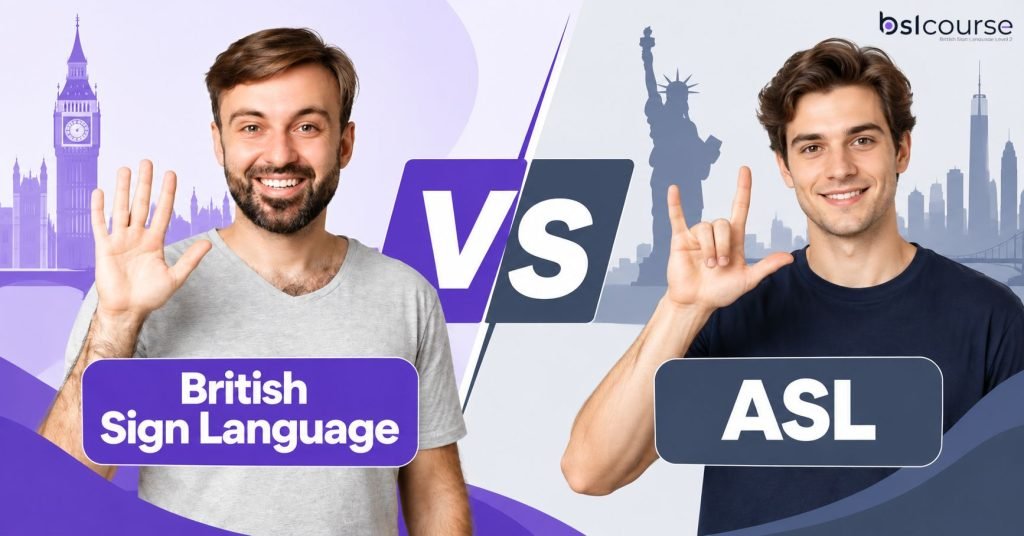
British Sign Language (BSL) and American Sign Language (ASL) are completely different languages, with distinct alphabets, grammar and vocabulary. Despite some similarities as visual languages, they are not mutually understandable, and knowing one does not mean you can automatically understand the other.
When comparing British Sign Language vs ASL, one of the clearest differences is their fingerspelling systems: BSL mainly uses a two-handed alphabet, while ASL uses a one-handed alphabet.
BSL is primarily used in the United Kingdom, whereas ASL is mainly used in the United States and parts of Canada.
This guide explores the key differences between BSL and ASL, including their alphabets, vocabulary, grammar, history, difficulty and practical use, so you can understand how they differ and decide which sign language is most relevant for you.
British Sign Language vs ASL : Key Differences
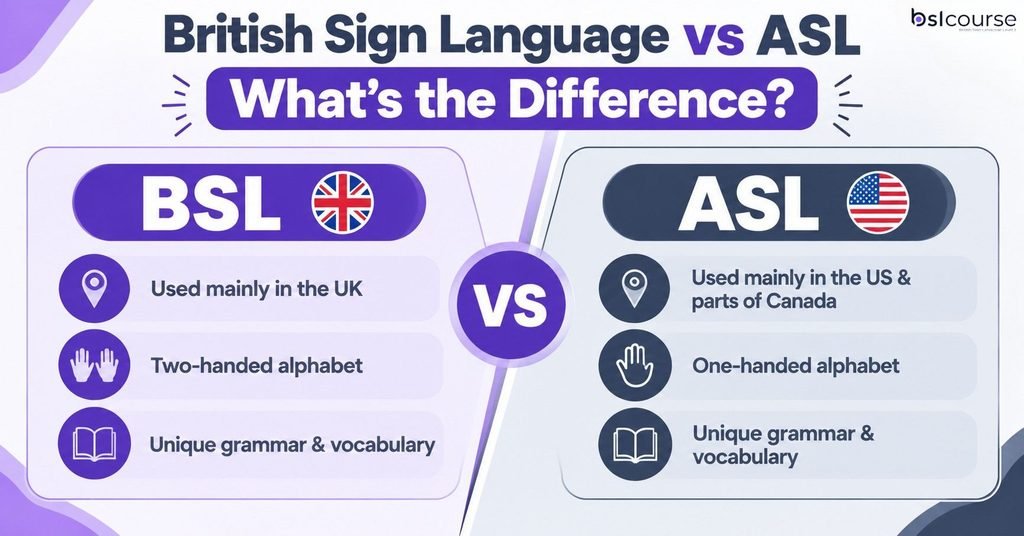
BSL and ASL are distinct sign languages with different grammar, vocabulary, and fingerspelling systems.
What Is British Sign Language (BSL)?
British Sign Language is the primary sign language of the Deaf community in the United Kingdom, used by an estimated 87,000 Deaf people as their first or preferred language, alongside many more hearing signers, interpreters and family members.
BSL is not “English on the hands.” It’s a natural, fully independent language with its own grammar, syntax and word order, recognised legally in the UK under the BSL Act 2022.
It uses space, movement and facial grammar to convey meaning that spoken English handles through word order and tone of voice, and its fingerspelling system uses both hands together to represent letters.
What Is American Sign Language (ASL)?
American Sign Language is the primary sign language used by Deaf communities across the United States and much of English-speaking Canada, with several hundred thousand to over a million users depending on how fluency is counted.
Like BSL, ASL is a complete, independent language rather than a signed version of English. It has its own grammar and sentence structure, often placing topic before comment rather than following English word order.
ASL fingerspelling uses a one-handed alphabet, and the language leans heavily on facial expression and body positioning to carry grammatical information such as questions, negation and emphasis.
ASL vs BSL vs ISL: Are They the Same?
No. British Sign Language, American Sign Language and Irish Sign Language (ISL) are three distinct languages, each with its own vocabulary and grammar.
ISL has its own historical development, influenced by French Sign Language education traditions in Ireland, which puts it in a different family again from BSL despite the geographical closeness of the UK and Ireland.
None of these three languages should be treated as regional variations of one shared European sign system.
Is ASL Similar to British Sign Language?
BSL and ASL share some surface-level similarities as visual, spatial languages, but they are not mutually interchangeable and a fluent signer of one cannot automatically understand the other.
Both languages rely on handshape, movement, location and facial expression to build meaning, and both are complete languages capable of expressing anything spoken English can.
That shared foundation, though, doesn’t translate into shared vocabulary or grammar. The differences show up clearly across four areas: the alphabet, everyday vocabulary, sentence structure and the way facial expression is used grammatically.
BSL vs ASL Alphabet
BSL fingerspelling is two-handed, forming letters by positioning both hands together, while ASL fingerspelling is almost entirely one-handed. This single difference alone makes BSL and ASL fingerspelling mutually unreadable, since the two systems don’t share a visual “alphabet” at all.
This matters more than it might seem. Fingerspelling is used constantly in both languages, for names, places, brand names and any word without an established sign, so an ASL signer watching BSL fingerspelling isn’t looking at a slightly different accent, they’re looking at an entirely unfamiliar hand-shape system.
Vocabulary and Signs
The vast majority of everyday signs in BSL and ASL are completely different from one another, even for basic concepts like colours, family members, days of the week and common verbs. A BSL sign for “mother” and an ASL sign for “mother” typically share no visual relationship at all.
This is one of the clearest proofs that BSL and ASL are separate languages rather than dialects. Learners sometimes assume that because both communities speak English, the signs must overlap somewhere in the middle.
In practice, vocabulary was built independently in each country, shaped by local history, education systems and Deaf community culture, so the overlap is minimal.
Grammar and Sentence Structure
BSL and ASL each follow their own grammatical rules, and neither one is simply English translated word-for-word into signs.
BSL commonly uses topic-comment structures and English SVO order can appear in some contexts, while ASL frequently fronts the topic before making a comment about it, with word order flexing depending on context and emphasis.
Neither language uses English grammar underneath the signs. Both use space itself grammatically, for example by placing people or objects at points in the signing space and referring back to those points later in the conversation, a feature spoken English has no real equivalent for.
Facial Expressions and Non-Manual Features
Facial expression, eyebrow movement, mouth patterns and body shifting aren’t decoration in BSL or ASL, they’re grammar. Raised eyebrows can signal a yes/no question, furrowed brows a wh-question, and specific mouth shapes can change a sign’s meaning entirely.
These non-manual features work differently enough between the two languages that even a signer who can lip-read some spoken English won’t automatically decode the other sign language’s facial grammar.
Getting this wrong is one of the fastest ways to be misunderstood, since a sign performed with the wrong facial expression can flip its intended meaning.
BSL vs ASL: Key Differences at a Glance
| Feature | BSL | ASL |
| Full name | British Sign Language | American Sign Language |
| Mainly used in | United Kingdom | United States and parts of Canada |
| Fingerspelling | Two-handed | One-handed |
| Vocabulary | BSL-specific | ASL-specific |
| Grammar | Independent BSL grammar | Independent ASL grammar |
| Legal recognition | BSL Act 2022 | Recognised in some US states, no federal law |
| Mutually understandable | No | No |
Can ASL Signers Understand BSL?
Generally, no. Without prior exposure or dedicated learning, an ASL signer cannot understand BSL, and the reverse is equally true for a BSL signer encountering ASL for the first time.
Sharing an English-speaking country doesn’t create shared sign language, because BSL and ASL evolved from different root languages and communities, entirely separately from spoken English.
That said, experienced Deaf signers who have travelled or met signers from other countries often develop strong visual communication skills, using gesture, mime, context and shared international signs to bridge some of the gap in casual conversation.
This isn’t the same as understanding BSL or ASL itself; it’s a separate improvised skill built on general visual literacy.
Why Are BSL and ASL So Different?
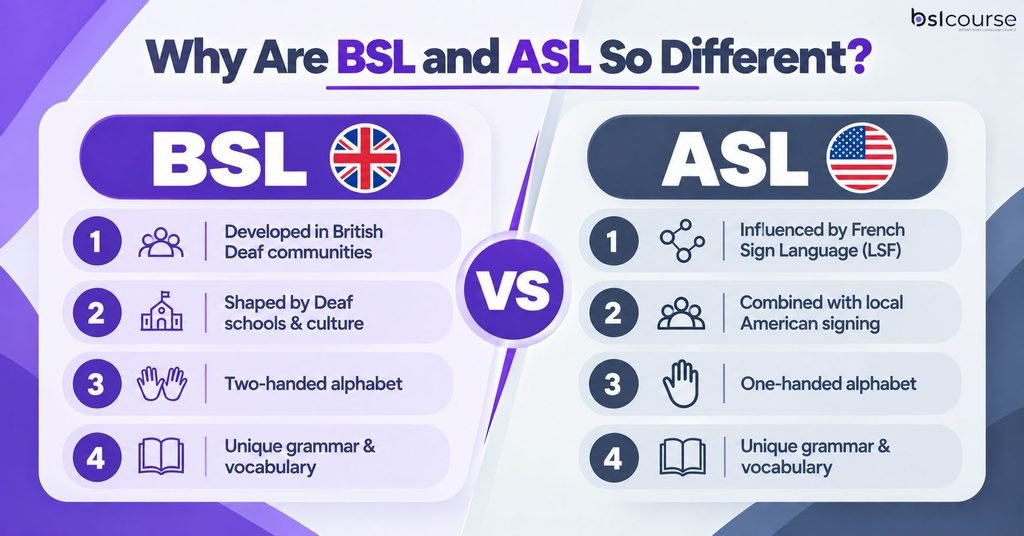
BSL developed independently through British Deaf communities, while ASL evolved largely from French Sign Language and local American signing systems.
The Historical Development of BSL
BSL traces its roots back through British Deaf schools and communities stretching back centuries, developing organically within the UK’s own Deaf culture rather than being imported or adapted from elsewhere.
Its two-handed alphabet and distinct grammar grew alongside British Deaf education, entirely separate from developments happening in Europe or America at the time.
ASL and Its Connection to French Sign Language
ASL’s history connects far more closely to French Sign Language (LSF) than to BSL. In the early 19th century, French Sign Language was brought to the US and blended with existing local signing systems, laying the foundation for what became ASL.
This is why ASL and LSF still share a noticeable degree of vocabulary and structural similarity today, while ASL and BSL, despite both existing in English-speaking countries, share very little.
It’s a useful reminder that a sign language’s history often has more influence on its structure than the spoken language of the country it’s used in.
Is ASL or BSL More Common in the World?
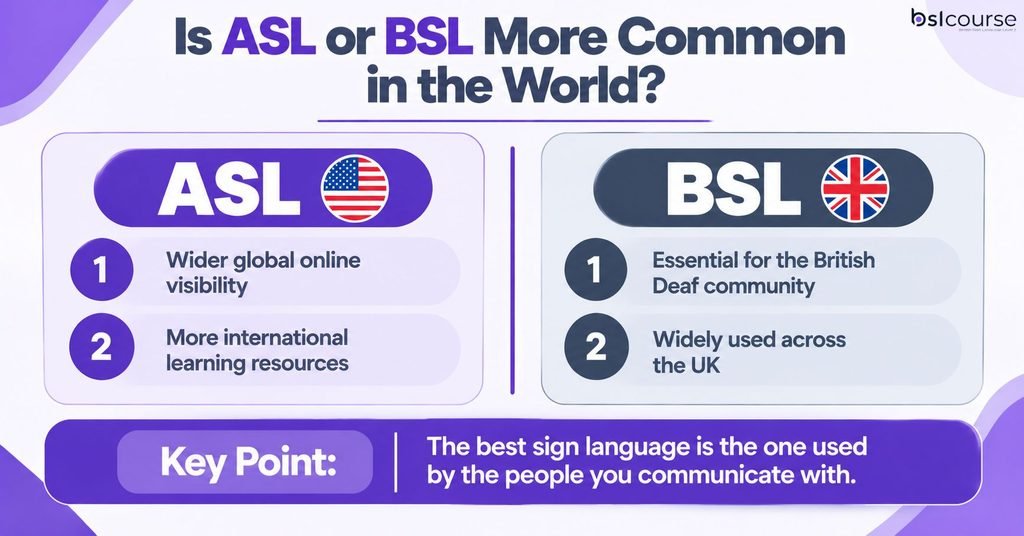
Neither BSL nor ASL functions as a universal or international sign language, and no single sign language holds that status globally.
ASL has a larger global footprint online, partly because of the volume of American Deaf content, education material and media available in ASL, which gives it wider passive visibility outside the US.
BSL remains the correct and relevant language for the British Deaf community specifically, and its usefulness isn’t diminished by having a smaller international footprint online.
Ultimately, which language is “more common” matters far less than which language is actually used by the people you want to communicate with.
Should I Learn ASL or BSL?
| Learn BSL If… | Learn ASL If… |
| You live or work in the UK | You live or work in the US |
| You communicate with British Deaf people | You communicate with American Deaf people |
| Your career involves UK services | Your work connects to ASL communities |
| You support a Deaf person in Britain | You use ASL-based content |
ASL or BSL in Europe?
BSL is relevant primarily within Britain, not across Europe as a whole. Most European countries have their own distinct national or regional sign languages, so being based in mainland Europe isn’t a reason to default to BSL.
If you’re learning a sign language for use in a specific European country, it’s worth researching that country’s own national sign language rather than assuming BSL will transfer.
Which Is Harder, ASL or BSL?
Neither language is objectively harder to learn for everyone, since difficulty depends far more on your access to fluent signers and consistent practice than on the language itself.
A few practical factors do shift the experience in each direction:
- Fingerspelling style: some learners find BSL’s two-handed system easier to read at a distance, while others adapt faster to ASL’s one-handed system.
- Exposure to fluent signers: whichever language you can practise with real Deaf signers regularly will always progress faster than one learnt from videos alone.
- Access to learning resources: course availability, local classes and structured curricula vary by country and can make one language more accessible where you live.
- Existing sign language experience: someone who already knows one sign language typically picks up grammar concepts in a second one faster, even without shared vocabulary.
- Opportunities for regular practice: consistent, real conversation practice matters more than any inherent property of the language.
Familiarity and regular practice consistently outweigh any claim that one language is inherently “easier.”
Can You Learn Both BSL and ASL?
Yes, and plenty of interpreters and Deaf-community professionals do exactly that. It’s generally best to build strong fluency in one language first before starting the second, since learning both simultaneously as a beginner makes it easy to mix vocabulary, fingerspelling systems and grammar rules together.
Once you’re confident in one, adding the second becomes a genuinely useful skill, particularly for interpreters, researchers or anyone working across Deaf communities in both the UK and the US.
BSL vs ASL in Healthcare and Medical Settings
Using the correct sign language in a healthcare setting isn’t a small detail, it directly affects whether a patient can understand their diagnosis, treatment and consent forms.
A BSL-using patient in Britain needs a BSL interpreter, and an ASL-using patient in the US needs an ASL interpreter; the two are not interchangeable, and neither is a substitute for the other.
Healthcare providers should never assume that any sign language interpreter can serve any Deaf patient. Booking a qualified, registered interpreter fluent in the specific sign language the patient actually uses is essential, both for accurate communication and for meeting legal duties around accessible healthcare.
BSL vs ASL: Which Should You Learn?
The short answer: if you’re based in the UK, learn BSL; if you’re based in the US, learn ASL. Neither language is universal, and neither is a better “default” choice in the abstract.
The right decision comes down to the Deaf community you actually want, or need, to communicate with, not which language sounds more widely spoken online.
FAQs
Is ASL similar to British Sign Language?
Only in that both are visual, spatial languages using handshape, movement and facial grammar. Their vocabulary, grammar and fingerspelling alphabets are all different, so fluency in one doesn’t transfer to the other.
Can ASL signers understand BSL?
Not without prior exposure or learning. The two languages don’t share enough vocabulary or grammar for spontaneous understanding, though experienced signers can sometimes bridge small gaps using gesture and context.
Should I learn ASL or BSL?
Base the decision on where you live and who you want to communicate with: BSL for the UK, ASL for the US. Neither is a universal choice, so pick according to the Deaf community relevant to you.
Which is harder, ASL or BSL?
Neither is objectively harder. Access to fluent signers, quality learning resources and regular practice matter far more than any inherent difference between the two languages.
Is ASL or BSL more common in the world?
ASL has wider visibility online globally, but neither functions as a universal sign language. BSL remains the correct choice for communicating with the British Deaf community specifically.
Is BSL used in America?
No. BSL is used in the United Kingdom, and American Deaf communities predominantly use ASL. The two aren’t interchangeable in either direction.
Is ASL used in the UK?
No. ASL isn’t the standard sign language in the UK. British Deaf communities use BSL, which has its own distinct grammar and vocabulary.
Do BSL and ASL have the same alphabet?
No. BSL fingerspelling is two-handed, while ASL fingerspelling is one-handed, making the two systems visually incompatible with one another.
Can BSL users understand Makaton?
They may recognise many of the signs, particularly because Makaton uses signs associated with BSL, but Makaton and BSL are used differently and should not be treated as interchangeable.
Is BSL the same as English sign language?
BSL is often referred to as “British Sign Language” or informally as “English sign language,” but this is the same language; it isn’t a signed version of spoken English and has its own independent grammar.
Can I learn BSL and ASL at the same time?
It’s possible, but it’s generally more effective to build solid fluency in one language first to avoid mixing vocabulary, fingerspelling and grammar together while still a beginner in both.
Conclusion
British Sign Language and American Sign Language may both be used in English-speaking countries, but they are completely separate languages.
BSL uses a two-handed alphabet and is primarily used in the UK, while ASL uses a one-handed alphabet and is mainly used in the US and parts of Canada.
Their vocabulary, grammar and historical development also differ, which means BSL and ASL users cannot automatically understand one another.
So, when choosing between BSL and ASL, focus less on which language seems easier or more popular and more on the community you want to communicate with.
If you live, study or work in the UK, BSL is generally the relevant choice. If your communication is mainly with Deaf communities in the United States, ASL is the more practical option.
Ultimately, the best sign language to learn is the one you can use regularly with the people and communities around you.
Want to connect with others interested in BSL and Deaf culture? Join our Facebook community for learning, discussions and shared experiences.

