A simple thank you can make someone feel appreciated. But what if you want to express your gratitude using British Sign Language (BSL)?
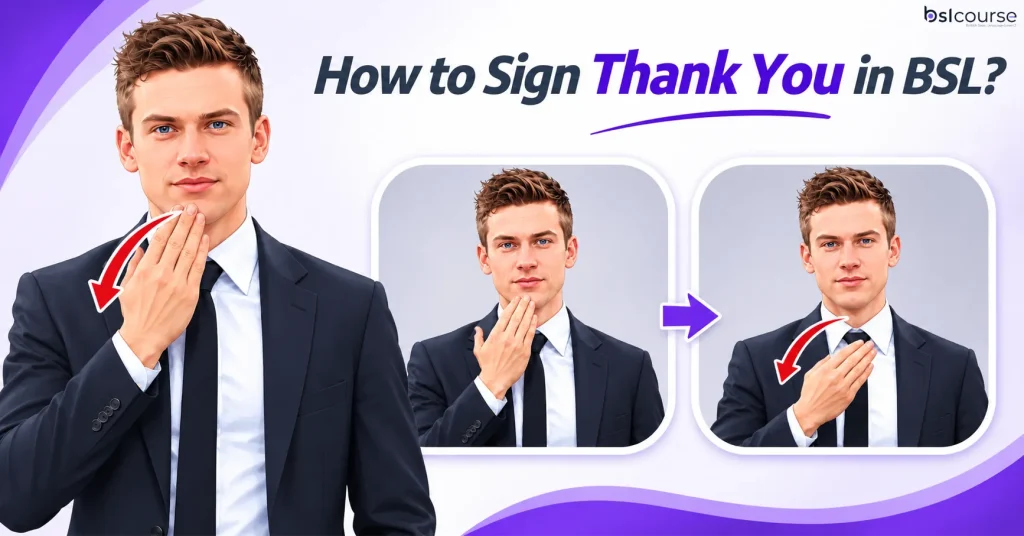
To sign thank you in BSL, place the fingertips of your flat hand against your chin. Then move your hand forwards and slightly downwards, away from your face, in one smooth movement. Keep your fingers together and use a natural, friendly facial expression.
This is one of the easiest and most useful signs for beginners to learn. Whether you are thanking a Deaf colleague, communicating with a friend or starting to learn BSL, understanding the correct handshape and movement will help you sign more confidently.
Let’s explore how to perform the sign correctly, recognise common mistakes and practise it in everyday situations.
How to Sign Thank You in BSL Step by Step

The British Sign Language sign for thank you is a one-handed gesture that begins at the chin and moves outwards.
Follow these five simple steps to learn the movement.
Step 1: Choose Your Dominant Hand
Start with the hand you naturally use for writing or completing everyday tasks. This is called your dominant hand.
You can sign thank you with either your left or right hand. Both are acceptable in BSL.
Keep your other hand relaxed while performing the sign.
Step 2: Form a Flat Handshape
Open your dominant hand and extend your fingers, keeping them straight and together.
Your hand should appear flat and relaxed, rather than stiff or tightly clenched.
This flat handshape is important because the position of your fingers helps make the sign recognisable.
Step 3: Place Your Fingertips on Your Chin
Raise your hand towards your face and gently place your fingertips against your chin.
Keep your palm facing towards you at the beginning of the movement.
Avoid placing your hand on your forehead or too far below your chin. The starting location is an important part of the sign.
Step 4: Move Your Hand Forwards and Downwards
Move your hand smoothly away from your chin, travelling forwards and slightly downwards.
Allow your wrist to move naturally as your hand travels away from your face.
There is no need to exaggerate the movement. One controlled action is enough to express thanks.
Step 5: Finish with a Friendly Expression
Complete the movement with your hand in front of your upper body. Your palm may face upwards as you finish, as shown in the demonstration.
Maintain a relaxed facial expression or a gentle smile to communicate warmth and appreciation.
Remember: Start at your chin, move your hand forwards and downwards, and finish naturally.
Understanding the Handshape, Location and Movement

BSL signs are formed using several visual features. These include handshape, location, palm orientation, movement and facial expression.
Understanding these elements will help you learn the thank you sign accurately rather than simply copying a hand gesture.
Handshape: Keep Your Fingers Together
The thank you sign uses a flat hand, with the fingers extended and held together.
Your thumb should remain naturally positioned alongside your hand.
Avoid spreading your fingers widely or making a fist. A consistent handshape makes the movement easier for another person to recognise.
Handshape is also important in other BSL signs. The same general hand position can appear in different signs, but its meaning may change depending on location and movement.
Location: Begin at the Chin
The sign begins with your fingertips touching or positioned close to your chin.
In BSL, location refers to where a sign is performed in relation to the body.
Some signs appear near the head, while others are made around the chest or in the space in front of the signer.
For thank you, starting at the chin and moving away from the face creates the recognisable gesture.
Palm Orientation: Follow the Natural Hand Position
Palm orientation describes the direction your palm faces while signing.
When performing thank you, your palm initially faces towards you. As your hand moves away from your chin, its orientation changes naturally.
Avoid forcing your wrist into an uncomfortable position. Focus on keeping the hand relaxed and following the movement shown in the demonstration.
The shape, movement and direction of your hand work together to communicate meaning.
Movement: Use One Smooth Action
Movement is a key feature of British Sign Language.
To express thank you, move your hand forwards and downwards in one controlled action.
The movement should be natural rather than rushed or exaggerated.
For everyday communication, a single movement is normally enough. You do not need to repeat the sign several times to make yourself understood.
Why Does Facial Expression Matter When Signing Thank You?

Facial expressions help communicate meaning, emotion and emphasis in British Sign Language.
These visual signals are known as non-manual features. They include facial expression, head movement, eye gaze and mouth movements.
When signing thank you, your expression helps communicate how you feel about the person you are thanking.
Use a Natural or Friendly Expression
A relaxed face is suitable for most everyday situations.
For example, imagine a colleague helping you complete a task. You can make the thank you sign while looking towards them with a friendly expression.
This makes your appreciation clear without adding unnecessary gestures.
Add a Gentle Smile When Appropriate
A smile can make your gratitude feel warmer and more personal.
You might smile when thanking a friend for a gift or expressing appreciation to someone who has helped you.
However, you do not need to force a smile every time. Your expression should match the situation.
In BSL, facial expressions can also carry grammatical meaning, so learning to use them naturally is an important part of developing your signing skills.
Which Hand Should You Use to Sign Thank You in BSL?
You can use either your left or right hand to sign thank you. The important point is to use your preferred dominant hand consistently.
Hand dominance refers to the hand that takes the leading role when producing a sign.
For a right-handed signer, this is usually the right hand. A left-handed signer may use the left.
Since thank you is a one-handed sign, your non-dominant hand does not need to participate.
As you learn more BSL vocabulary, understanding hand dominance will become increasingly useful, particularly for signs that require both hands.
Do You Need to Repeat the Thank You Sign?
No. A single smooth movement is normally enough to say thank you in BSL.
Some beginners repeat the movement because they want to make their gratitude stronger. However, repetition is not necessary for a standard expression of thanks.
In certain contexts, signers may use repetition, stronger facial expressions or other signs to add emphasis.
The meaning depends on the full expression and the situation. Repeating a movement does not automatically translate to adding the word “very”.
For beginners, focus on producing one accurate movement before learning more expressive variations.
Common Mistakes When Signing Thank You in BSL

Although thank you is a straightforward sign, small changes to its handshape or movement can make it less clear.
Here are five mistakes worth avoiding.
1. Starting Too Far Away from Your Chin
Some beginners begin the movement in front of their chest or mouth without bringing their fingertips close to the chin.
How to fix it: Start with your fingertips gently touching your chin before moving your hand away.
2. Spreading Your Fingers Too Widely
A widely spread hand can make the gesture look different from the intended flat handshape.
How to fix it: Keep your fingers extended and together, without unnecessary tension.
3. Moving Your Hand in the Wrong Direction
Moving upwards, sideways or towards your body changes the appearance of the sign.
How to fix it: Practise moving your hand forwards and slightly downwards, away from your chin.
4. Using an Exaggerated Movement
Large or jerky movements may make your signing appear unnatural.
How to fix it: Use a short, smooth and controlled action. Focus on accuracy rather than speed.
5. Ignoring Facial Expression
Concentrating entirely on your hand can make your expression appear unusually tense or disconnected.
How to fix it: Relax your face, maintain appropriate visual attention and add a natural smile when it suits the conversation.
Correcting these habits early will help you develop clearer and more confident signing.
How Can You Practise the Thank You Sign at Home?
You do not need specialist equipment to practise a basic BSL sign. A mirror, a short video and a few minutes of focused practice can help.
Try this simple routine.
- Watch a demonstration. Observe where the hand starts, how it moves and where it finishes.
- Practise slowly. Repeat the movement several times while keeping your fingers together.
- Use a mirror. Check your handshape, chin position and facial expression.
- Record yourself. Compare your signing with a reliable BSL demonstration to identify differences.
- Use it in context. Practise thanking someone after they help you or give you something.
You can also learn alongside a fluent BSL signer or qualified tutor who can provide feedback on your technique.
Remember that BSL is a complete language with its own grammar and structure. Learning individual signs is a useful starting point, but real communication requires more than memorising gestures.
When Can You Use the BSL Sign for Thank You?
Thank you is useful in many everyday situations. You can use it at home, in education, at work or when communicating with members of the Deaf community.
Thanking a Friend or Family Member
Imagine your friend hands you something you have been looking for.
You can use the thank you sign with a friendly smile to express your appreciation.
Showing Appreciation at Work
A colleague may help you solve a problem or complete an important task.
If they use BSL, signing thank you can be an appropriate way to acknowledge their support.
Communicating in Shops and Public Places
You might use the sign when thanking a Deaf customer, colleague or service user.
However, learning one sign does not replace accessible communication. Always consider the person’s preferred communication method and whether additional support is needed.
Thanking a Teacher or Classmate
When learning BSL, practising polite expressions during lessons can help you become more comfortable using signs in conversation.
The more often you use the sign appropriately, the more natural it may become.
Is Thank You the Same as Please in BSL?
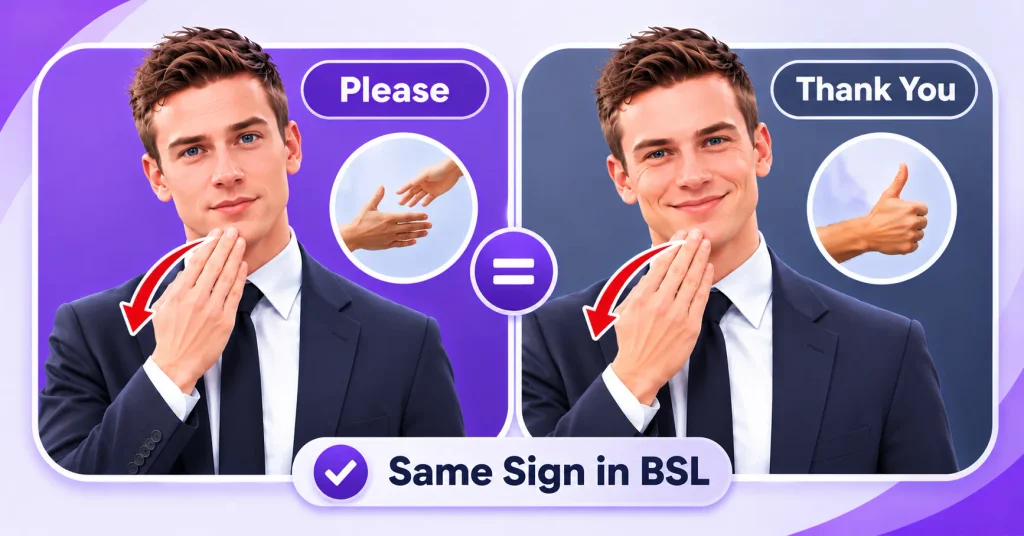
Yes. In commonly taught BSL vocabulary, please and thank you can use the same hand movement.
Both involve placing a flat hand near the chin and moving it forwards and downwards.
The intended meaning is understood through context and may be supported by appropriate mouth movements and facial expression.
For example, you might use the sign while asking someone for assistance to express please. After receiving their help, the same sign can express thank you.
This highlights an important feature of BSL: a sign’s meaning is not always determined by hand movement alone.
You can learn more about the similarities and differences between these two signs in our BSL Please article.
Why Is Learning Thank You in BSL Important?
Learning a simple expression such as thank you is a practical first step towards understanding British Sign Language and Deaf awareness.
BSL is a visual language with its own vocabulary, grammar and linguistic structure. It is not simply English expressed through hand movements.
The British Sign Language Act 2022 formally recognised BSL as a language of England, Wales and Scotland. This recognition reflects its importance to Deaf communities and the wider public.
You can read more about this in the British Sign Language Act 2022.
Learning everyday signs may also encourage people to become more aware of communication barriers.
For example, a customer-facing employee who learns basic BSL greetings may feel more confident initiating an interaction with a Deaf customer.
However, respectful communication also involves understanding individual needs, giving people time to respond and not assuming every Deaf person uses BSL.
Frequently Asked Questions
How do you say thank you in British Sign Language?
Place the fingertips of your flat hand against your chin, then move your hand forwards and downwards, away from your face. Use one smooth movement and a natural facial expression.
Can you sign thank you with your left hand?
Yes. Both left-handed and right-handed people can sign thank you in BSL. Use whichever hand feels natural as your dominant hand.
How many hands do you need to sign thank you?
The standard sign uses one hand. Your other hand can remain relaxed while you perform the movement.
Is thank you in BSL the same as in ASL?
The common signs for thank you in British Sign Language and American Sign Language look similar. However, BSL and ASL are distinct languages with different vocabulary and grammar.
Can I use thank you in formal situations?
Yes. You can use the sign in both informal and formal situations. Maintain a natural expression that suits the context, whether you are thanking a friend, teacher, colleague or customer.
How long does it take to learn the thank you sign?
Many beginners can learn the basic movement in a short practice session. However, producing it consistently and using it naturally in conversation may require further practice and feedback.
Final Thoughts
Knowing how to sign thank you in BSL is a useful first step towards more inclusive everyday communication.
The key is to keep your fingers together, start with your fingertips at your chin and move your hand forwards and downwards in a smooth motion.
With regular practice, the gesture can become more natural, helping you communicate gratitude with greater confidence.
Want to expand your British Sign Language vocabulary? Explore The BSL Course and continue building your signing skills, Good Luck.