
Have you ever wondered about the Difference Between BSL and Makaton ? You’re not alone. Many people are curious about how these two communication systems compare and when each one should be used.
Understanding the difference between BSL (British Sign Language) and Makaton is essential, especially for anyone looking to communicate with Deaf, non-verbal, or people with additional communication needs. While both use signs to express meaning, they have different purposes, structures, and areas of use.
In this article, we’ll explore the key differences between BSL and Makaton, including their signs, words, uses, and benefits. You’ll learn when and why each system is used and how they help create more inclusive communication in everyday life.
Table of Contents
- Signs in BSL and Makaton
- Is Makaton Universal?
- Significance and Impact
- The Impact on Inclusion and Social Participation
- BSL and Makaton: A Comparison
- When Makaton and BSL Are Used
- Makaton or BSL for Babies
- Can anyone use Makaton?
- Difference Between BSL And Makaton Signs
- Difference Between BSL And Makaton Words
- Frequently Asked Questions About BSL and Makaton
- Some Makaton signs are based on or adapted from BSL, so certain signs may look similar. However, Makaton uses signs alongside speech and symbols, while BSL signs form part of a complete visual language with its own grammar.
- Final Summary
Signs in BSL and Makaton
Signs in BSL
The Deaf community in the UK uses British Sign Language (BSL) as the primary means of communication. A sign is more than just a hand gesture; it is a meticulously planned fusion of non-manual elements, including body language and facial expressions, with the handshape, movement, placement, and orientation. These components work together to give each sign its grammatical function, meaning, and emotion.
For example, depending on how and where it is used, the same hand form might represent entirely distinct words. Some signs are iconic—visually representing what they mean—while others are more abstract and require skill. Signs can be one-handed or two-handed, symmetrical or asymmetrical.
BSL is a complete, visual language that differs from English in its grammar and sentence structure. In order for BSL users to communicate clearly and fluently and to express their thoughts, feelings, and ideas in everyday contexts, signs are necessary. In addition to aiding with language acquisition, knowing what signs are and how they function promotes more polite and inclusive interactions with Deaf people.
Signs in Makaton
Makaton is a communication system that combines symbols, signs, and speech, developed in the early 1970s to help individuals with communication difficulties express themselves. The system was created by speech and language therapists Margaret Walker, Katherine Johnston, and Tony Cornforth.
Makaton uses spoken words alongside visual symbols and signs, following the order of spoken language, which makes it easier for people with learning difficulties, autism, and other communication challenges to convey their thoughts. While Makaton is widely used, its users are not typically part of the Deaf community. Today, over 100,000 people use Makaton in the UK and beyond.
The primary goal of Makaton is to enable individuals to communicate more effectively by overcoming barriers that prevent understanding. It provides children and adults with the tools to connect and express themselves inclusively, reducing frustration and enhancing social interactions.
Makaton signs are often derived from British Sign Language but are simplified and used in conjunction with spoken words. These signs are typically used for everyday concepts such as “eat,” “drink,” or “help,” but they can also include more complex ideas related to emotions, time, and activities.
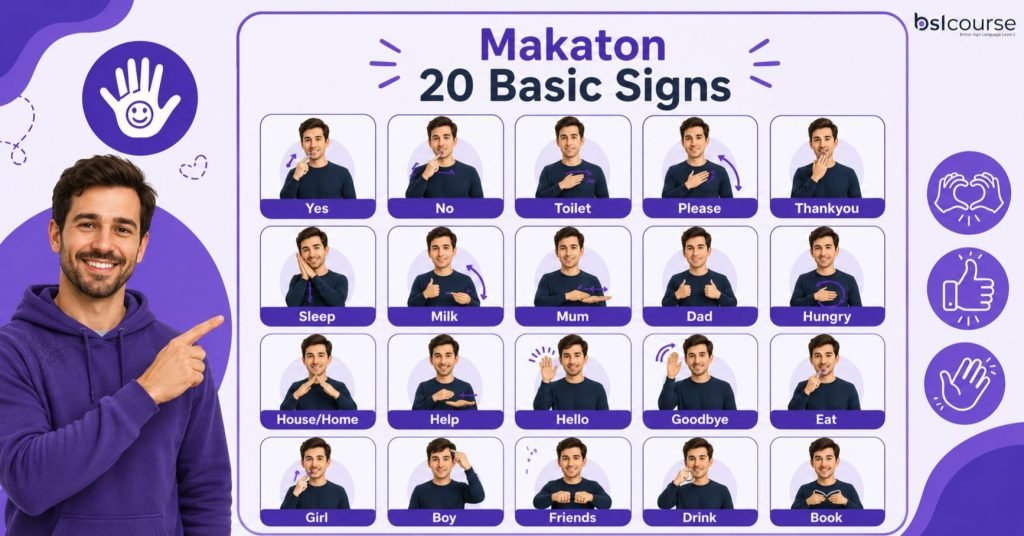
Makaton is also widely used across schools, healthcare facilities, and community groups in the UK to help individuals with conditions such as autism, Down syndrome, or acquired neurological disorders. It is especially beneficial for those who may struggle with verbal communication but can still express themselves using signs and symbols.
Is Makaton Universal?
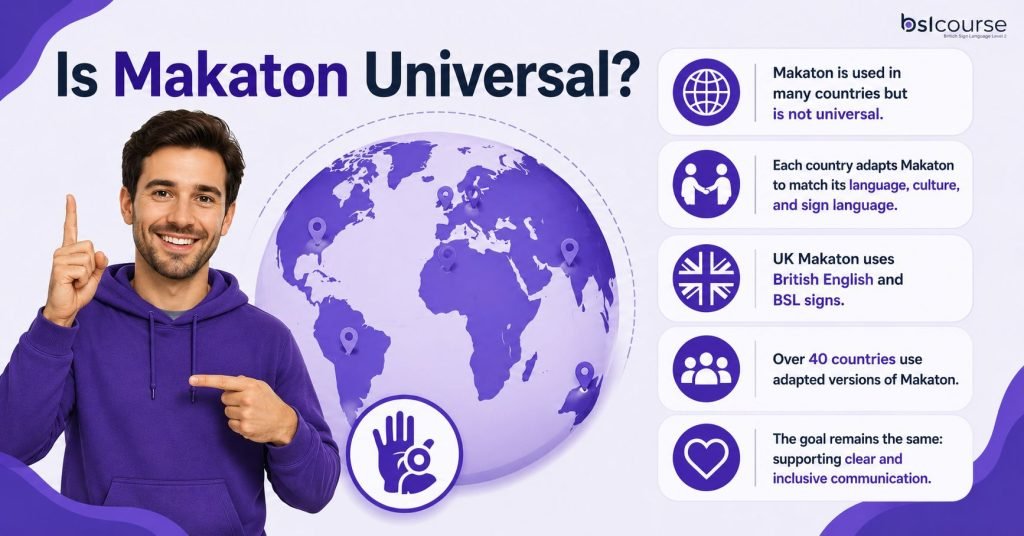
Makaton is not universal, although it is widely used across the UK and in many other countries. While the core concept of Makaton remains the same — combining signs, symbols, and speech to support communication — each country has adapted the system to suit its local language, culture, and sign languages.
For example, the version used in the UK is tailored to British English and British Sign Language (BSL) signs.
Makaton has been adapted and used in over 40 countries, including Australia, Canada, Germany, and the USA, where each country incorporates its own sign language and cultural nuances.
These adaptations ensure that Makaton remains effective and relevant in different linguistic and cultural contexts. Therefore, while the foundational idea of Makaton is universal, its specific signs and symbols can vary from country to country, and users need to be aware of the version most appropriate for their region.
Significance and Impact
Makaton was created to bridge the gap between spoken words and sign languages, offering an inclusive way to communicate. Its power lies in breaking down communication barriers and connecting people. Makaton helps unite hearts and minds, fostering a world filled with compassion and empathy.
Children with learning disabilities often struggle to express themselves, but Makaton provides a way to communicate effectively. It helps build language skills and supports social interaction. Makaton also strengthens relationships between caregivers, healthcare professionals, and those they support.
Similarly, British Sign Language (BSL) enhances communication and independence. It improves the quality of life for many people, enabling clearer communication and promoting mental well-being. BSL and Makaton are essential for active participation in the community, helping people connect with others in meaningful ways.
The Impact on Inclusion and Social Participation
Efforts to promote BSL have greatly supported social inclusion. For example, neighbours in Worcester learned BSL so a deaf child could join in trick-or-treating for the first time. Additionally, Paramount Pictures’ decision to show captioned films before their general release has made cultural events more accessible for the deaf and hard-of-hearing communities.
Public figures like Rose Ayling-Ellis, the first deaf presenter of live sports coverage on British television, have raised awareness of the Deaf community, inspiring greater inclusivity.
Makaton Training for Clinicians with Unique Community Services
Unique Community Services offers tailored Makaton training for beginners and advanced learners. We provide both classroom-based sessions and Zoom training to equip support workers and care teams with the tools to deliver humanised care. Upon completion, participants receive certification to show they’ve gained the necessary skills to use Makaton effectively.
BSL and Makaton: A Comparison
Makaton and British Sign Language (BSL) are both essential communication systems, but they serve different purposes and are used in distinct ways.
Visual Communication: Both Makaton and BSL are visual languages that use hand gestures, facial expressions, and body movements to convey meaning, relying on sight rather than sound.
Use of Signs: Both systems employ signs to represent words or concepts. However, BSL signs follow their grammar and structure, while Makaton signs are simplified and often used alongside spoken language for easier understanding.
Enhanced Communication: Both systems enhance communication for those with difficulties expressing themselves. They provide an alternative communication method for people with hearing loss or other communication barriers, improving accessibility and reducing frustration.
Facial Expressions: In both Makaton and BSL, facial expressions play a critical role in conveying emotions and adding depth to the message, making communication more nuanced and expressive.
Gesture-Based: Makaton and BSL are gesture-based, meaning they rely on physical movement rather than auditory cues to express ideas.
Community Usage: While both have active user communities, BSL is the primary language of the Deaf community in the UK, whereas Makaton is used as a supplementary communication system, often for people with learning disabilities, developmental delays, or communication challenges.
Despite their similarities, Makaton and BSL are not the same. Makaton is a simplified communication tool that works alongside spoken language, whereas BSL is a complete, independent language with its own rules and syntax, used primarily by the Deaf community for all forms of communication.
When Makaton and BSL Are Used
Makaton is particularly useful for individuals of all ages who face various communication challenges. It supports people with speech or learning difficulties, such as those with Autism, Developmental Language Disorder, Down’s Syndrome, Global Developmental Delay, Sensory Difficulties, or Verbal Dyspraxia.
Makaton is commonly used in schools to support children who struggle with verbal language skills, helping them develop communication and literacy skills. It also plays a crucial role in promoting social integration by supporting communication between children with and without additional needs.
On the other hand, BSL is the primary language for the Deaf community in the UK, with over 87,000 people using it as their first language. BSL is a fully developed and independent language, providing a complete system of communication for those who are Deaf or hard of hearing.
It is also estimated that 125,000 adults and 20,000 children in the UK rely on BSL for effective communication. For anyone working in the Deaf community or needing professional interpretation, BSL is an essential tool for clear and accurate communication.
Makaton or BSL for Babies

When considering which communication system is more appropriate for babies, Makaton is typically the better choice, especially for hearing babies. Makaton is a structured system that combines signs, symbols, and speech, making it an effective tool for young children, especially before they develop verbal speech.
It is widely used in nurseries, schools, and early years settings across the UK to support children with communication difficulties, including those with learning disabilities or developmental delays.
Makaton signs are often simplified versions of British Sign Language (BSL), designed to be more accessible for babies and young children. The key benefit of Makaton is its ability to bridge the gap between gestures and spoken language, allowing babies to express their needs before they can speak.
For instance, babies can use Makaton signs to indicate things like “more,” “eat,” “sleep,” and “help” — reducing frustration and improving communication in daily activities.
On the other hand, British Sign Language (BSL) is a fully developed, independent language with its grammar and syntax, primarily used by the Deaf community.
While BSL can be introduced to babies, especially those who are Deaf or hard of hearing, it is more complex and may not be as easily accessible for hearing babies without additional support. BSL requires more structured learning and may be better suited for children who need it for their primary mode of communication.
Can anyone use Makaton?
In the UK, Makaton is widely used to support babies’ communication development. This signing system combines speech, signs, and symbols to help children express their needs and understand others.
Makaton is particularly beneficial for babies who are not yet speaking, as it allows them to communicate through gestures and symbols, reducing frustration and promoting early language skills.
Many nurseries and early years settings across the UK incorporate Makaton into their daily routines. For instance, LEYF Nurseries use Makaton to support young children’s communication development, enabling them to express themselves through gestures and learn vital communication basics.
Additionally, Makaton Signing for Babies sessions are designed to teach parents and caregivers signs and symbols for approximately 130 words, covering a range of vocabulary for use with young children.
Parents can also access Makaton resources online, such as flashcards and instructional videos, to learn and practice signs at home. These resources support consistent communication between parents and babies, reinforcing the signs used in nurseries and other settings.
Difference Between BSL And Makaton Signs
British Sign Language (BSL) and Makaton are two distinct communication systems, each serving different purposes. BSL is a fully developed language used predominantly by the Deaf community in the UK. It has its grammar, syntax, and vocabulary, and is not simply a signed version of English.
BSL is a visual language that relies on hand shapes, facial expressions, and body movements to convey meaning. It is a rich, complete language that allows users to communicate in a way that is separate from spoken English. In contrast, Makaton is not a language of its own but a communication support system designed to help individuals with learning disabilities, autism, or speech and language impairments.
Makaton combines signs, symbols, and speech to aid communication and is typically used alongside spoken English. While Makaton signs may resemble BSL, they are simplified and follow the structure of spoken English, not the grammar of BSL.
One key difference between BSL and Makaton lies in their usage and the communities they serve. BSL is the first language for many Deaf individuals and is used in a variety of settings, including social interactions, education, and professional environments.
Makaton, however, is primarily used to support communication for individuals who face difficulties in speech and language development, regardless of whether they are Deaf or hearing.
Makaton is widely used in schools, nurseries, and care settings to help children and adults express basic needs, emotions, and requests. Although both systems use signs to represent words, BSL operates as a fully independent language, while Makaton is a supplementary communication tool. This distinction is vital for understanding when and how each system should be used to support effective communication.
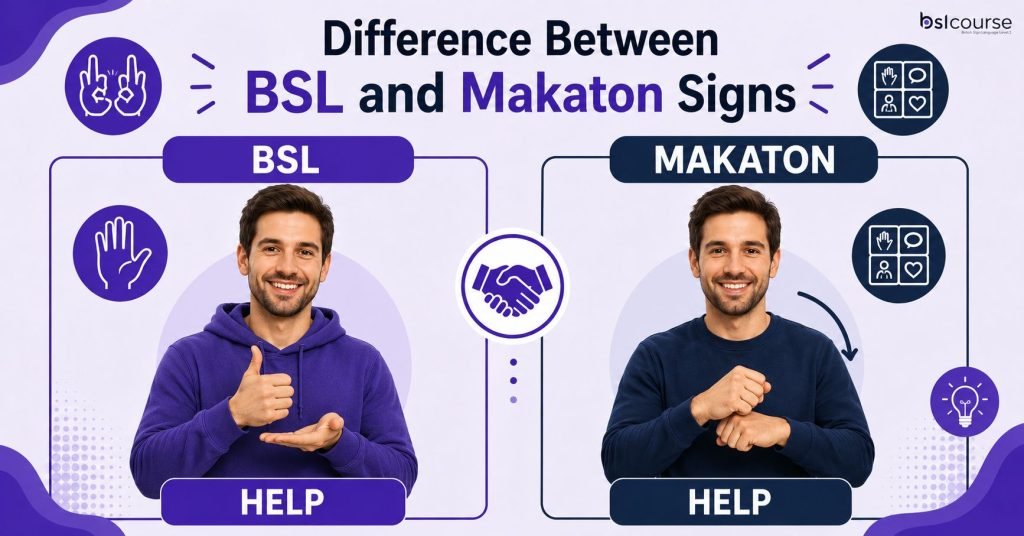
Example: Sign for “Help”
BSL Sign for “Help”:
In BSL, the sign for “help” is made by placing both hands in front of your chest, palms facing up. The dominant hand is placed in a “thumbs-up” position, while the non-dominant hand remains flat. You then move both hands upwards slightly, symbolising the request for help.
Makaton Sign for “Help”:
The Makaton sign for “help” is a simple version, where the right hand forms a fist and is placed on top of the left hand, which is flat. The right hand then moves slightly upwards. Makaton uses this gesture along with spoken words or symbols.
Difference Between BSL And Makaton Words
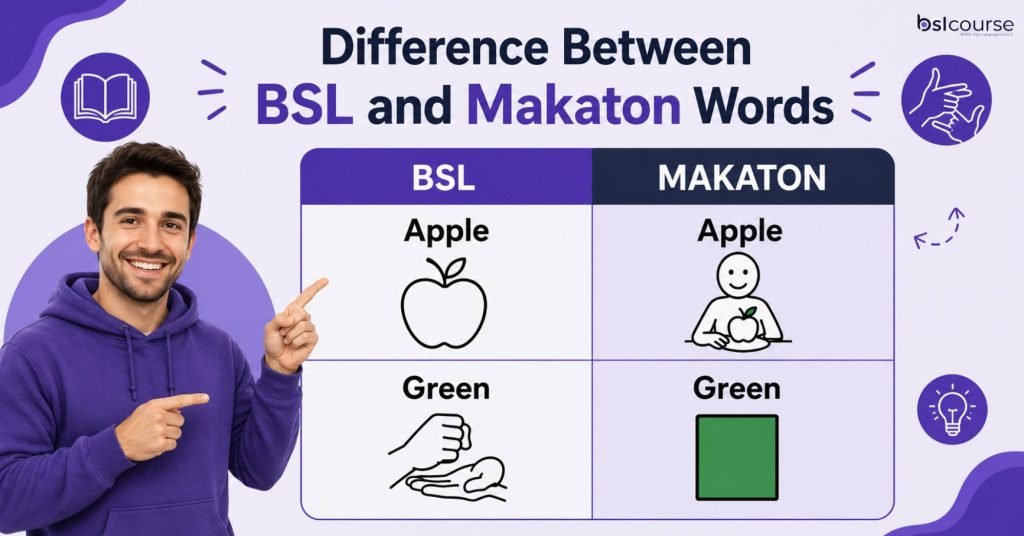
BSL (British Sign Language) and Makaton differ significantly in both structure and usage. BSL is a fully developed language with its own grammar, syntax, and vocabulary, used primarily by the Deaf community in the UK. BSL is not a signed version of English; it operates independently, with its own rules for sentence construction, facial expressions, and hand movements.
It is a rich and complex language that allows Deaf individuals to communicate in a variety of settings, from everyday conversations to formal situations. The signs in BSL are visually expressive, and their meaning often depends on context, facial expressions, and the specific hand movements used.
The key difference between BSL and Makaton is that BSL is a complete language, while Makaton is a supportive tool used alongside spoken language. Makaton signs are typically simpler and more visual, used to represent key concepts rather than formulating complex sentences like BSL.
For instance, Makaton signs are often derived from BSL but are modified to fit the structure of spoken English, making them easier to understand and use for people with various communication needs. Makaton also uses symbols alongside signs to support communication, which is not a feature of BSL. This makes Makaton particularly useful for children or adults with learning disabilities, as it provides a way to express thoughts and needs more clearly.
Frequently Asked Questions About BSL and Makaton
What is the main difference between BSL and Makaton?
BSL (British Sign Language) is a complete natural language with its own grammar, vocabulary, and sentence structure. Makaton is a communication programme that combines signs, symbols, and speech to support people with communication difficulties.
What are the main reasons to learn sign language in 2026?
The 12 Reasons Why Learn Sign Language in 2026 include improving communication, supporting inclusion, developing new skills, and connecting with Deaf communities. Learning sign language can also create opportunities in careers such as healthcare, education, childcare, and customer service.
Is Makaton the same as British Sign Language?
No. Although Makaton uses many signs derived from BSL, it is not the same as British Sign Language. BSL is an independent language, while Makaton is designed to support spoken communication.
Are BSL and Makaton signs the same?
Some Makaton signs are based on or adapted from BSL, so certain signs may look similar. However, Makaton uses signs alongside speech and symbols, while BSL signs form part of a complete visual language with its own grammar.
Is BSL better than Makaton?
Neither is universally better. BSL is appropriate for people who communicate using British Sign Language, particularly within the Deaf community. Makaton is useful for people who need additional support with speech, language, or communication.
Is the BSL alphabet easy to learn?
The BSL alphabet can be learned with regular practice. Starting with individual letters such as A and gradually working through the alphabet can help beginners develop handshape recognition and fingerspelling skills.
Final Summary
It is essential to understand the differences between British Sign Language (BSL) and Makaton, as both serve unique roles in communication. There are key distinctions—BSL is a complete language with its grammar, used fluently by the Deaf community. On the other hand, Makaton is a simplified system combining speech, signs, and symbols, designed to support individuals with speech or learning difficulties.
Moreover, knowing when and how to use each system can greatly improve communication in inclusive settings. This awareness encourages respectful interactions and ensures that people with different communication needs feel supported and understood in everyday situations.

