
Before babies can say their first words, they are already trying to communicate through gestures, sounds and expressions. Baby sign language UK gives infants another way to express their needs, such as wanting milk, asking for more food, or showing they are tired, before spoken language develops.
In the UK, baby signing is usually introduced around 6 to 9 months of age and involves simple gestures used alongside spoken words. Many programmes use signs adapted from British Sign Language (BSL) or Makaton, helping babies build early communication skills while supporting parent-child interaction.
This guide explains the most useful British baby signs, how to use them in everyday routines, and the leading UK baby signing programmes available for parents who want structured support. Whether you are completely new to baby signing or looking for the best first signs to teach, these practical tips will help you get started confidently.
What Is Baby Sign Language?
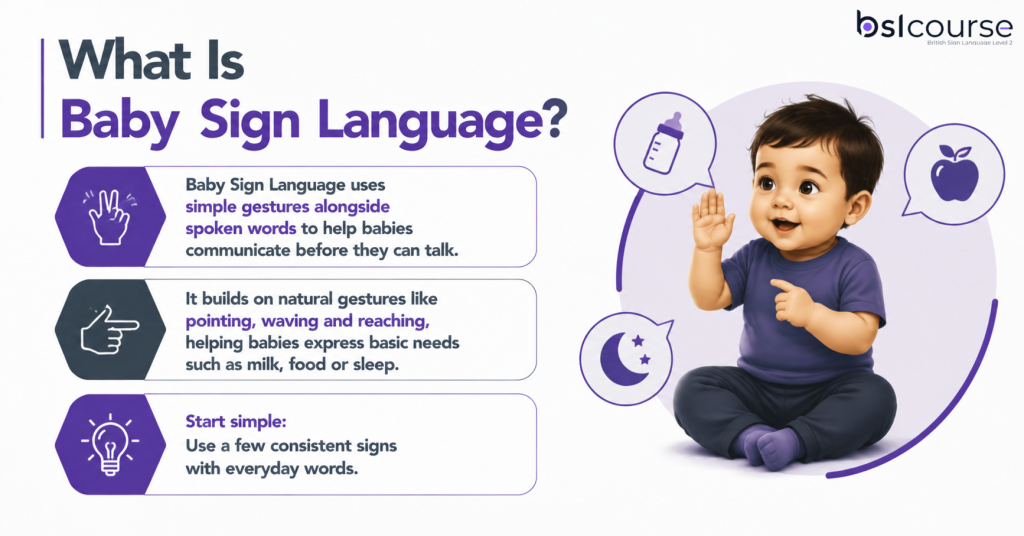
Baby sign language is a set of simple gestures that parents and carers use alongside talking, to help hearing babies communicate before their speech develops. It doesn’t replace spoken words: you say “milk” while making the sign, so your baby learns both together.
Long before babies can talk, they already point, wave and reach to get their message across. Baby signing UK programmes build on this natural instinct by giving parents a small, consistent set of gestures to pair with everyday words. Babies typically develop the physical coordination to copy simple hand movements before they can coordinate the muscles needed for clear speech, which is why signing often “clicks” earlier than talking does.
Consistency matters more than the number of signs you know. A baby who sees the same sign for “milk” every single time you say the word will pick it up far faster than one shown a dozen signs used inconsistently. Start with two or three signs tied to things that matter to your baby every day, then add more once those feel natural.
One thing worth saying plainly: baby signing does not delay speech, and it doesn’t mean your child will “talk less” because they can sign. We’ll cover this properly in its own section below, because it’s the question most UK parents ask before they start.
Is Baby Sign Language UK the Same as BSL?

No. British Sign Language (BSL) is a complete, independent language with its own grammar, used by the Deaf community across the UK, while baby sign language is a small set of everyday gestures that hearing families use to support spoken communication with babies. They are related but not interchangeable.
BSL has its own sentence structure, facial grammar and regional dialects, in the same way spoken English does. It’s recognised as a language in its own right in the UK, and people spend years reaching fluency in it, in the same way they would with French or Mandarin.
Baby sign language, by contrast, is a practical tool rather than a language. Most baby-signing programmes borrow a handful of individual signs, often from BSL, and use them one word at a time alongside spoken English. There’s no BSL grammar involved, no sentence structure and no expectation that a baby will go on to use BSL fluently just because they learned a “milk” sign at nine months.
Some baby-signing courses lean heavily on BSL vocabulary and say so clearly, sometimes marketing themselves specifically as BSL for babies. Others use their own simplified gesture systems that only loosely resemble BSL, or borrow from Makaton, which is a UK communication system originally designed for people with learning or communication difficulties and uses signs alongside speech and symbols.
If you want your baby exposed specifically to BSL vocabulary, check what a class actually teaches before signing up. Ask the instructor directly which system they use and whether it’s based on BSL, Makaton or an independent baby-sign vocabulary. A good class will tell you plainly, and understanding this distinction between baby sign language and BSL from the outset saves confusion later.
When Can You Start Baby Sign Language?
Most UK parents start introducing signs from around six months, though there’s no fixed “correct” age, and starting earlier or later both work fine. What matters more than the calendar age is whether your baby is showing signs of readiness.
Look out for a baby who watches your face and hands closely, tries to copy simple movements like waving or clapping, and makes purposeful gestures such as reaching for something specific rather than just moving their arms randomly. These are good signals that signing will land.
You can start signing with a much younger baby too. Signs simply won’t be copied back for a while, that’s completely normal. Babies typically understand far more than they can physically produce, so a four-month-old watching you sign “milk” every feed is still absorbing something, even if they don’t attempt the sign themselves until eight or nine months.
Keep talking normally throughout. Baby sign language for beginners works best as an addition to speech, never a substitute for it. Say the word, make the sign, and carry on talking as you normally would. Babies learn language by hearing it constantly, and signing sits alongside that, not instead of it.
What Are the First Baby Signs to Teach?

The best first baby signs are the ones tied to things your baby wants or needs several times a day, such as milk, more, finished, eat and sleep. Starting with high-frequency, high-motivation words gives your baby the most chances to practise and the strongest reason to use the sign.
These common baby signs form the core vocabulary taught across nearly every UK baby-signing course, and the baby sign language words below cover the situations that come up most in a typical day: feeding, sleeping, bathing and basic manners.
Milk: Open and close your hand in a gentle squeezing motion, as if milking a cow. Use it right before a feed, every time, so your baby connects the gesture with what’s about to happen.
More: Tap your fingertips together repeatedly. This is often the first sign babies produce themselves, because it applies to almost everything: more food, more bubbles, more of a favourite song.
Finished (or “all done”): Turn both hands over, palms facing down, in a brushing-off motion. Use it at the end of meals or activities so your baby has a way to signal they want to stop, which can genuinely cut down on mealtime frustration.
Eat: Bring your fingertips together and tap them towards your mouth. Use it consistently at the start of meals and snacks.
Drink: Make a “C” shape with your hand and bring it to your mouth, as if holding a cup.
Sleep: Rest your head briefly on your open hand, close to your cheek. Useful during your bedtime routine so your baby links the gesture to the wind-down that follows.
Mummy and daddy: Many baby-signing courses use an open hand tapped against the chin for “mummy” and against the forehead for “daddy”, though variations exist. Pick one version and stick with it.
Please and thank you: A flat hand circled on the chest works for both in many UK baby-signing systems, sometimes distinguished by speed or context. These are lovely early manners signs that toddlers often keep using long after they start talking.
Help: One fist placed on top of the opposite flat palm, both hands lifted slightly. Genuinely useful for a frustrated toddler trying to reach a toy.
Bath, book and food round out a solid starter set. Introduce two or three signs at once, not all eleven together. Once your baby is confidently responding to those, or attempting them back, add the next couple.
These baby sign language signs are deliberately simple: single, repeatable hand shapes rather than the more precise handshapes and movements used in full BSL vocabulary, which makes them easier for a baby’s developing motor skills to copy.
How to Teach Baby Sign Language at Home
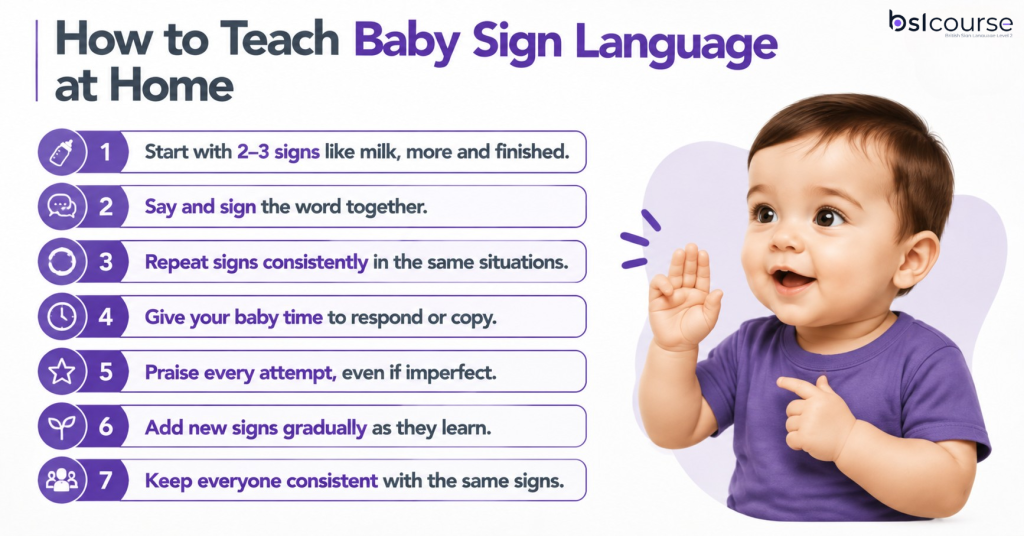
Teaching baby sign language at home works best when signs are woven into routines you’re already doing every day, rather than treated as a separate “lesson”. Say the word, make the sign clearly at chest height where your baby can see it, and repeat it every single time that word comes up.
- Pick two or three signs to start. Choose ones tied to daily routines, such as milk, more and finished. Trying to introduce ten signs at once overwhelms both of you.
- Say the word while signing. Always speak the word out loud as you make the gesture. The sign supports the word; it doesn’t replace it.
- Repeat it in the same context every time. Sign “milk” before every single feed, not just occasionally. Repetition in a predictable context is what makes a sign stick.
- Give your baby time to respond. After signing, pause and wait. Babies need a beat to process and attempt a response, and it’s tempting to rush past this.
- Praise any attempt, not just a perfect copy. A clumsy approximation of “more” is still communication. Respond to it as if it were the full sign.
- Add new signs gradually. Once your baby recognises or attempts a sign confidently, introduce another one from your list.
- Get everyone involved using the same signs. Grandparents, nursery staff and other carers should use identical signs for identical words, so your baby isn’t trying to learn two versions of “milk” at once.
Build signs into routines you already have: say and sign “milk” before feeds, “bath” as you run the water, “book” as you settle down to read, “more” and “finished” at mealtimes, and “bye-bye” as you leave the house. These small, repeated moments, several times a day, do far more than a single dedicated “signing session” ever will.
What Are the Benefits of Baby Sign Language?
The main benefit of baby sign language is giving your baby another way to communicate before speech is reliable, which can reduce frustration for both of you and support back-and-forth interaction. It’s worth being cautious here: signing can help communication in the moment, but it isn’t proven to boost intelligence or guarantee earlier talking.
Parents who sign with their babies often report being able to work out what their baby wants more quickly, particularly around common needs like hunger, thirst or tiredness. That can genuinely reduce the guessing game and the crying that comes with it.
Signing also tends to encourage more intentional back-and-forth interaction. Once a baby realises that a gesture gets a response, they start using it purposefully, which is an early and meaningful step in learning that communication works both ways.
Be wary of bigger claims you might see elsewhere, such as signing making babies measurably smarter or guaranteeing earlier speech. The evidence for those specific outcomes is limited and mixed. What’s more consistently supported is the simpler, more modest benefit: signing gives babies another tool for expressing themselves while their spoken vocabulary is still catching up.
Does Baby Sign Language Delay Speech?
No, there’s no good evidence that baby sign language delays speech, provided it’s used alongside talking rather than instead of it. Signing and spoken language develop through different, complementary pathways, and using one doesn’t come at the expense of the other.
The key word there is “alongside”. Baby sign language for beginners always pairs a spoken word with a gesture, so your baby is hearing language constantly while they sign, not instead of it. Signing simply gives them an earlier outlet for communication while their mouth and vocal cords are still catching up with what their brain wants to say.
Every child develops speech and communication at their own pace, with or without signing involved, and that variation is completely normal. If you have any concerns about your baby’s language development, whether or not you’re signing, it’s worth speaking to your health visitor or GP, who can refer you on for a speech and language assessment if needed. Signing itself isn’t something you need to worry about setting aside “in case” it causes delay: it doesn’t.
Baby Sign Language Classes in the UK
Baby sign language classes UK-wide vary in the signing system they teach, the age groups they’re aimed at and how much home-practice support they offer, so it’s worth asking a few direct questions before booking. A good class should be able to answer all of them clearly.
When comparing baby signing classes UK providers, consider:
- Which signing system does the class use? Ask specifically whether it’s based on BSL, Makaton or an independent baby-sign vocabulary, so you know what your baby is actually learning.
- What’s the instructor’s background and experience? Some instructors are qualified BSL tutors; others come from an early-years or childcare background.
- What age range is the class aimed at? Some start from a few weeks old with very simple exposure; others are geared towards mobile babies from six months.
- What’s the class format? Group sessions with songs and rhymes suit some families; smaller, quieter sessions suit others.
- How much parent participation is expected? You’ll usually be signing alongside your baby throughout, so make sure the pace and style suit you both.
- Are take-home resources provided? Sign sheets, song lists or short video clips make it far easier to keep practising consistently between sessions.
You don’t need a class at all to teach baby sign language successfully. Plenty of parents learn a handful of signs from a book, video or app and build them into home routines with great results. Classes are useful for structure, community and confidence, but they’re a support, not a requirement.
If you’d rather learn how to sign BSL properly further down the line, rather than just a baby-signing vocabulary, look for dedicated BSL UK courses run by qualified Deaf tutors, which teach the full language rather than a handful of borrowed signs.
Baby Sign Language vs BSL: Quick Comparison
Baby Sign Language and BSL may look similar, but they serve very different purposes. Here’s a quick comparison of Baby Sign Language and BSL:
| Feature | Baby Sign Language | British Sign Language |
| Main purpose | Early communication with babies | Full language |
| Typical users | Babies, parents and carers | Deaf and hearing BSL users |
| Language status | Not necessarily a complete language | Complete natural language |
| Vocabulary | Usually selected everyday signs | Extensive vocabulary and grammar |
| Grammar | Usually simplified or spoken-language-based | Has its own grammar and structure |
| UK relevance | Used by families and baby-signing programmes | Main sign language of the UK Deaf community |
FAQs
Is baby sign language popular in the UK?
Yes, baby sign language has grown steadily in popularity across the UK over the last two decades, with classes now widely available in most towns and cities alongside baby massage and swimming groups. Many nurseries and health visitors are familiar with it too.
Is baby sign language the same as BSL?
No. BSL is a complete, independent language used by the Deaf community, while baby sign language is a small set of everyday gestures that hearing families use alongside speech. Some baby-signing courses borrow BSL vocabulary, but that doesn’t make them the same thing.
What is the British Sign Language alphabet?
The BSL alphabet is a two-handed fingerspelling system representing the 26 letters of the English alphabet.
Why are BSL Colours useful to learn?
BSL Colours are useful because colours are commonly used when describing objects, clothing, pictures, and surroundings. Learning colour signs helps beginners expand their vocabulary and communicate more clearly.
What age should I start baby signing?
Most parents start around six months, though there’s no fixed age. You can begin earlier for exposure, understanding it will take longer before your baby signs back, or later if your baby shows clearer readiness signals such as purposeful gestures and sustained eye contact.
What are the easiest baby signs to teach?
Milk, more and finished are usually the easiest starting signs, because they relate to something your baby wants several times a day, giving them frequent, motivated chances to practise.
Can baby signing help babies communicate?
Yes, signing gives babies an extra way to express common needs, such as hunger or tiredness, before their spoken words are reliable, which can reduce frustration for both baby and parent.
Does baby sign language delay speech?
No. Used alongside talking, rather than as a replacement for it, baby signing doesn’t delay speech. Every child develops at their own pace regardless of whether they sign.
Where can I learn baby sign language in the UK?
Local baby-signing classes are widely available, often through children’s centres, private instructors or baby-and-toddler groups, and many run alongside book, app or video resources for practising signs at home.
Can I teach baby sign language at home?
Yes, entirely. Many parents teach themselves a small set of signs from a book, app or video and build them into daily routines like feeding, bathtime and bedtime, without ever attending a formal class.
Conclusion
Baby sign language is a simple but effective way to support communication during the stage when babies understand more than they can say. By introducing a few everyday signs, such as milk, more, eat, finished and sleep, parents can help babies express their needs and reduce frustration.
The key to successful baby signing is consistency. Say the word, make the sign, and repeat it naturally during daily routines. Whether you choose to learn through a UK baby signing programme or practise at home, patience and repetition are what help babies recognise and use signs over time.
Remember, baby sign language does not replace speech. It works alongside spoken language, giving babies an extra tool to communicate while their talking skills continue to develop.

