
Many job seekers look for ways to make their CV stand out in a competitive employment market. While qualifications and experience remain important, adding practical skills that demonstrate communication, inclusion, and adaptability can help create a stronger professional profile.
Is Learning BSL Good for Your CV? Yes, learning British Sign Language (BSL) can add real value to your CV by showing employers that you can communicate with a wider range of people and contribute to more inclusive workplaces. Learning British Sign Language (BSL) strengthens your CV, enhances employability, and demonstrates your commitment to creating inclusive and accessible environments.
As accessibility becomes increasingly important across workplaces in the UK, BSL is becoming a valuable skill for professionals in healthcare, education, customer service, HR, and other people-focused roles. This guide explains how BSL can improve your CV, which careers benefit most from this skill, and how to present your BSL knowledge effectively to employers.
What Is BSL, and Why Is It Becoming More Valuable to Employers?
BSL is a full, standalone visual language used by the Deaf community across the UK, with its own grammar, syntax, and regional variations, entirely separate from English. It is not “English spelled out with hands” and it is not the same as American Sign Language or other sign systems.
1. How Is BSL Different From English-Based Signing Systems?
BSL uses handshape, facial expression, and spatial grammar to build meaning, in a structure closer to languages like Japanese than to spoken English. Systems such as Signed Exact English simply map English word order onto signs, so they’re easier for hearing learners to pick up but don’t reflect how Deaf BSL users naturally communicate. Recognising this distinction on a CV shows you understand accessibility properly, rather than treating it as a novelty skill.
2. Why Are UK Employers Prioritising Accessibility Skills Right Now?
Employers are prioritising accessibility skills because equality, diversity, and inclusion have moved from a compliance checkbox to a genuine hiring criterion, particularly since the Equality Act 2010 placed a duty on service providers to make reasonable adjustments for disabled customers and staff. Around 12 million people in the UK are deaf or have hearing loss, according to RNID, which means most public-facing organisations interact with Deaf customers regularly whether they’re prepared for it or not. A candidate who can bridge that gap, even at a conversational level, solves a real operational problem for the business.
Does BSL Actually Look Good on a CV?
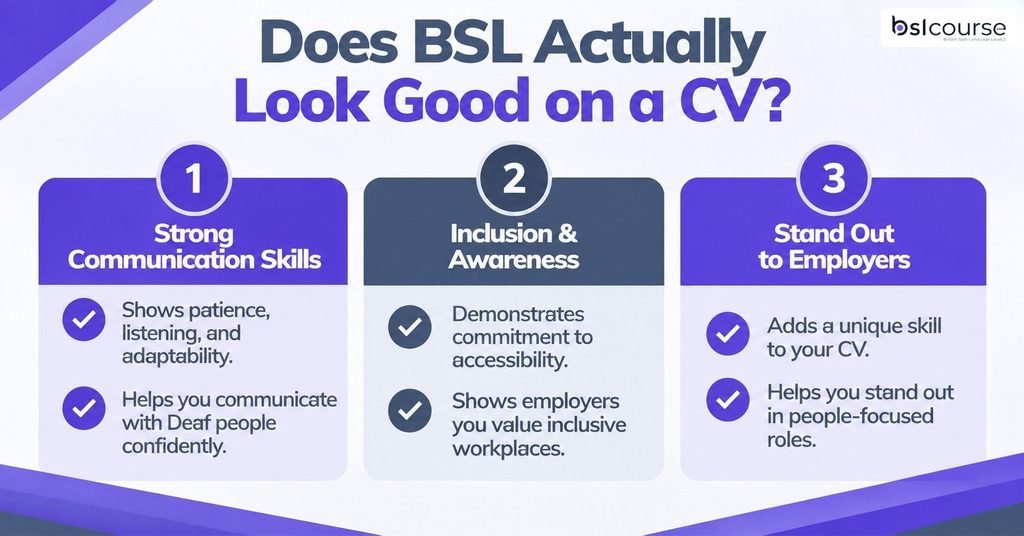
BSL looks good on a CV because it demonstrates three things recruiters actively screen for: strong communication skills, awareness of inclusion, and a point of difference from other applicants. Unlike generic soft skills, it’s specific, verifiable (you can list a qualification level), and immediately understandable to a hiring manager without further explanation.
1. Does BSL Show Strong Communication Skills?
Learning BSL demonstrates that you can communicate effectively beyond spoken language, which recruiters read as a proxy for patience, active listening, and adaptability under pressure. A receptionist who knows even basic BSL can greet, direct, and reassure a Deaf visitor without needing to hunt for a colleague or resort to writing notes back and forth. That’s a concrete, observable skill, not a vague claim of being “a good communicator” that every other CV in the pile also makes.
2. Does BSL Demonstrate Inclusion and Awareness?
BSL signals that you already think about accessibility before you’re asked to, which is exactly the mindset employers building inclusive workplaces are trying to hire for. It shows you’ve made an effort to understand a community’s communication needs on your own initiative, rather than waiting for a training mandate. For organisations trying to build genuinely welcoming environments, that self-starting awareness matters as much as the language skill itself.
3. Does BSL Help You Stand Out From Other Candidates?
BSL helps you stand out because most CVs in any given pile list the same handful of skills, such as Microsoft Office, teamwork, and “excellent communication,” which recruiters skim past without registering. A line reading “British Sign Language Level 2” is unusual enough to make a hiring manager pause, and in people-facing roles, that moment of memorability can be the difference between an interview and a rejection email.
Which Jobs Benefit Most From BSL Skills?
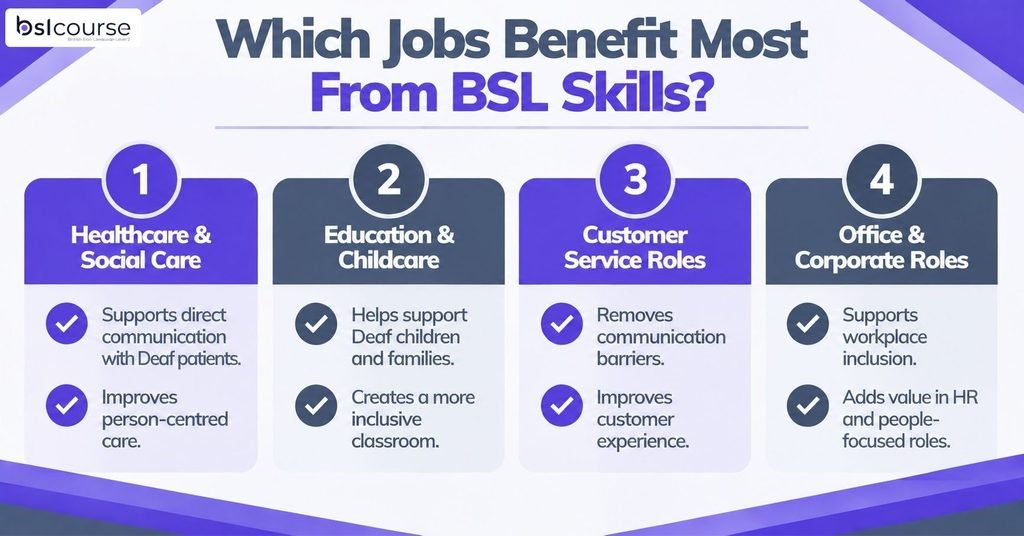
BSL delivers the most value in healthcare, education, customer service, and HR roles, essentially any job where you’re regularly communicating with the public or supporting people directly. The skill transfers less directly into purely technical or back-office roles, though it still signals soft skills employers value everywhere.
1. Is BSL Useful for Healthcare and Social Care Careers?
BSL is highly useful in healthcare and social care because it lets staff communicate directly with Deaf patients about their needs, symptoms, and preferences, rather than relying solely on an interpreter or written notes. Roles including healthcare assistants, nurses, support workers, care workers, and mental health professionals all benefit, since person-centred care depends on the patient being properly understood. Even conversational-level BSL can reduce anxiety for a Deaf patient in situations, such as appointments or emergencies, where clear communication genuinely matters.
2. Is BSL Useful for Education and Childcare Roles?
BSL is valuable in education and childcare because it supports Deaf children’s learning directly and improves communication with their families. Teachers, teaching assistants, nursery workers, and special educational needs professionals who know BSL can include Deaf pupils more fully in everyday classroom activity, rather than routing every interaction through a support worker. It also helps build trust with parents, who often notice quickly whether a school has made a genuine effort to communicate with their child.
3. Is BSL Useful for Customer Service and Public-Facing Roles?
BSL improves customer experience in public-facing roles by removing a communication barrier that would otherwise force a Deaf customer to write everything down or bring their own interpreter. Retail employees, receptionists, hospitality workers, bank staff, and customer support teams all deal with the public daily, and even basic BSL greetings and directions can turn an awkward interaction into a smooth one. Businesses that can demonstrate this kind of accessible service also tend to build stronger loyalty among Deaf customers, who often share recommendations within their community.
4. Is BSL Useful for Office and Corporate Roles?
BSL is useful in office and corporate roles primarily through HR and internal inclusion work, where it supports diversity initiatives and shows leadership on accessibility from within the organisation. An HR professional with BSL skills can engage more directly with Deaf colleagues during recruitment, onboarding, or workplace adjustments conversations. It’s less of a day-to-day necessity here than in frontline roles, but it still strengthens a CV aimed at people-focused corporate positions.
What Specific Skills Does Learning BSL Add to Your CV?
Learning BSL adds five transferable skills beyond the language itself: visual communication, cultural awareness, adaptive problem-solving, empathy, and a demonstrated commitment to inclusion. These are the qualities a recruiter should be able to infer the moment they see BSL listed, so it’s worth spelling a couple of them out explicitly in your personal statement rather than assuming they’ll join the dots.
- Communication skills – the ability to convey meaning through a visual language and adjust your approach to different communication needs.
- Cultural awareness – a working understanding of Deaf culture and the everyday experiences of Deaf people.
- Problem-solving – the flexibility to adapt how you communicate depending on the person and situation in front of you.
- Empathy and patience – a demonstrated willingness to slow down and genuinely understand someone else’s perspective.
- Commitment to inclusion – visible proof that accessibility and equality matter to you, not just to your employer’s policy document.
How Do You Add BSL Skills to Your CV Properly?
Add BSL to your CV in three places: your core skills section, a dedicated qualifications line if you’ve completed a course, and a brief mention in your personal statement connecting it to the role. Listing it in only one spot undersells it, since recruiters often scan skills sections and personal statements separately.
Where Do You List BSL Under Your Skills Section?
List BSL alongside your other core competencies, worded specifically enough to show your actual level, for example:
Skills
- British Sign Language (BSL) Level 2
- Inclusive communication
- Customer service
- Accessibility awareness
Writing “BSL Level 2” rather than just “BSL” gives recruiters a concrete benchmark, since Level 1 and Level 2 represent noticeably different levels of fluency.
How Do You Include a BSL Qualification on Your CV?
Include your BSL qualification the same way you would any other certification: course name, level achieved, training provider, and completion date if it’s recent enough to be relevant. For example:
British Sign Language Level 2 Certificate – Completed 2026
If your qualification is older, you can leave the date off, though recent completion often reassures employers that your skills are current rather than something you did years ago and never used.
How Do You Mention BSL in Your Personal Statement?
Mention BSL in your personal statement by connecting it directly to the value you’d bring in the specific role, rather than listing it as an isolated achievement. For example, a healthcare applicant might write that they’re “committed to inclusive, person-centred communication, demonstrated through completing BSL Level 2 alongside my clinical training.” This ties the skill to the job rather than leaving the recruiter to guess why it’s relevant.
Is BSL Worth Learning If You’re Looking for a Job?
BSL is worth learning if you’re job hunting, particularly for roles in healthcare, education, or customer service, because it demonstrates initiative and adds a concrete, verifiable skill that most competing candidates won’t have. It works best as a complement to your existing qualifications and experience, not as a replacement for them.
For job seekers specifically, BSL helps demonstrate additional workplace-relevant skills, supports applications for communication-heavy roles, and shows employers you’re willing to invest time in something genuinely useful rather than padding a CV with generic filler. For longer-term career development, it can support progression in healthcare, education, and customer service specifically, adding a distinctive skill alongside your core qualifications that stays relevant as you move up.
How Long Does It Take to Learn BSL?
Learning enough BSL to be genuinely useful on a CV typically takes a structured course of several months, though you can pick up everyday signs and basic greetings within a few weeks of consistent practice. Progress depends heavily on how often you practise and whether you’re learning with others, since sign language relies on real interaction to build fluency, not just memorisation.
Most UK training follows a tiered structure:
- BSL Level 1 – basic, everyday communication, including greetings, simple questions, and common vocabulary.
- BSL Level 2 – more detailed conversations, covering a wider range of topics and more complex grammar.
- BSL Level 3 and above – advanced communication, often required for interpreting or specialist roles.
For most CVs, Level 1 or Level 2 is enough to demonstrate genuine competence without requiring years of study.
Can BSL Alone Get You More Job Opportunities?
BSL alone won’t guarantee you a job, but it meaningfully strengthens an application when paired with relevant qualifications and experience for the role you’re applying to. Its impact depends heavily on the industry, being far more relevant in healthcare, education, and customer-facing sectors than in, say, purely technical or analytical positions with little public contact.
Where BSL does carry particular weight is in organisations that have explicitly committed to accessibility, since these employers are actively looking for candidates who already align with that priority. In those settings, BSL can be a genuine differentiator between two otherwise similar applications, even if it wouldn’t be the deciding factor everywhere.
Frequently Asked Questions
Is BSL a useful skill for a CV?
Yes. BSL demonstrates communication skill, accessibility awareness, and initiative, and it’s specific enough to stand out against generic CV skills like “teamwork” or “Microsoft Office.”
Do employers value British Sign Language skills?
Many do, particularly in healthcare, education, and customer service, where staff regularly interact with the public and Deaf service users specifically.
What jobs benefit from knowing BSL?
Healthcare and social care roles, education and childcare roles, customer service and public-facing roles, and HR or inclusion-focused corporate roles all benefit from BSL skills.
Should I put BSL on my CV?
Yes, if you’ve completed even a Level 1 course, list it in your skills section, your qualifications, and briefly in your personal statement, connected to the role you’re applying for.
Is BSL difficult to learn?
BSL has its own grammar and structure, so it takes genuine practice rather than simple memorisation, but most learners can manage everyday signs within weeks and hold basic conversations after a Level 1 course.
Does BSL improve career opportunities?
It improves your competitiveness for people-facing roles rather than guaranteeing opportunities outright, working best alongside relevant qualifications and experience for the job in question.
What BSL level should I learn for work?
Level 1 covers basic, everyday communication, while Level 2 supports more detailed conversations; either is enough to list credibly on a CV, with Level 2 carrying slightly more weight.
Conclusion
Adding British Sign Language (BSL) to your CV can demonstrate much more than language ability. It highlights your communication skills, awareness of accessibility, willingness to learn, and commitment to creating inclusive environments.
For careers in healthcare, education, social care, customer service, and other people-focused industries, BSL can be a valuable addition that helps you stand out from candidates with similar qualifications. However, BSL works best alongside your existing experience and professional skills rather than replacing them.
Whether you are starting your career, changing industries, or looking to strengthen your professional profile, learning BSL is a practical investment that can support personal development and improve your employability.

