
How Long Does It Take to Learn BSL? Learning British Sign Language (BSL) can take anywhere from 15 to 20 hours to learn simple beginner signs, around 3 to 4 years to develop everyday fluency, and 5 to 7 years to reach a professional interpreter level.
The exact time depends on your learning goals, practice routine, access to qualified teachers, and regular interaction with Deaf signers.
British Sign Language is a complete visual language with its own grammar, sentence structure, and regional variations. It is not simply a collection of hand gestures or a direct translation of spoken English.
To become confident in BSL, learners need to develop signing skills, understand facial expressions, and practise real conversations in everyday situations.
In this guide, we will explore how long it takes to learn BSL at different levels, what makes BSL challenging, the stages of learning, the difference between beginner and fluent signing, and the best ways to improve your progress.
What Is BSL?
British Sign Language is the first or preferred language of an estimated 87,000 Deaf people in the UK, with hundreds of thousands more using it as a second language, including family members, interpreters, and support workers.
It was formally recognised as a language in its own right by the UK government in 2003, and the BSL Act 2022 gave it further legal recognition in England, Scotland, and Wales.
BSL is not signed English. It has its own grammar, its own word order, and its own regional variations, much like any spoken language has dialects.
Where spoken languages rely on sound, BSL relies on hand shape, movement, location, and facial expression working together. Facial expression in particular is not just emphasis, it’s grammatical: it can change a statement into a question or mark a clause as conditional.
Is BSL Difficult to Learn?
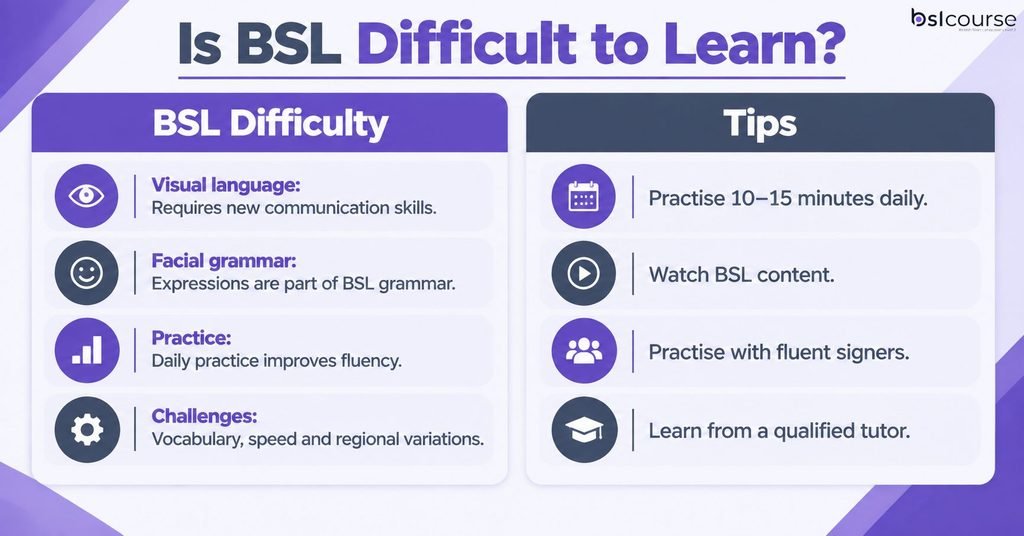
BSL is genuinely challenging for hearing beginners, mainly because it asks you to communicate visually and spatially rather than verbally, which most adult learners have never had to do before.
The difficulty is less about memorising individual signs and more about retraining how you process and produce language altogether.
Factors That Affect How Difficult BSL Is
- Previous language-learning experience. If you’ve learned another language before, you already have habits like regular practice and tolerating not understanding everything at once, and those transfer well.
- Comfort with visual communication. BSL asks you to read hand shape, movement, and facial expression simultaneously, which takes deliberate practice for anyone used to listening rather than watching.
- Understanding of facial grammar. Raised eyebrows for a yes/no question, a tilted head for a rhetorical one; these are grammar, not decoration, and beginners often miss them at first.
- Frequency of practice and exposure. Learners who sign a little every day consistently overtake those who do a longer session once a week, because BSL is a physical, muscle-memory skill as much as a mental one.
Common Challenges Beginners Face
New signers typically report the same handful of sticking points. Vocabulary retention is one, since there’s no phonetic spelling to lean on and each sign has to be remembered visually.
Signing speed is another; understanding fluent signers at natural pace is far harder than producing your own signs slowly.
Regional and personal variation in signs also throws learners early on, and many beginners freeze up the first time they try to hold a real conversation with a fluent Deaf signer rather than a fellow student.
Tips to Make Learning BSL Easier
- Sign for at least 10 to 15 minutes every day rather than cramming once a week.
- Watch BSL content regularly, such as Deaf vloggers, BSL Zone, or signed news bulletins, even before you understand all of it.
- Join a local Deaf club or an online BSL community to get exposure to natural, conversational signing.
- Learn from a qualified, ideally Deaf, tutor, since native fluency picks up nuance that textbooks and apps miss.
How Long Does It Take to Learn Sign Language?
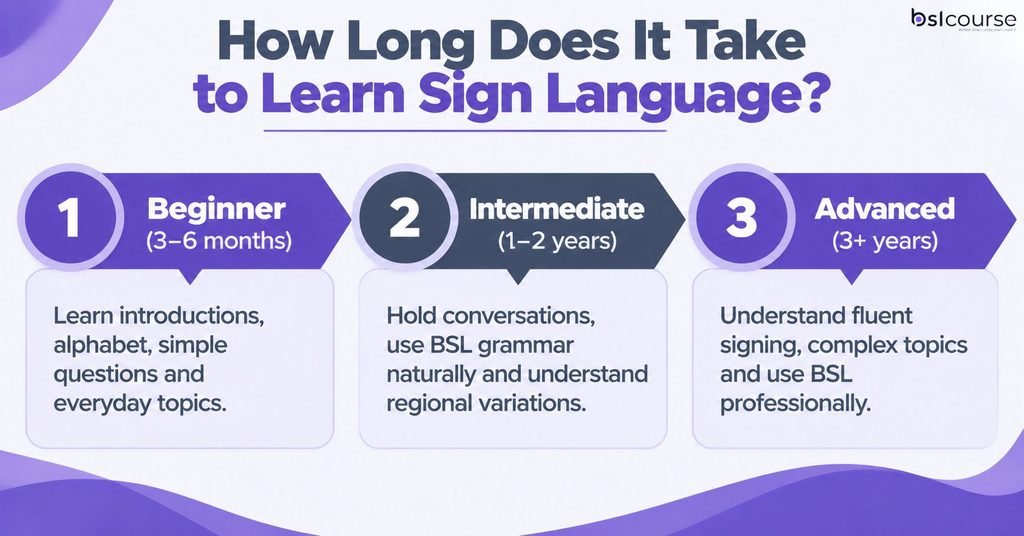
Realistically, expect three to six months for basic everyday conversation, one to two years for intermediate fluency, and three or more years of regular use for full fluency, with the exact pace shaped by how much you practise and how much contact you have with Deaf signers.
These figures assume regular practice, not occasional dabbling, and they track closely with the UK’s formal BSL qualification levels.
Beginner Level (roughly Level 1, 3 to 6 months)
At this stage, you can introduce yourself, sign the alphabet, ask and answer simple questions, and manage everyday topics like family, weather, or ordering food.
Most beginners get here within three to six months of weekly classes plus regular practice at home, though this varies with how much time you put in outside class.
Intermediate Level (roughly Level 2 to 3, 1 to 2 years)
Intermediate signers can hold a genuine two-way conversation, follow BSL grammar and sentence structure more naturally, and start to pick up regional variation and idiom.
Confidence tends to be the biggest shift here: you stop translating in your head and start thinking directly in BSL structure.
Advanced or Fluent Level (roughly Level 4 and above, 3+ years)
Fluent signers can follow fast, natural conversation between Deaf people, understand complex or abstract topics, and use BSL professionally, for example in interpreting or Deaf-facing roles.
Reaching this stage almost always requires sustained, regular contact with fluent Deaf signers, not just classroom study.
Factors That Influence Learning Speed
- Practice hours per week. This is the single biggest lever; daily short sessions consistently beat weekly long ones.
- Learning method. A structured course with a qualified tutor tends to build correct habits faster than self-teaching from videos alone.
- Exposure to Deaf signers. Real conversational practice accelerates fluency far more than classroom drills, because it forces you to process at natural speed.
- Personal motivation and goals. Learners working towards a specific goal, such as a job, a Deaf family member, or a qualification, tend to progress faster than those learning casually.
How Many Levels of BSL Are There?
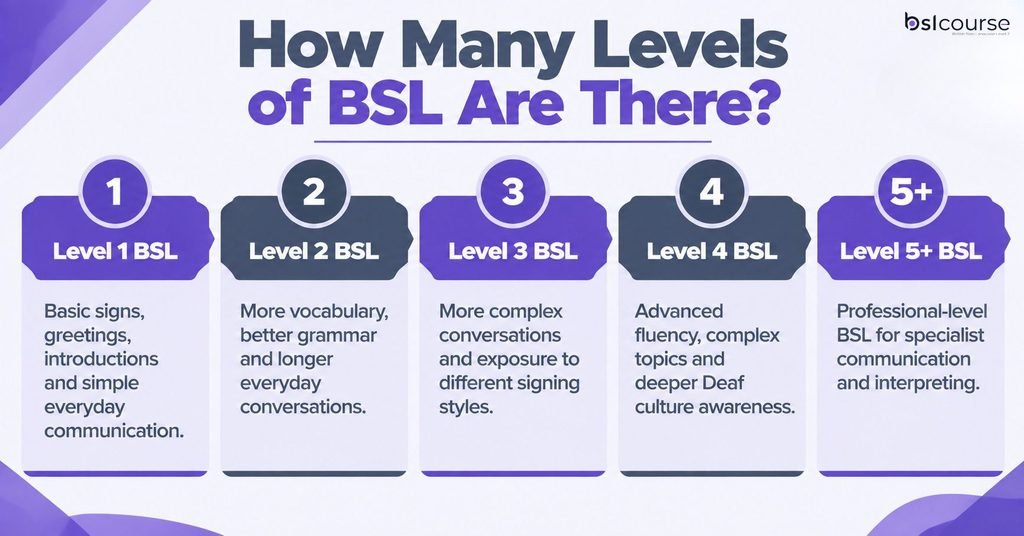
BSL in the UK follows a recognised qualification pathway from Level 1 through to Level 6, each building on the last in complexity and fluency, typically awarded through bodies such as Signature or iBSL. Most people never need to go beyond Level 3 or 4 unless they’re aiming for interpreting or professional Deaf-facing work.
Level 1 BSL
Level 1 covers basic signs and everyday communication: greetings, personal information, simple questions, and short exchanges. It’s the standard starting point for hobbyists, colleagues of Deaf staff, or parents of Deaf children.
Level 2 BSL
Level 2 moves into more detailed conversation, a firmer grasp of BSL grammar, and enough vocabulary to discuss a wider range of everyday topics with growing confidence.
Level 3 BSL
Level 3 is often treated as a professional baseline, for example for teaching assistants or frontline staff. It covers longer, more complex conversations and exposure to different signing styles and registers.
Level 4 BSL
Level 4 represents advanced fluency: complex discussion, abstract topics, and a deeper understanding of Deaf culture and community norms, alongside the linguistic skill to navigate them.
Level 5 and Higher
Level 5 and above sit at professional and interpreting standard, covering specialist communication, formal interpreting contexts, and the linguistic precision those settings demand.
What’s Easier: ASL or BSL?
Neither ASL nor BSL is inherently easier to learn; difficulty depends far more on your access to teachers, classes, and a signing community than on the language itself.
This surprises a lot of English speakers, who assume that because ASL and BSL both interact with English, one must be simpler than the other.
Key Differences Between ASL and BSL
- Different origins. ASL descends partly from French Sign Language, while BSL developed independently in Britain, so the two are not mutually intelligible despite sharing a spoken language.
- Different hand alphabets. ASL uses a one-handed fingerspelling alphabet; BSL uses a two-handed one, which is often the first concrete difference learners notice.
- Different signs for the same words. Even everyday vocabulary rarely overlaps between the two languages.
- Different grammar features. Sentence structure, use of space, and non-manual features such as facial grammar vary between the two.
Which One Is Easier to Learn?
In practice, the deciding factor is what’s available where you live. If you’re in the UK, BSL classes, tutors, and Deaf community events will be far easier to find than ASL ones, and the reverse is true in the US.
Native English speakers don’t get an automatic head start with either language, since both require the same shift into visual, spatial communication. Access to teachers and practice partners, not the language itself, is what makes learning faster or slower.
How Can You Learn BSL Faster?
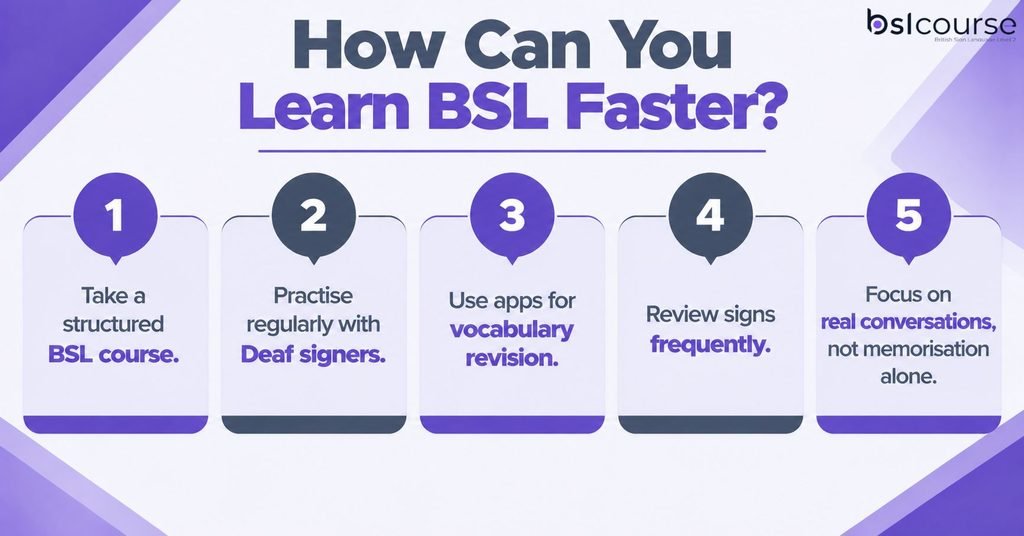
The fastest route combines structured, qualified teaching with regular contact with Deaf signers, daily short practice sessions, and consistent review, rather than relying on any single method alone.
Learners who combine several of these consistently tend to progress noticeably faster than those relying on just one.
Effective Learning Strategies
- Take a structured BSL course through a recognised provider so you build correct grammar habits from the start, rather than picking up mistakes to unlearn later.
- Practise with Deaf communities as early and as often as you can; this is consistently the single biggest accelerator learners report.
- Use online resources and apps for vocabulary revision, but treat them as a supplement to real conversation, not a replacement for it.
- Review previously learned signs regularly, since visual vocabulary fades faster without repetition than spoken-word vocabulary does.
- Prioritise real conversation practice over pure sign memorisation, since fluency comes from use, not from a growing list of isolated words.
Mistakes to Avoid
Learning individual signs without their grammatical context is one of the most common traps, since BSL meaning often depends on how a sign is used, not just what it looks like in isolation.
Ignoring facial expression is another, given that it carries real grammatical weight rather than just emotional tone. Practising only occasionally is the biggest one of all: irregular practice is the single most common reason learners plateau.
Benefits of Learning BSL
Learning BSL opens direct communication with Deaf and hard-of-hearing people, which is valuable in itself and often opens doors professionally, particularly in education, healthcare, customer service, and social care.
It also sharpens non-verbal communication skills more broadly, since BSL forces you to read expression, posture, and context in a way spoken language never demands.
Beyond the personal and professional gains, every new signer also contributes, in a small way, to a more accessible and inclusive society for Deaf people.
FAQ’s
Q1. How long does it take to become fluent in BSL?
Most learners reach genuine fluency after three or more years of consistent practice and regular contact with Deaf signers. Fluency depends far more on real conversational exposure than on classroom hours alone.
Q2. Is BSL harder than spoken language?
BSL isn’t harder overall, but it demands a different kind of skill: visual processing, spatial grammar, and facial expression, rather than pronunciation and listening. Many learners find the shift to visual communication the biggest early challenge.
Q3. Can I learn BSL in three months?
In three months of regular practice, you can typically reach a solid beginner level: introductions, everyday topics, and simple conversation. Full conversational fluency takes considerably longer, usually a year or more.
Q4. How many BSL levels are there?
The standard UK pathway runs from Level 1 through to Level 6, with Levels 1 to 3 covering everyday to professional-baseline communication and Levels 4 and above covering advanced fluency and interpreting standard.
Q5. Is ASL easier than BSL?
Neither is inherently easier; ASL and BSL are unrelated languages with different alphabets and grammar. Which one is easier for you depends mostly on which language you have access to teachers and communities for.
Q6. How often should I practise BSL?
Short daily practice, even just 10 to 15 minutes, produces faster progress than longer, infrequent sessions, because BSL relies on muscle memory as much as recall. Pairing daily practice with weekly conversation practice gives the best results.
Conclusion
Learning British Sign Language is a rewarding journey that requires patience, consistency, and regular interaction with fluent signers.
While beginners can often learn basic BSL communication within three to six months, reaching true fluency takes years of practice, ongoing exposure, and a deeper understanding of Deaf culture and BSL grammar.
The fastest progress comes from combining structured learning with daily practice, real conversations, and engagement with Deaf communities.
Whether your goal is personal communication, professional development, or supporting accessibility, learning BSL creates meaningful connections and helps build a more inclusive world.
Ultimately, there is no shortcut to fluency—consistent practice, real-world use, and commitment are the keys to mastering BSL.

