Yes, you can teach yourself the basics of British Sign Language (BSL). Free apps, video dictionaries and YouTube channels now cover everything from the alphabet to everyday conversation, and thousands of hearing people pick up their first signs this way every year, long before they ever book a formal course.
This guide is for complete beginners: hearing parents of Deaf children, colleagues who want to communicate with a Deaf teammate, carers, or anyone who’s simply curious about the UK’s fourth indigenous language.
Through self-study alone, you can realistically expect to learn fingerspelling, build a working vocabulary of a few hundred signs, and hold basic everyday conversations within a few months of regular practice.
What you won’t get from an app is fluency, and there’s a ceiling to how far self-teaching can take you before you need real interaction with Deaf signers.
This guide covers what BSL is, what you can and can’t achieve alone, the best free apps and courses available right now, and how to build a daily learning routine that actually sticks.
What Is British Sign Language (BSL)?
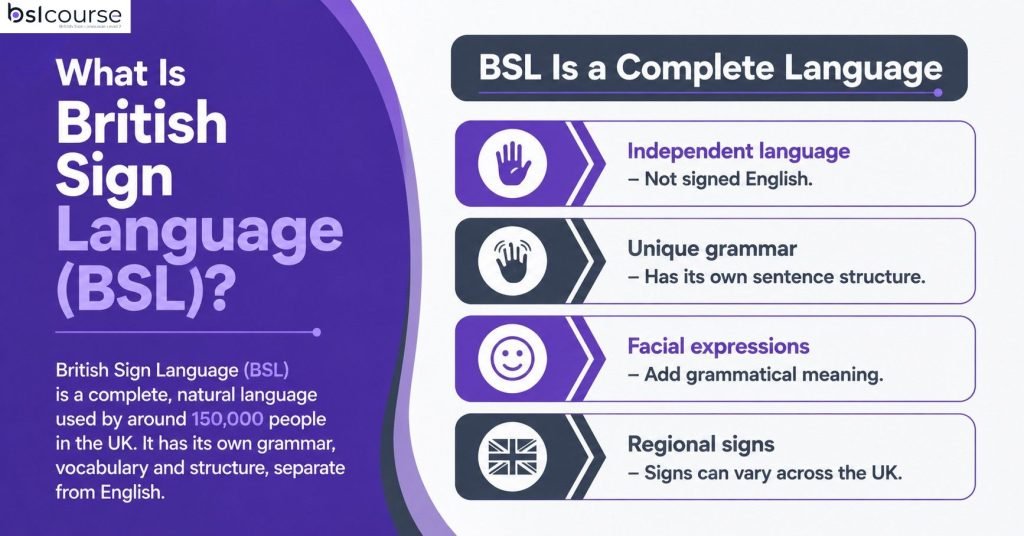
British Sign Language is a complete, natural language used by around 150,000 people in the UK as their first or preferred language, according to the British Deaf Association.
It has its own grammar, vocabulary and structure entirely separate from English, and since 2003 it has held recognition from the UK government, cemented in law by the British Sign Language Act 2022.
BSL Is a Complete Language
BSL isn’t a signed version of English, a code, or a simplified system. It’s a language in its own right, with the same depth and expressive range as any spoken language.
1. Grammar and sentence structure: BSL uses topic-comment structure (the subject or topic is often signed first, followed by a comment about it) rather than English’s subject-verb-object order.
2. Facial expressions and non-manual features: eyebrow position, mouth patterns and head tilts aren’t decoration; they carry grammatical meaning, marking questions, conditionals and intensity.
3. Regional variations across the UK: just as spoken English has regional accents, BSL has regional dialects, so signs for everyday words like colours or numbers can differ between, say, London, Manchester and Glasgow.
Why BSL Is Different From Spoken English
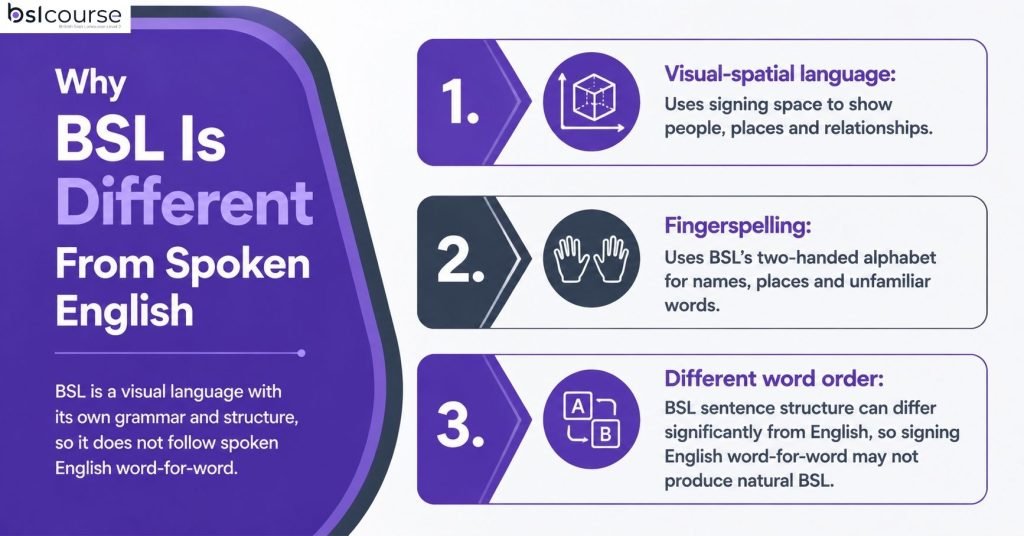
Understanding these differences early will save you a lot of confusion once you start learning signs.
1. Visual-spatial language: BSL uses the space in front of the signer to show relationships between people, places and objects, rather than relying purely on word order.
2. Fingerspelling: used for proper nouns, place names and words without an established sign, spelled out using a two-handed alphabet unique to BSL (unlike the one-handed alphabet used in American Sign Language).
3. Sign order vs English word order: a sentence signed in BSL word-for-word rarely reads as correct English, and vice versa; this is one of the biggest early mistakes beginners make.
Can I Teach Myself BSL ?
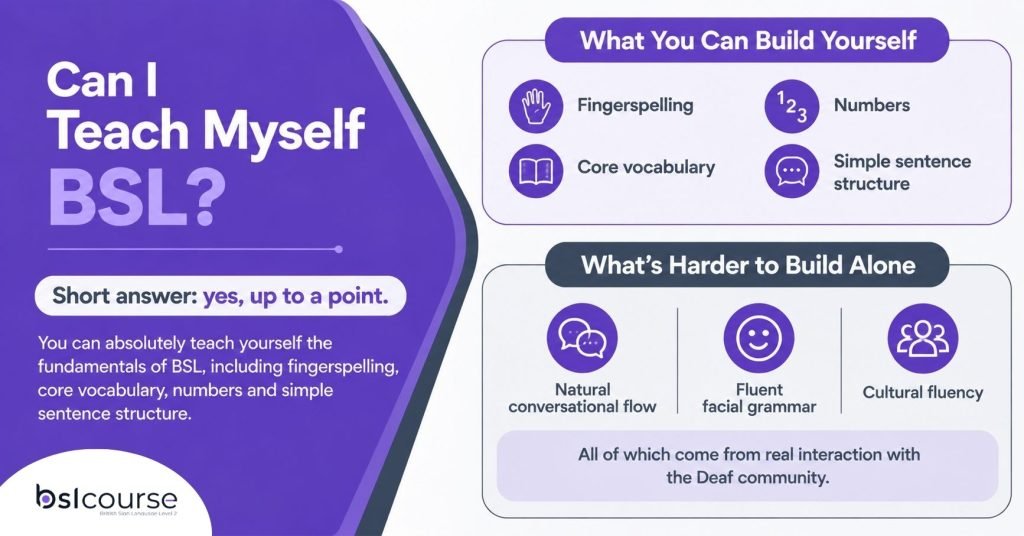
Short answer: yes, up to a point. You can absolutely teach yourself the fundamentals of BSL, including fingerspelling, core vocabulary, numbers and simple sentence structure. What’s harder to build alone is natural conversational flow, fluent facial grammar, and cultural fluency, all of which come from real interaction with the Deaf community.
Independent learners can typically pick up:
- The BSL alphabet and fingerspelling
- Everyday vocabulary (greetings, family, food, numbers, time)
- Basic sentence patterns and simple questions
- An introduction to Deaf culture and etiquette
What becomes genuinely difficult without guidance:
- Getting real-time feedback on your handshapes and signing speed
- Mastering facial grammar, which is easy to under-use when you’ve only ever watched, not signed back
- Building the receptive skill of understanding fast, natural signing from a range of different signers
- Picking up regional variation and informal, conversational register
A realistic expectation: self-study alone will get most learners to a strong beginner level, roughly equivalent to the early stages of a Level 1 qualification, within two to three months of consistent daily practice. Getting further usually means adding a class, a tutor, or regular contact with Deaf signers to what you’re doing on your own.
5 Benefits of Learning BSL on Your Own

1. Learn at Your Own Pace
There’s no class schedule to keep up with. If a sign or grammar point isn’t sticking, you can rewatch a video ten times without holding anyone else back, and move quickly through material you already find easy.
2. Study from Anywhere
All you need is a phone, a laptop and a bit of space to move your hands. Self-study fits around shift work, childcare, or a commute in a way that a fixed weekly class often can’t.
3. Affordable Learning Options
Many of the best starting resources, including several video dictionaries and beginner app content, are free. Even paid options tend to cost far less than a term of in-person classes, making self-study the natural first step for anyone unsure how far they want to take BSL.
4. Build Daily Learning Habits
Because sessions can be short (ten to fifteen minutes works well for signing, since it’s physically tiring in longer bursts), self-teaching makes it easier to build a genuine daily habit rather than cramming once a week.
5. Great Preparation for Formal Courses
Turning up to a Signature-accredited Level 1 course already knowing your alphabet and fifty or so signs means you spend classroom time on conversation and feedback rather than absolute basics, and tutors consistently report that self-taught beginners progress faster.
The Challenges of Self-Teaching BSL

No Feedback on Your Signing
An app can show you a sign; it can’t tell you that your handshape is subtly wrong or that you’re signing too fast to be understood. Recording yourself and comparing against native footage helps, but it’s a poor substitute for a real Deaf tutor watching you sign live.
Difficulty Learning Facial Expressions
Most beginners focus entirely on their hands and forget their face, yet facial grammar changes meaning as much as any handshape does. Without correction, it’s easy to build fluent hands and a flat, grammatically incomplete face.
Limited Conversation Practice
Watching videos builds receptive skills slowly and passively. Real conversation, where you have to understand and respond in real time, develops far faster, and it’s the one thing self-study genuinely struggles to replicate.
Understanding Deaf Culture
BSL doesn’t exist separately from Deaf culture and community norms, from turn-taking conventions to naming signs to attitudes around Deaf identity. Apps can introduce these ideas, but understanding them properly comes from spending time within the Deaf community itself.
Learning BSL Grammar Correctly
Grammar mistakes are easy to make and hard to notice on your own, particularly around topic-comment structure, use of space, and non-manual markers for questions. Left uncorrected, these become habits that are much harder to unlearn later.
5 Best Ways to Learn British Sign Language Online

1. Structured Online BSL Courses
Accredited online courses, including those working towards a Signature Level 1 or Level 2 Award, give you a syllabus, assessed units and a recognised qualification at the end. They’re the closest thing to formal study you can do without attending in person.
2. Live Online Classes
Zoom or Teams-based classes with a Deaf tutor combine the flexibility of learning from home with the feedback and conversation practice that pre-recorded material can’t offer. These sit between fully independent study and an in-person course.
3. Video-Based Learning
Structured video courses let you pause, rewind and repeat difficult signs as many times as you need. They work best when paired with active recall (testing yourself) rather than passive rewatching.
4. Free Learning Resources
Video dictionaries such as Sign BSL and Spread the Sign let you look up individual signs on demand, which is invaluable once you’ve got past the absolute basics and want to build vocabulary around your own life and interests.
5. YouTube Channels for Beginners
A number of Deaf creators and BSL tutors publish free structured lesson series and vlogs in BSL, which double as listening (or rather, watching) practice once you’ve built a bit of vocabulary. Look for channels run by Deaf signers rather than hearing learners, since native input is worth more at every stage.
Best Free Apps to Learn BSL
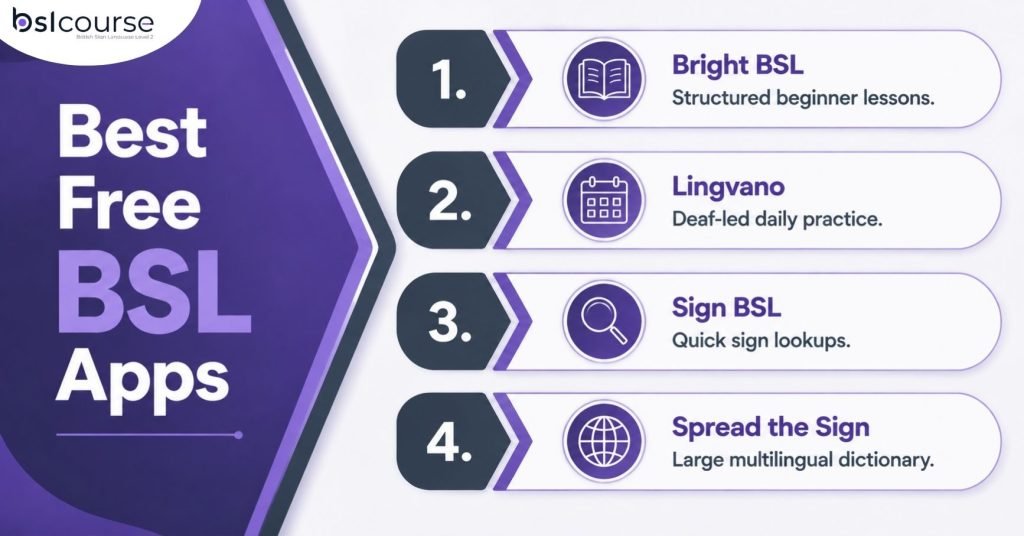
These four are the apps beginners ask about most often. None will make you fluent alone, but each is a genuinely useful part of a self-study routine.
Bright BSL
Free with in-app purchases. Bright BSL uses a Duolingo-style structure of twenty modules, each with several gamified lessons covering signs, grammar and Deaf culture tips, plus a built-in sign bank for reference.
- Pros: clear video demonstrations, gamified progress tracking, culture notes woven into lessons.
- Cons: the more advanced and interactive exercises sit behind a paywall.
- Best for: absolute beginners who want a structured, game-like introduction.
Lingvano
Free with premium subscription. Lingvano is built around bite-sized lessons taught entirely by Deaf teachers, with a vocabulary trainer, a sign mirror for self-checking your handshapes, and real-life dialogue practice.
- Pros: Deaf-led teaching throughout, a genuinely useful self-check mirror feature, strong dialogue-based practice.
- Cons: full lesson content requires a paid subscription after the free trial.
- Best for: learners who want daily habit-building lessons plus a way to sense-check their own signing.
Sign BSL
Sign BSL is a free, searchable video dictionary rather than a course. Type or browse for a word and watch a short clip of the sign, which makes it the tool you’ll open most often once you’re building vocabulary around your own day-to-day needs.
- Pros: completely free, fast to search, good for quick lookups mid-conversation.
- Cons: no structured lessons, grammar teaching or progress tracking.
- Best for: quick reference alongside a structured course or app.
Spread the Sign
Spread the Sign is a free, multilingual sign language dictionary covering dozens of countries’ sign languages side by side, including BSL. It’s particularly useful if you ever need to compare BSL with another country’s sign language, or want additional example footage of a sign from a second source.
- Pros: free, huge vocabulary coverage, useful for cross-checking a sign against another native source.
- Cons: video quality and clarity vary more than on dedicated BSL apps.
- Best for: learners who want a second opinion on a sign, or who split their time between BSL and another sign language.
How to Teach Yourself BSL Successfully
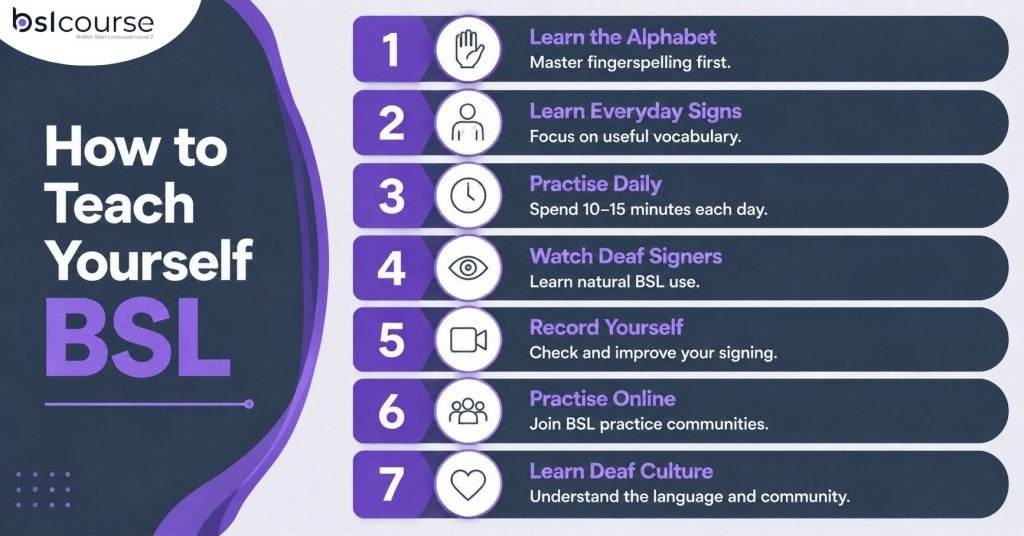
Start with the BSL Alphabet
Fingerspelling is the foundation everything else sits on, since it lets you spell names and unfamiliar words from day one. Spend your first week or two on nothing else until it becomes automatic.
Learn Everyday Vocabulary
Build outward from words you’ll actually use: family, food, feelings, time, numbers, and the names of people in your own life. Vocabulary tied to your real routine sticks far better than random word lists.
Practise Every Day
Ten to fifteen focused minutes a day beats a single long weekly session, both because signing is physically tiring and because language skills, like any motor skill, need frequent repetition to move into muscle memory.
Watch Native Signers
Prioritise content made by Deaf signers over hearing learners wherever you can. Native signing gives you accurate rhythm, facial grammar and natural variation that beginner-to-beginner content can’t.
Record Yourself Signing
Film short clips of yourself signing back what you’ve learned, then compare against the original. It’s the closest thing to feedback you can get without another person in the room, and it exposes flat facial expression and rushed handshapes fast.
Join Online Practice Groups
Look for online BSL practice meet-ups, Discord servers or social media groups where learners (and ideally some Deaf members) practise together. Even irregular conversation practice will move you further than months of solo video-watching.
Learn Deaf Culture Alongside BSL
Read about Deaf history, etiquette and identity as you learn the language itself. Understanding, for example, why eye contact and direct communication styles matter, or how naming signs work within the Deaf community, will shape how naturally and respectfully you actually use BSL.
5 Common Mistakes Beginners Make
1. Memorising signs without grammar: knowing five hundred signs is worthless if you string them together in English word order; grammar has to be learned alongside vocabulary, not after it.
2. Ignoring facial expressions: treating the face as optional produces signing that’s technically correct but grammatically incomplete.
3. Not practising receptive skills: it’s far easier to produce a sign than to understand one flashed past you at conversational speed, so dedicate real time to watching and understanding, not just signing.
4. Learning too many signs too quickly: cramming vocabulary without repetition leads to fast forgetting; a smaller, well-practised vocabulary beats a large, shaky one.
5. Depending on only one learning resource: every app, course or channel has blind spots, so combine at least two or three sources for a rounder picture of the language.
How Long Does It Take to Learn BSL?
Timelines vary with how often you practise, but most learners following a consistent daily routine can expect roughly the following.
Learning the Basics
Fingerspelling, greetings and core everyday vocabulary: typically four to eight weeks of daily practice.
Becoming Conversational
Comfortable with simple everyday conversation and basic grammar, broadly comparable to a Signature Level 1 to Level 2 standard: typically six months to a year of regular practice, ideally combined with a course or conversation partner.
Achieving Fluency
Genuine fluency, including fast receptive understanding, natural facial grammar and cultural fluency, typically takes several years and near-certainly requires sustained interaction with Deaf signers, not app-based study alone.
Can You Become Fluent Without a Teacher?
Realistically, no, not to a genuine, conversational standard. Fluency means understanding fast natural signing from a range of different people, producing accurate facial grammar automatically, and navigating Deaf cultural norms comfortably, none of which self-study alone reliably develops.
Interacting with Deaf signers is the single biggest factor separating fluent signers from advanced hobbyists. Community events, Deaf clubs and Deaf-led classes expose you to natural signing speed and variation that no app or video series can fully replicate.
Qualified BSL tutors, particularly those teaching towards Signature-accredited qualifications, add structured feedback and formal assessment that self-study can’t provide. Many are Deaf themselves, which means lessons double as cultural immersion.
When self-study is enough: if your goal is basic everyday communication, supporting a Deaf family member or friend a little, or simply satisfying curiosity about the language.
When formal learning becomes worthwhile: if you’re aiming for a recognised qualification, considering interpreting or teaching, or need genuinely reliable communication for work, caring responsibilities or a close relationship.
Frequently Asked Questions
Can I learn BSL by myself?
Yes. You can teach yourself fingerspelling, core vocabulary and basic sentence structure using free apps, video dictionaries and YouTube content. Reaching fluency, however, generally requires real interaction with Deaf signers and, usually, a structured course.
What is the best free app to learn BSL?
There’s no single best app for everyone. Bright BSL and Lingvano suit structured beginners best, while Sign BSL and Spread the Sign work better as quick-reference dictionaries alongside a course.
Is British Sign Language difficult to learn?
BSL is no harder than learning any other new language, though it demands skills many hearing learners haven’t used before, particularly facial grammar and spatial memory. Most beginners find fingerspelling and basic vocabulary approachable within weeks, while fluent, natural signing takes years, as with any language.
How long does it take to learn BSL?
Expect four to eight weeks for the basics, six months to a year for everyday conversational ability with regular practice, and several years, alongside real contact with Deaf signers, to reach fluency.
Can I learn BSL online?
Yes. Free video dictionaries, structured apps, YouTube channels and live online classes all support online learning, and accredited online courses can now take you all the way to a recognised Level 1 or Level 2 qualification without attending in person.
Do I need a tutor to become fluent?
In practice, yes. Self-study can get you to a strong conversational base, but genuine fluency, including fast receptive skills and natural facial grammar, is very difficult to reach without a qualified tutor and regular contact with Deaf signers.
Can someone who knows BSL understand every sign language?
No, understanding is sign language universal requires knowing that different sign languages are separate languages. A person who knows BSL may not automatically understand ASL or another country’s sign language.
Is BSL recognised as an official language?
Yes. The UK government first formally recognised BSL as a language in 2003, and this was written into law by the British Sign Language Act 2022, which recognises BSL as a language of England, Wales and Scotland.
Can hearing people learn British Sign Language?
Absolutely. The majority of people learning BSL, whether through self-study or accredited courses, are hearing. Learning BSL as a hearing person is one of the most direct ways to support and connect with the Deaf community.
Conclusion
Teaching yourself BSL is a genuinely excellent starting point, not a lesser alternative to formal study. Free apps and video dictionaries will comfortably take a motivated beginner from zero to basic everyday conversation within a few months.
The habit matters more than the resource: ten minutes a day, every day, will always beat an occasional hour-long binge. Combine a structured app or course with a free dictionary for quick lookups, and look for opportunities, however small, to practise with Deaf signers as early as you can.
Wherever self-study takes you, there’s a natural next step waiting, whether that’s a live online class, a local Signature-accredited course, or simply your first real conversation with a Deaf friend or colleague. Start with the alphabet today, keep showing up daily, and the rest of the language will follow.

