
Learning British Sign Language (BSL) can feel challenging when you are starting from scratch, especially when you need to learn new handshapes, movements, facial expressions and grammatical patterns. A 90-day BSL challenge makes the process more manageable by breaking your learning into small, achievable daily steps.
The goal is to learn your first 500 BSL signs in 90 days, focusing on around 5–6 new signs each day while regularly reviewing signs you have already learned. This approach helps you build practical vocabulary gradually instead of trying to memorise hundreds of signs at once.
The challenge begins with essential foundations such as fingerspelling, numbers, greetings, family and everyday activities, before progressing to topics such as food, emotions, weather, travel, work, education, health and hobbies. As your vocabulary develops, you will also practise combining signs and using them in simple everyday interactions.
Remember that BSL involves much more than hand movements. Facial expressions, eye gaze, body movement and other non-manual features can contribute to meaning, so your practice should focus on how complete signs are produced rather than memorising handshapes alone.
By following the challenge consistently, you can finish the 90 days with a broader practical vocabulary, stronger recall and a regular BSL learning habit. Your first 500 signs will not make you fluent, but they can provide a strong foundation for developing your receptive skills, understanding BSL grammar and becoming more confident when communicating with BSL users.
Whether you want to communicate more effectively with Deaf friends or family members, develop useful communication skills for work, or simply learn a new language, this 90-Day “Learn Your First 500 Signs” Challenge Plan gives you a clear and structured roadmap for making steady progress.
Table of Contents
- Can You Really Learn 500 BSL Signs in 90 Days?
- 90-Day "Learn Your First 500 Signs" Challenge Plan : Why Start With 500 BSL Signs?
- Month 1: Build Your BSL Foundation
- Month 2: Expand Your Everyday BSL Vocabulary
- Month 3: Turn Your Vocabulary Into Communication
- How to Remember 500 BSL Signs
- How to Improve Your BSL Fluency During the Challenge
- A Simple 30-Minute Daily BSL Study Routine
- Your 90-Day BSL Challenge Milestones
- Tips for Completing the 90-Day Challenge
- Frequently Asked Questions
- Conclusion
Can You Really Learn 500 BSL Signs in 90 Days?
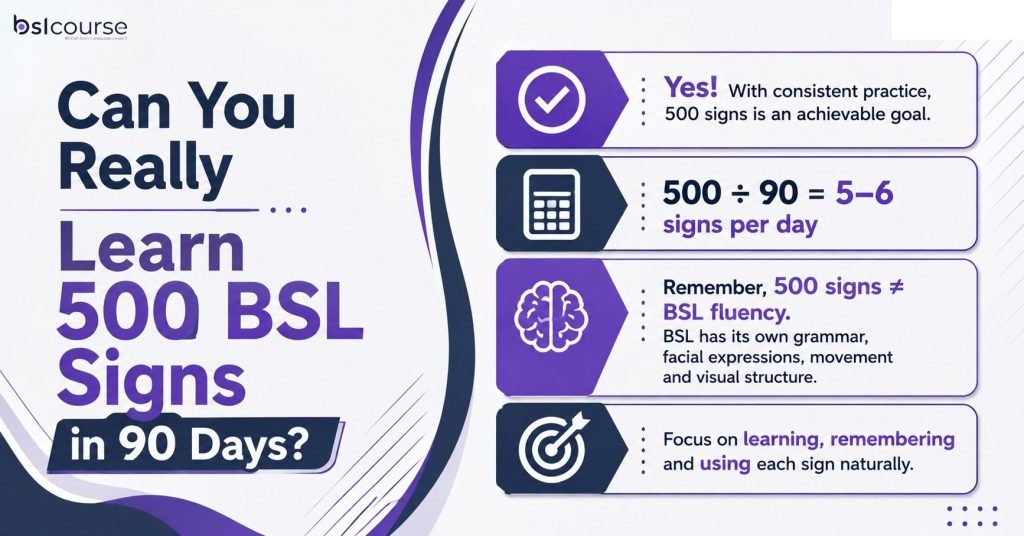
Yes, 500 signs in 90 days is a reasonable vocabulary-building target if you practise consistently.
The maths is straightforward:
500 signs ÷ 90 days = approximately 5.6 signs per day
That means learning 5–6 new signs each day will put you on track. However, reaching 500 signs should not be treated as the same thing as becoming fluent in BSL.
BSL is a complete visual language with its own grammar and structure. Handshape, movement, location, facial expression, eye gaze and body movement can all contribute to meaning.
Think of the 500-sign challenge as a foundation. Your real objective is to remember the signs and begin using them meaningfully.
90-Day "Learn Your First 500 Signs" Challenge Plan : Why Start With 500 BSL Signs?
Building a vocabulary of around 500 useful signs can give you a strong starting point for everyday BSL communication.
During the challenge, you can develop vocabulary for areas such as:
Greetings and introductions
Family and relationships
Numbers and dates
Food and drink
Work and education
Emotions
Weather
Travel
Health
Hobbies
Common actions
Everyday questions
More importantly, the challenge creates a regular learning habit. Instead of practising occasionally, you work with BSL every day and repeatedly revisit what you have learned.
Month 1: Build Your BSL Foundation
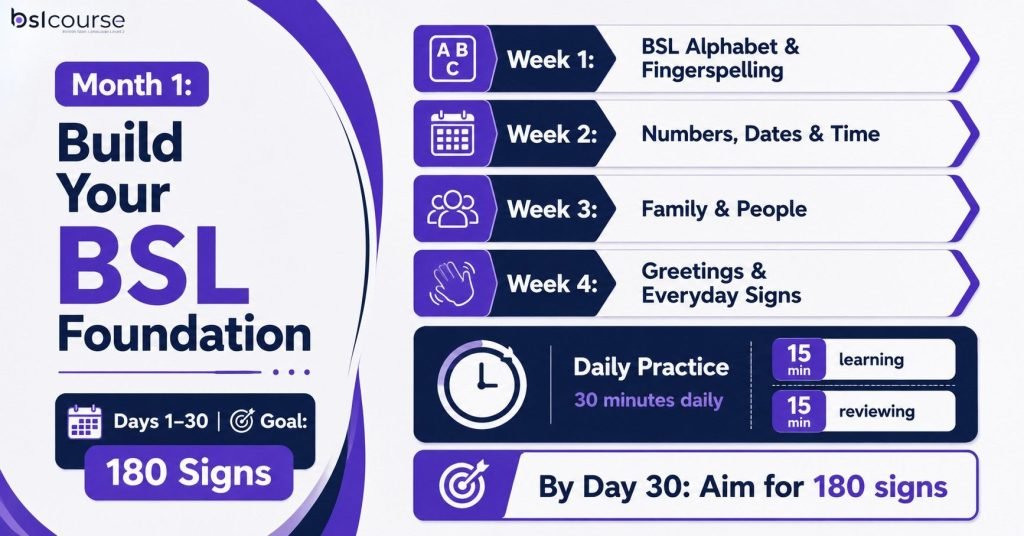
Days 1–30
Target: 180 signs
The first 30 days focus on essential BSL vocabulary and skills. Your priority should be accuracy rather than speed.
Week 1: Learn the BSL Fingerspelling Alphabet
Start with the two-handed BSL alphabet.
Learn all 26 letters and then use them immediately rather than simply practising A to Z repeatedly.
Practise:
Fingerspelling your name
Names of friends and family
Familiar places
Short everyday words
Recognising fingerspelled letters
Spend a few minutes each day reading and producing fingerspelling. Gradually increase your speed, but keep your handshapes clear.
Week 2: Numbers, Dates and Time
Next, develop practical number skills.
Focus on:
Numbers 1–20
Larger numbers
Tens such as 30, 40 and 50
Numbers up to 100
Age
Dates
Prices
Time-related vocabulary
Use the signs in context. For example, practise communicating your age, birthday and today’s date rather than simply signing numbers in sequence.
Week 3: Family and People
Now build vocabulary around people you are likely to discuss regularly.
Useful signs can include:
Mother
Father
Sister
Brother
Grandparents
Husband
Wife
Children
Friend
Teacher
Student
Once you know several signs, combine them when describing people in your life.
Week 4: Greetings and Everyday Life
Finish your first month with highly practical everyday vocabulary.
Learn signs associated with:
Hello
Goodbye
Please
Thank you
Sorry
Yes
No
Morning
Afternoon
Evening
Home
School
Work
Eat
Drink
Sleep
Don’t wait until you have learned hundreds of signs before using them. Start combining the vocabulary you already know.
Your Month 1 Daily Routine
Set aside approximately 30 minutes each day.
Spend around 15 minutes learning your new signs and another 15 minutes reviewing older vocabulary.
Use active recall during your revision. Instead of simply watching the same demonstration repeatedly, try to produce the sign before checking the answer.
Day 30 milestone: approximately 180 signs
Month 2: Expand Your Everyday BSL Vocabulary
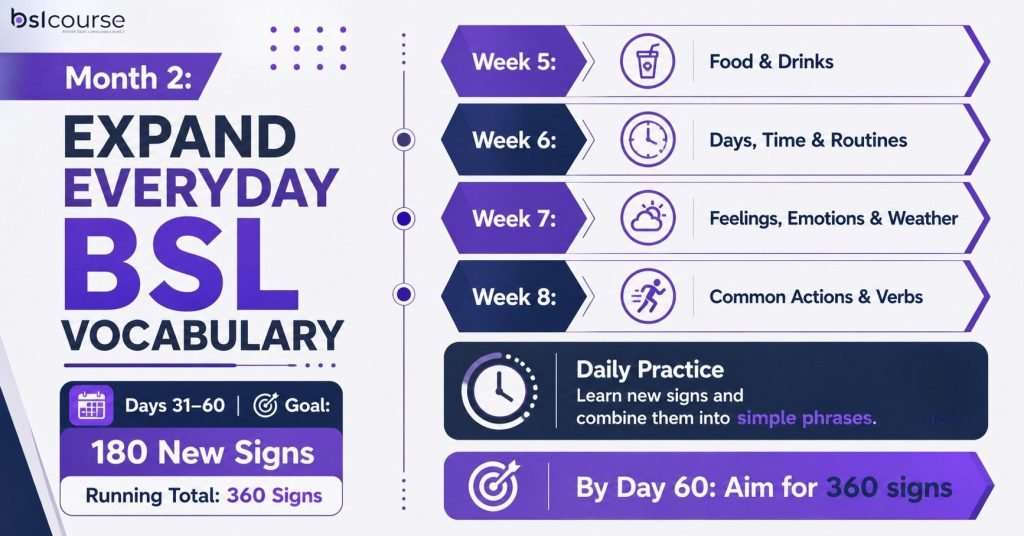
Days 31–60
Target: 180 additional signs
Running total: 360 signs
During the second month, you will expand into common conversation topics while beginning to connect signs rather than treating each one as an isolated item.
Week 5: Food and Drink
Build vocabulary around things you encounter every day.
Learn signs such as:
Water
Tea
Coffee
Bread
Rice
Fruit
Vegetables
Breakfast
Lunch
Dinner
A simple way to practise is to sign foods and drinks when you see or use them.
Week 6: Days, Time and Daily Routines
Learn vocabulary that helps you describe when something happens.
Focus on:
Days of the week
Months
Yesterday
Today
Tomorrow
Morning
Afternoon
Evening
Now
Later
Use the vocabulary to practise describing parts of your daily routine.
Week 7: Feelings, Emotions and Weather
Communication is not limited to objects and actions. You also need vocabulary for describing feelings, experiences and your surroundings.
Learn emotions such as:
Happy
Sad
Angry
Excited
Tired
Nervous
Confused
Proud
Worried
Calm
Then add common weather vocabulary, including:
Sunny
Rain
Wind
Snow
Hot
Cold
Cloudy
Storm
Warm
Pay close attention to facial expressions when learning emotional vocabulary. In BSL, facial expression is not simply decoration. Non-manual features can play an important grammatical and communicative role.
Week 8: Common Actions and Useful Verbs
Action vocabulary gives you more freedom to communicate.
Useful signs include:
Go
Come
Want
Need
Like
Help
Read
Write
Watch
Learn
Buy
Give
At this stage, start combining familiar signs into meaningful phrases and short utterances.
Instead of practising only coffee, for example, practise communicating an idea involving want + coffee.
Day 60 milestone: approximately 360 signs
Month 3: Turn Your Vocabulary Into Communication
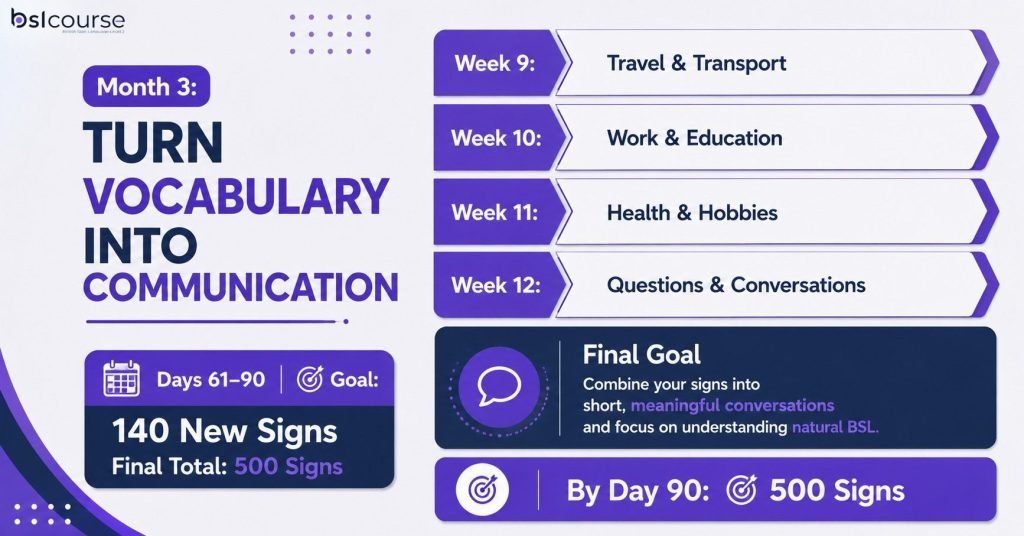
Days 61–90
Target: final 140 signs
Final total: 500 signs
The last month should not simply be another vocabulary sprint. You now have enough signs to put greater emphasis on understanding and communicating complete ideas.
Week 9: Travel and Transport
Learn practical signs associated with getting around.
Your vocabulary might include:
Bus
Train
Car
Airport
Ticket
Holiday
Hotel
Map
Journey
Use the signs to describe familiar journeys or future travel plans.
Week 10: Work and Education
Develop vocabulary relevant to school, study and the workplace.
Useful signs include:
Office
Computer
Meeting
Manager
Study
University
Course
Homework
Exam
Try creating short descriptions of your normal school or working day.
Week 11: Health and Hobbies
Add vocabulary that allows you to discuss wellbeing and personal interests.
For health, learn signs such as:
Doctor
Hospital
Medicine
Pain
Ill
Healthy
Exercise
Sleep
Appointment
For hobbies and interests, explore vocabulary including:
Music
Reading
Sport
Cooking
Gaming
Photography
Swimming
Walking
Travel
Personal vocabulary is particularly useful because you have a genuine reason to use it when introducing yourself or communicating with others.
Week 12: Questions and Everyday Conversations
Your final full week should bring together everything you have learned.
Practise communicating common questions and responses around topics such as:
What’s your name?
How are you?
Where do you live?
What do you like?
Where do you work?
Can you help me?
Don’t assume that English sentences can always be converted directly into BSL one word at a time. Pay attention to BSL sentence structure and learn complete expressions from reliable BSL sources.
How to Remember 500 BSL Signs
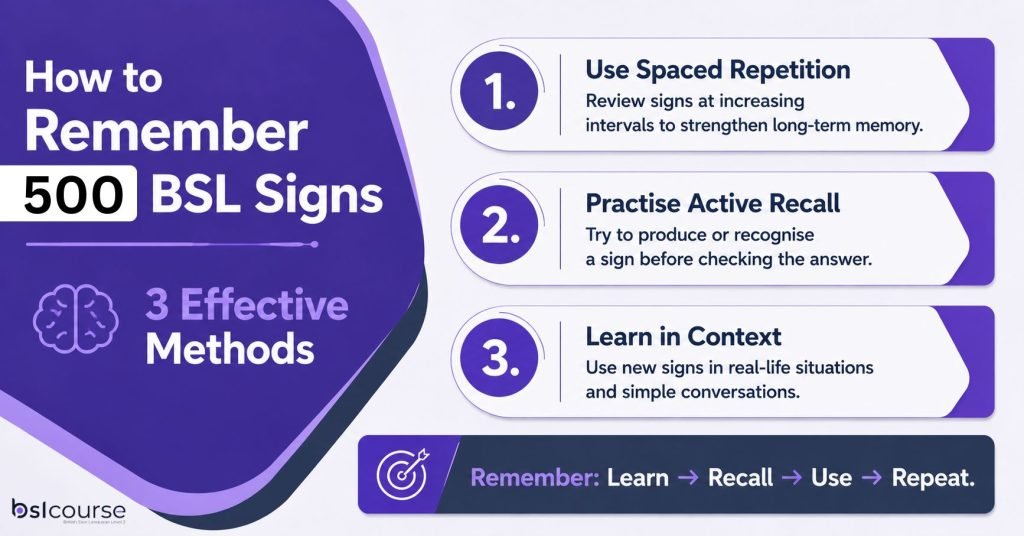
Learning a sign once does not mean you will remember it several weeks later. Your revision method is therefore just as important as your daily vocabulary target.
Use Spaced Repetition
Return to signs at increasing intervals instead of reviewing everything equally every day.
For example, review newly learned vocabulary the next day, later in the week and again after a longer gap.
Signs you struggle with should appear more frequently in your revision.
Use Active Recall
Test yourself before looking at the answer.
If your flashcard says hospital, try producing the sign from memory before watching the demonstration.
You can also reverse the exercise by watching a sign and trying to recall its meaning.
This trains both expressive and receptive skills.
Learn Signs in Context
Avoid building a vocabulary that exists only in a flashcard deck.
If you learn signs for food, use them while preparing or eating food. If you learn weather vocabulary, describe the weather. If you learn travel signs, use them when discussing a journey.
Context gives vocabulary meaning and makes recall easier.
How to Improve Your BSL Fluency During the Challenge
Knowing 500 signs and communicating effectively with 500 signs are different skills.
Your 90-day challenge should therefore include more than vocabulary memorisation.
Pay Attention to Facial Expressions
BSL uses non-manual features as an important part of communication.
These can include:
Facial expressions
Eyebrow movements
Head movements
Eye gaze
Body posture
When learning from a demonstration, observe the signer’s entire upper body rather than focusing only on their hands.
Watch Fluent and Native BSL Signers
Regular exposure helps you see how BSL is actually used.
Observe:
Sign placement
Movement
Facial grammar
Rhythm
Transitions between signs
Use of signing space
This also develops receptive skills, which are essential for understanding other signers.
Try BSL Shadowing
Shadowing involves watching a short section of signing and attempting to reproduce it closely.
You are not merely copying individual signs. Pay attention to timing, expression, movement and transitions.
Even a short daily shadowing session can complement your vocabulary practice.
Record Yourself Signing
Recording yourself allows you to review your signing from another perspective.
Compare your handshape, orientation, movement, location and non-manual features with the source you are learning from.
This can help you identify mistakes that are difficult to notice while you are signing.
A Simple 30-Minute Daily BSL Study Routine
You do not need to spend hours studying every day.
A practical routine could look like this:
Activity | Time |
Review older signs | 10 minutes |
Learn 5–6 new signs | 10 minutes |
Practise phrases or sentences | 5 minutes |
Watch or shadow BSL | 5 minutes |
Total | 30 minutes |
Consistency matters more than occasionally completing a very long study session.
Your 90-Day BSL Challenge Milestones
Time | Main Goal | Target Vocabulary |
Day 30 | Build your BSL foundation | 180 signs |
Day 60 | Expand everyday vocabulary | 360 signs |
Day 90 | Use vocabulary more confidently | 500 signs |
Reaching each milestone is useful, but don’t become too focused on the number.
If you can remember and confidently use 450 signs, that is more valuable than rushing through 500 signs that you cannot recall.
Tips for Completing the 90-Day Challenge
Completing a 90-day BSL challenge requires consistency, patience and regular practice. You do not need to study for long periods every day. Short and focused practice sessions can be very effective when repeated consistently.
Practise BSL Every Day
Try to include BSL in your daily routine, even when you only have a few minutes available. Regular exposure helps your brain remember handshapes, movements and meanings more easily.
A short five or ten-minute practice session is better than waiting several days for a longer study session. Daily practice also helps signing feel more natural over time.
Learn Around 5–6 New Signs Each Day
Learning approximately five or six new signs per day keeps the challenge manageable. This pace allows you to build your vocabulary without trying to remember too much information at once.
Focus on understanding each sign properly. Pay attention to the handshape, movement, position, direction and facial expression used with the sign.
Review Older Signs Regularly
Do not focus only on learning new vocabulary. Spend time reviewing signs from previous days and weeks.
Regular revision helps move vocabulary from short-term memory into long-term memory. You can review yesterday’s signs first, followed by signs learned several days or weeks earlier.
Use Active Recall
Active recall means trying to remember a sign before looking at the answer or watching the demonstration again.
For example, look at an English word and try to produce the BSL sign from memory. You can also watch a sign and try to remember its meaning.
This method makes your brain work harder than simple repetition. That extra effort can help strengthen memory.
Practise Producing and Recognising Signs
Knowing how to produce a sign is only one part of communication. You also need to recognise signs when another person uses them.
Practise in both directions. Try signing a word from an English prompt, then watch BSL videos and identify signs without checking the answer immediately.
This can improve both expressive and receptive BSL skills.
Learn Signs in Related Groups
Vocabulary is often easier to remember when signs are connected by a topic.
For example, you could learn signs for mother, father, brother, sister and family together. Another session could focus on food, drink, hungry, thirsty and restaurant.
Learning signs in groups helps you understand how vocabulary can be used in real situations.
Use New Signs in Context
Avoid learning signs as isolated pieces of information whenever possible. Try combining them into short phrases, questions or simple conversations.
If you learn signs related to travel, imagine asking for directions or discussing a journey. If you learn food vocabulary, practise signs you might use while ordering or discussing meals.
Context gives each sign a practical purpose.
Watch Fluent and Native BSL Signers
Regularly watching fluent and native BSL signers can help you understand how BSL looks during natural communication.
Notice the speed, rhythm, facial expressions, body movements and transitions between signs. You do not need to understand everything immediately.
Over time, regular viewing can make natural signing easier to recognise.
Pay Attention to Facial Expressions
BSL communication involves more than hand movements. Facial expressions, head movements, eye contact and body position can also carry meaning.
These features are often called non-manual features.
When learning a new sign or sentence, pay attention to the complete movement rather than copying only the hands. This can make your signing clearer and more natural.
Record Yourself Signing
Recording yourself occasionally can help you notice things that are difficult to recognise while you are signing.
Choose several signs or a short sentence and record yourself performing them. Compare your signing with a reliable BSL demonstration.
Look at your hand position, movement, facial expression and overall clarity. Repeat the recording later to see how your skills have developed.
Practise With Other People
Whenever possible, use BSL with other learners, tutors, Deaf signers or people who already communicate using BSL.
Real interaction helps you practise recognising signs at different speeds. It also teaches you how to respond without relying on prepared vocabulary lists.
Even short conversations can improve confidence and communication skills.
Focus on Consistency Rather Than Perfection
The purpose of the challenge is to give your learning a clear structure. It should not create unnecessary pressure.
Some signs will be easier to remember than others. You may also have days when you complete less practice than planned. That is completely normal during a long learning challenge.
If you miss a day, continue with your normal schedule when you return. Avoid trying to learn a large number of signs in one session simply to catch up.
Steady progress is usually more useful than cramming.
Keep Your Final Goal in Mind
By the end of the 90 days, your goal is not simply to recognise 500 separate signs. You should also begin using those signs to understand and communicate simple ideas.
Think of the challenge as a gradual progression:
Learn → Review → Recall → Use → Communicate
Following this cycle throughout the 90 days can help you build stronger vocabulary, better recognition skills and greater confidence when using BSL.
Frequently Asked Questions
Can You Learn 500 BSL Signs in 90 Days?
Yes. Learning 500 signs over 90 days requires an average of approximately 5–6 new signs per day. Regular revision is essential because the objective is to retain and use the vocabulary, not simply encounter 500 signs.
How Many BSL Signs Should I Learn Per Day?
Around 5–6 new signs per day is enough to reach approximately 500 signs within 90 days. You should also spend time reviewing previously learned vocabulary.
Can I really learn 50 BSL signs in 7 days?
Yes. Learning around 7–8 signs per day makes 50 signs a realistic short-term vocabulary goal. The key is to practise consistently and review previous signs every day.
How Long Should I Practise BSL Each Day?
Around 30 minutes of focused daily practice can provide a manageable starting routine. Divide your time between new vocabulary, revision, receptive practice and using signs in context.
How much time should I spend on the 7-Day Learn Your First 50 Signs Challenge Plan each day?
The 7-Day Learn Your First 50 Signs Challenge Plan works best when learners practise consistently for a short period each day. Regular repetition helps improve memory, hand movement accuracy, and confidence when using BSL signs.
Will Knowing 500 BSL Signs Make Me Fluent?
No. Knowing 500 signs gives you useful vocabulary, but fluency involves much more. You also need receptive skills, appropriate BSL grammar, non-manual features, natural sentence construction and real communication practice.
Should I Learn BSL Grammar While Learning Vocabulary?
Yes. Introduce BSL grammar alongside vocabulary from the beginning. Avoid assuming that BSL follows English word order or that every English sentence can be translated sign by sign.
What Should I Do After the 90-Day Challenge?
Continue expanding your vocabulary while increasing the amount of real BSL you watch and use. Focus more heavily on conversations, receptive comprehension, grammar, natural signing speed and communication with BSL users.
Conclusion
The 90-Day “Learn Your First 500 Signs” Challenge is a practical way to build your BSL vocabulary through small, consistent daily steps. By learning around 5–6 signs each day, reviewing regularly and practising signs in real contexts, you can develop stronger recall and greater confidence in using BSL.
Remember, learning 500 signs is only the beginning. Continue practising BSL grammar, facial expressions, receptive skills and real communication as your vocabulary grows.
To make your learning journey easier and more organised, download the 90-Day BSL Learning Workbook to track your progress, plan your revision and stay consistent throughout the challenge.
Start today, keep practising and build your BSL skills one sign at a time.

