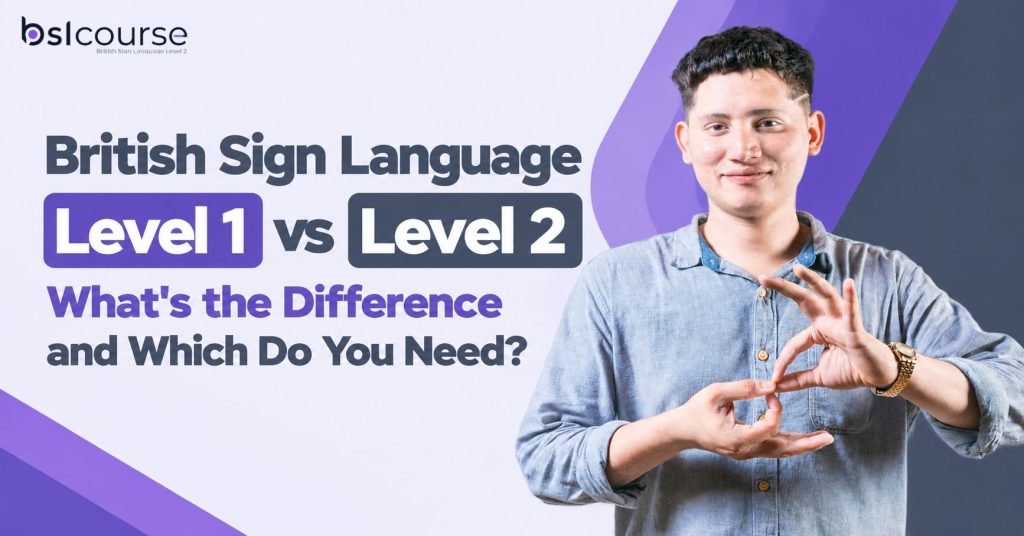
If you’re deciding between British Sign Language Level 1 vs Level 2 , the short answer is simple: choose Level 1 if you’re completely new to British Sign Language and want to learn the basics, such as greetings, fingerspelling, and everyday vocabulary. Choose Level 2 if you’ve already developed those foundations and want to build confidence, hold longer conversations, and communicate more naturally with Deaf people.
British Sign Language (BSL) Level 1 introduces learners to essential signs, greetings, and everyday communication, while Level 2 expands on these foundations to support more confident conversations and practical workplace interactions. Most learners begin with Level 1 before progressing to Level 2 once they feel comfortable with basic signed exchanges.
The demand for BSL skills has grown significantly across workplaces, schools, and healthcare settings. More people are learning BSL not just as a hobby, but as a valuable communication tool to support Deaf colleagues, connect with family members, improve customer service, and create more inclusive environments.
In this guide, we’ll break down the key differences between BSL Level 1 and Level 2, what each course covers, who each level is best suited for, and how to decide which one matches your learning goals.
What Is British Sign Language?
British Sign Language is a full, independent language used by the Deaf community in the UK. It has its own grammar and sentence structure, separate from spoken or written English, and it relies on hand shapes, facial expression, body position and space to convey meaning.
BSL isn’t “English on the hands.” Word order, question forms and even how you show tense all work differently from English, which is why it takes structured learning rather than picking up a few signs.
Learning it opens up direct communication with an estimated 87,000 Deaf BSL users in the UK, plus many more hearing family members, friends and colleagues who sign.
Understanding this from the outset matters because it sets realistic expectations. BSL Level 1 won’t make you fluent, and even Level 2 is still an intermediate stage. Both levels are stepping stones within a longer, worthwhile learning path.
What Is BSL Level 1?
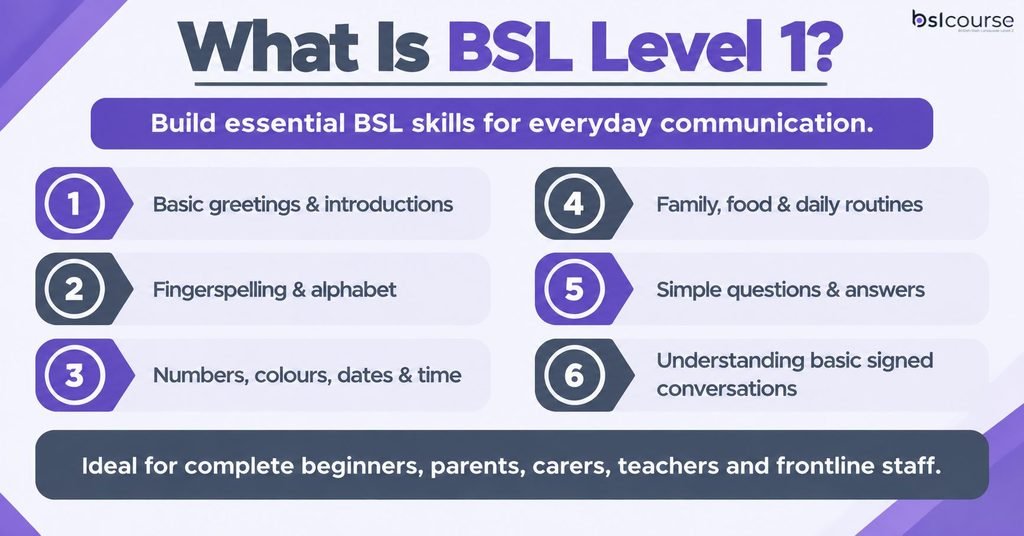
BSL Level 1 is the entry-level qualification for people with little or no prior experience of British Sign Language. It builds the foundational vocabulary and basic sentence structure you need to hold simple, everyday conversations.
What Do You Learn at BSL Level 1?
At Level 1, you build a working set of signs and basic BSL grammar rather than deep conversational skill. Course content typically covers:
- Greetings, introductions and polite exchanges
- Fingerspelling the alphabet, for names and words with no dedicated sign
- Everyday vocabulary: colours, numbers, days, dates and time
- Family members, hobbies, food and daily routines
- Simple question forms and short answers
- Recognising and following basic signed conversations at a slow pace
By the end of Level 1, most learners can introduce themselves, ask simple questions and follow short, clearly signed exchanges, though they’ll still rely heavily on repetition and a patient signing partner.
Who Is BSL Level 1 For?
Level 1 suits complete beginners who want a solid, achievable starting point rather than trying to run before they can walk. It’s a common choice for:
- People with no prior BSL knowledge who want to test their interest before committing further
- Parents and carers of Deaf children who need immediate, practical communication tools
- Teachers, receptionists and frontline staff who occasionally interact with Deaf people
- Anyone adding a foundational communication skill to their CV
What Is BSL Level 2?
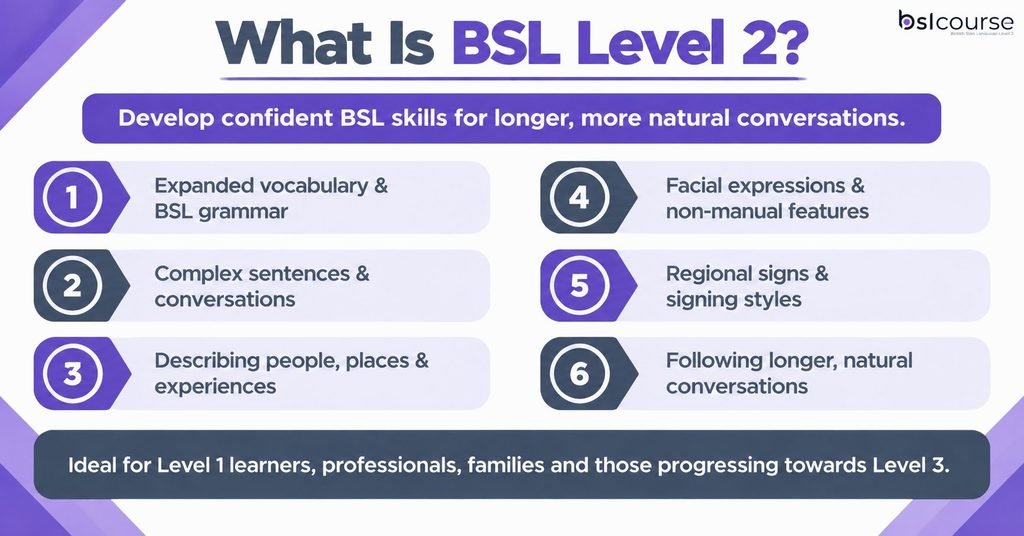
BSL Level 2 builds directly on Level 1, developing the vocabulary, grammar and confidence needed to hold longer, more natural conversations with Deaf signers. It’s generally recognised as the point where learners start communicating with real fluidity rather than relying on memorised phrases.
What Do You Learn at BSL Level 2?
Level 2 shifts the focus from isolated vocabulary to connected, natural conversation. You’ll typically cover:
- A significantly wider vocabulary across more topics and situations
- More complex sentence structures and accurate use of BSL grammar
- Describing people, places, events and personal experiences in detail
- Holding and following longer, less predictable conversations
- Using facial expression and non-manual features correctly to change meaning
- Understanding regional sign variation and different signing styles
Learners finishing Level 2 can usually hold a genuine two-way conversation on familiar topics, ask follow-up questions, and understand Deaf signers who aren’t deliberately slowing down for a beginner.
Who Is BSL Level 2 For?
Level 2 suits learners who’ve completed Level 1 (or hold equivalent knowledge) and want to move from basic exchanges to real, working communication. This includes:
- Learners who finished Level 1 and want to keep progressing
- Professionals who regularly work with Deaf colleagues, patients, students or customers
- Family members of Deaf people who want deeper, more natural everyday communication
- Anyone planning to eventually pursue Level 3 or interpreter training
BSL Level 1 vs Level 2: What’s the Difference?

The core difference is depth and independence. Level 1 gives you basic vocabulary and short, simple exchanges, while Level 2 gives you the grammar, range and confidence to hold a genuine conversation without constant repetition.
| Feature | BSL Level 1 | BSL Level 2 |
| Experience level | Complete beginner | Intermediate |
| Main focus | Basic, functional communication | Confident, natural conversation |
| Vocabulary | Everyday signs, core topics | Wide range across many topics |
| Conversation length | Short, simple exchanges | Longer, less predictable discussions |
| Grammar | Introduction to BSL structure | Accurate, more advanced use |
| Facial expression/grammar features | Basic awareness | Applied consistently and correctly |
| Typical outcome | Can introduce yourself and follow slow signing | Can hold real conversations with Deaf signers |
| Best for | Getting started | Building genuine fluency |
Can You Start With BSL Level 2 Without Level 1?
Yes, but only if you already have equivalent knowledge, most course providers will assess this before enrolling you directly into Level 2. Skipping Level 1 without that foundation usually means struggling to keep up, since Level 2 assumes fluent fingerspelling and a solid grasp of basic grammar already.
This route tends to suit people who grew up around BSL, have Deaf family members, or have completed an informal but thorough introduction to the language elsewhere. If you’re at all unsure, most providers offer a quick placement conversation or informal assessment, it’s worth asking for one rather than guessing and finding yourself out of your depth in week one.
Which BSL Level Do You Need?
The right level depends on your current ability and what you actually need to do with BSL, not just how long you’ve been interested in learning it.
Choose BSL Level 1 If You Want To:
- Learn the fundamentals of BSL from scratch
- Communicate simple, everyday messages with a Deaf person
- Test whether BSL learning suits you before committing further
- Add a recognised introductory qualification to your CV
Choose BSL Level 2 If You Want To:
- Hold meaningful, two-way conversations rather than short exchanges
- Improve day-to-day communication with Deaf colleagues or customers
- Support Deaf students, patients or service users more effectively
- Keep progressing towards Level 3 or further qualifications
What Are the Benefits of Learning Beyond BSL Level 1?
Pushing on to Level 2 and beyond gives you communication skills that actually hold up in real, unscripted situations, rather than just covering the basics. The main benefits include:
- Genuine confidence: you can follow conversations at a natural pace, not just slowed-down demonstrations
- Better cultural understanding: deeper exposure to Deaf culture, humour and social norms
- Stronger workplace inclusion: colleagues and customers feel properly understood, not just tolerated
- Wider opportunities: a pathway towards Level 3, interpreter training, or specialist Deaf-facing roles
How Long Does It Take to Learn BSL Level 1 and Level 2?
Most people complete BSL Level 1 in one academic term to two terms of weekly classes, and Level 2 typically takes a similar length of time again, though actual progress varies a lot between learners. Several factors affect your pace more than the course length on paper:
- Course format: weekly evening classes progress more slowly than intensive block courses
- Practice time: signing outside class, even for ten minutes daily, accelerates retention noticeably
- Prior language-learning experience: learners used to picking up new grammar systems often progress faster
- Real interaction with signers: regular contact with Deaf people or fluent signers builds fluency far quicker than classroom study alone
Treat the qualification as a marker of progress, not the finish line. Consistent practice between classes matters more for actual fluency than simply completing the course on schedule.
What Comes After BSL Level 2?
After Level 2, most learners progress to BSL Level 3, which develops more advanced conversational range, greater signing speed, and the ability to discuss abstract or unfamiliar topics.
Level 3 is also generally the point where learners start seriously considering interpreter training pathways, should that interest them.
Level 2 gives you a genuinely useful, functional foundation even if you go no further. But for anyone aiming at professional-level communication or interpreting work, it’s very much the middle of the journey rather than the end of it.
Conclusion
The difference between BSL Level 1 and Level 2 comes down to depth and independence. Level 1 gives you the basics: greetings, fingerspelling and everyday vocabulary for short, simple exchanges.
Level 2 builds on that foundation with wider vocabulary, more accurate grammar, and the confidence to hold a genuine, unscripted conversation.
Here’s what to remember when choosing:
- Start with Level 1 if you’re new to BSL or want to test whether it’s right for you.
- Move to Level 2 once you’re comfortable with the basics and want real conversational ability.
- Skip straight to Level 2 only if you already have equivalent knowledge and a provider has assessed you into it.
- Keep progressing to Level 3 and beyond if your goal is fluency or interpreter training.
Neither level is the finish line, but each one makes a real difference to how confidently you can communicate. Ready to start learning British Sign Language? Explore our BSL courses and find the right level for your learning journey.

