
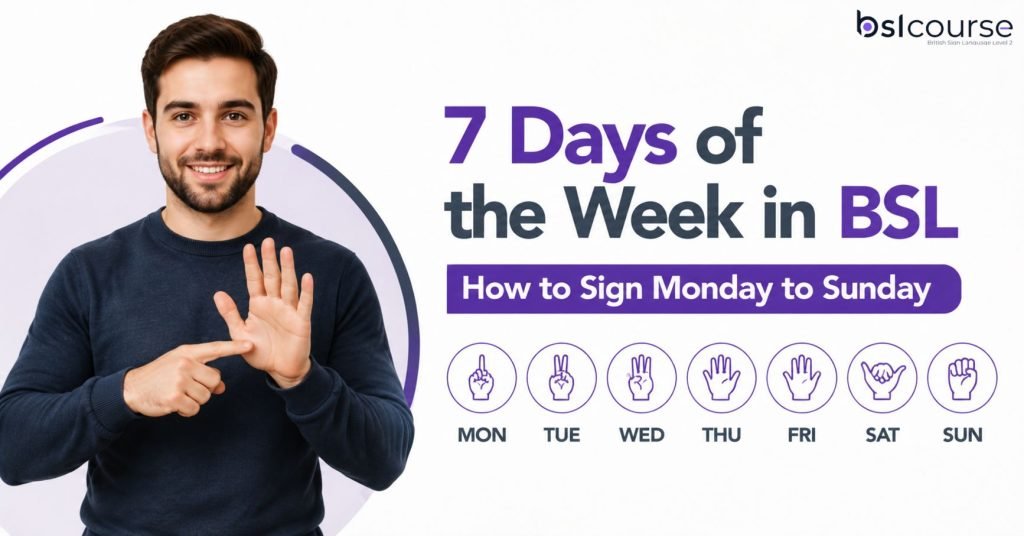
If you’re learning British Sign Language (BSL), the 7 days of the week in BSL are some of the most useful signs to learn early. British Sign Language represents the seven days of the week through specific handshapes, locations, movements, and, in some cases, fingerspelled initials. You’ll use these signs when discussing appointments, work schedules, plans, and everyday routines.
This guide covers Monday to Sunday, including the handshapes, movements, mouth patterns, and regional variations you may encounter. While many signs use the first letter of the English word, the movement is equally important. For example, Wednesday uses a two-handed W, Thursday moves from T to H, and Friday uses a circular movement with F.
By the end of this guide, you’ll be able to sign the days of the week and use them in simple conversations about your weekly routine.
How Are the Days of the Week Signed in BSL?
Several weekday signs in BSL borrow their handshape from the BSL alphabet, which is why learning fingerspelling early makes the rest of your vocabulary click into place faster. But a sign is never just a letter held up in the air. Five things combine to make a sign correct:
- Handshape – the letter or shape your hand forms
- Location – where the sign happens in relation to your body or other hand
- Movement – tapping, circling, or moving from one shape to another
- Orientation – which way your palm faces
- Mouth pattern – the shape your mouth makes alongside the sign, which carries real meaning in BSL
Get the handshape right but skip the movement, and you haven’t actually made the sign; you’ve just spelled a letter. That’s the single biggest mistake beginners make with weekday signs, so it’s worth slowing down and practising the whole movement, not just the starting shape.
You’ll also notice most of these signs use two hands: a dominant hand (the one you write with, usually) that does the moving, and a non-dominant hand that stays still and acts as a base. Get comfortable with that dominant/non-dominant split now, because it comes up throughout BSL, not just in weekday signs.
How to Sign the 7 Days of the Week in BSL
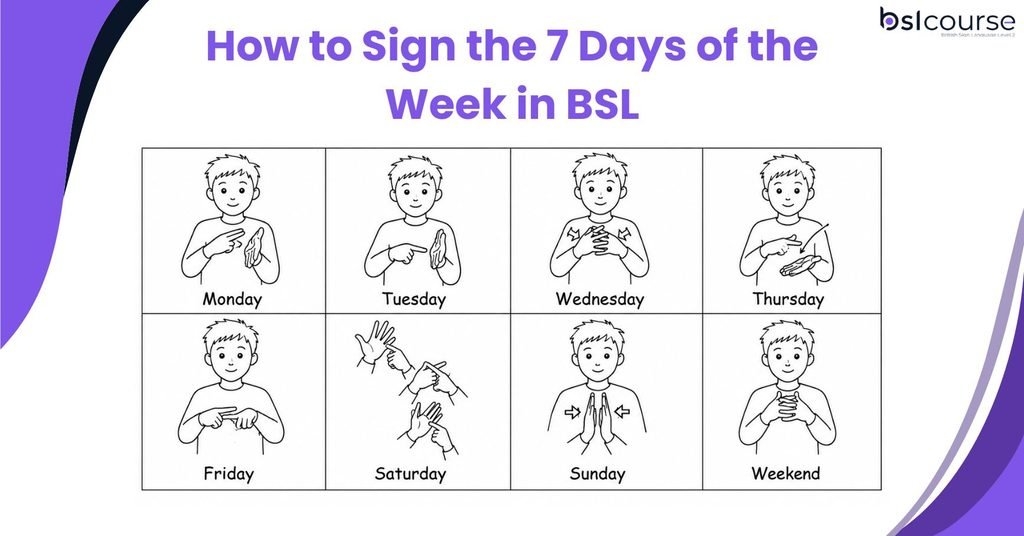
Learn how to sign all seven days of the week in British Sign Language (BSL), including the correct handshapes, movements, and common regional variations.
Practise each sign carefully and remember that BSL signs can vary across different regions and Deaf communities in the UK.
Monday in BSL
The commonly taught sign for Monday uses the BSL fingerspelled M on your dominant hand. Rest your non-dominant hand palm-up in front of you, then tap the M-shaped fingers gently onto your non-dominant palm. Say “Monday” as you sign it; the mouth pattern helps distinguish it from similar-looking signs and reinforces meaning for anyone lip-reading alongside the sign.
Tuesday in BSL
Tuesday follows the same pattern as Monday, but with a T handshape instead of an M. Form the T with your dominant hand, hold your non-dominant palm flat in front of you, and tap the T onto it. The tapping movement, not just the letter, is what makes this recognisably “Tuesday” rather than a random fingerspelled T.
Wednesday in BSL
Wednesday breaks the single-letter pattern. It’s commonly signed with both hands forming a W shape, brought together in front of you. The movement of bringing the two W handshapes together is the important part; hold a static W with each hand and you’ve missed the sign entirely. This is a good early example of why memorising only the first letter of each day won’t get you very far.
Thursday in BSL
Thursday is the one beginners mix up with Tuesday most often, so it’s worth learning them side by side. The commonly taught sign moves from a T handshape into an H handshape in one flowing motion, rather than tapping a single static letter. Practise the T-to-H transition slowly at first so the two shapes stay distinct, then build up speed once it feels natural.
Friday in BSL
Friday uses the BSL fingerspelled F, made with a small circular movement over the stationary fingers of your non-dominant hand. If you’ve studied American Sign Language before, take extra care here: BSL fingerspelling is a completely different system from ASL, so an F handshape that looks familiar from ASL won’t necessarily behave the same way in BSL.
Saturday in BSL
Saturday is commonly signed as a two-handed sign with a circular movement. It’s also one of the days with the most noticeable regional variation, so don’t be thrown if a Deaf signer in a different part of the UK produces something that looks quite different from what you’ve been taught. Both can be correct; they’re just regional forms of the same word.
Sunday in BSL
Sunday is typically signed by bringing the palms of both hands together twice. As with Saturday, you may come across regional alternatives, particularly among older or more traditional signers. If in doubt, mirror the version used by your tutor or local Deaf community first, then expand from there.
Quick Reference: Monday to Sunday in BSL
| Day | Main Feature to Remember |
| Monday | M-based sign, tapped onto the non-dominant palm |
| Tuesday | T-based sign, tapped onto the non-dominant palm |
| Wednesday | W-based, two-handed sign brought together |
| Thursday | T-to-H movement, distinct from Tuesday |
| Friday | F-based sign with a circular movement |
| Saturday | Two-handed sign with a circular movement |
| Sunday | Two palms brought together, twice |
These are the commonly taught forms. You may see regional variants, particularly for Saturday and Sunday, so treat this table as a starting point rather than the only correct version.
Why Do BSL Signs for the Days of the Week Vary?
BSL has natural regional and generational variations, so weekday signs may differ across the UK without either version being incorrect.
Beginners should start with the form taught by their tutor or local Deaf community, then gradually learn alternative signs as their BSL skills develop
Regional variation in BSL
BSL isn’t a single fixed set of gestures handed down from one source; it’s a natural language that developed and spread across different Deaf communities in different parts of the UK, much like spoken English has regional accents and dialect words.
Vocabulary, including weekday signs, can vary by region and even by generation, with older signers sometimes using forms that younger signers no longer favour.
If you learn a weekday sign in one city and then see a different version used in another, neither signer is wrong. Regional variation is a completely normal, expected feature of BSL, not a sign of inconsistency in the language.
Which version should beginners learn?
Start with a commonly taught form, ideally the one used by your tutor or your local Deaf community, and treat that as your working version. Once you’re comfortable with it, start paying attention to alternative signs you encounter through other signers, videos, or Deaf events.
Over time you’ll build up a small mental library of variants, but there’s no need to memorise every regional form right away. Communication and understanding matter far more at this stage than covering every possible variant.
5 Common Mistakes When Signing the Days of the Week
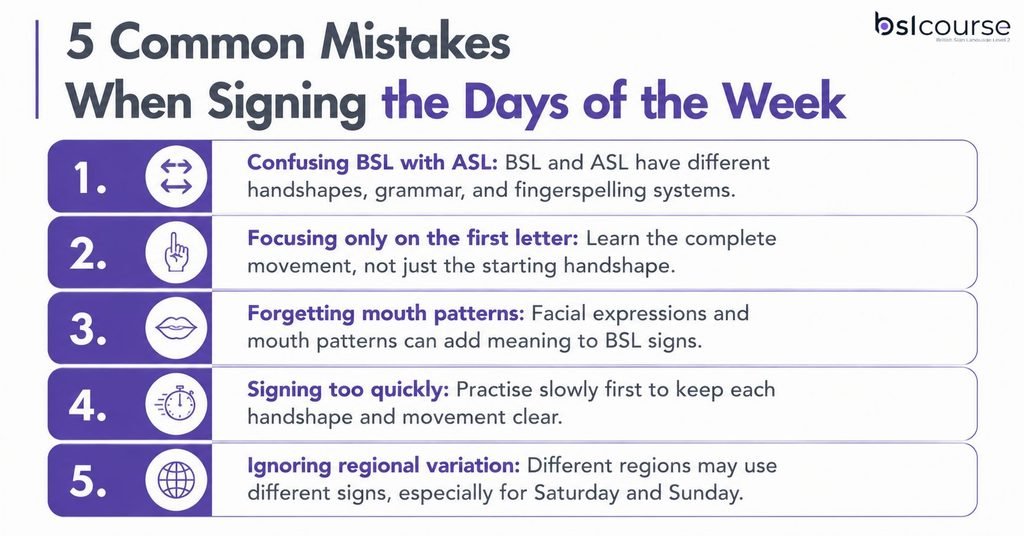
These five common mistakes can make weekday signs unclear, so focus on accurate handshapes, movement, mouth patterns, and regional variations.
1. Confusing BSL with ASL: British Sign Language and American Sign Language are entirely separate languages with different grammar, different vocabulary, and different fingerspelling alphabets. A handshape that means one thing in ASL can mean something different, or nothing at all, in BSL.
2. Focusing only on the first letter: As you’ve seen above, several signs (Wednesday and Thursday especially) depend on movement and a shift between handshapes, not a static letter. Treat the letter as a starting point, never the whole answer.
3. Forgetting mouth patterns: BSL uses mouth patterns and other non-manual features (facial expression, head position) as genuine parts of grammar and meaning, not decoration. Practise saying the day as you sign it so the two develop together.
4. Signing too quickly: It’s tempting to speed up once you know the basic shape, but rushing tends to blur the handshape and movement together until the sign becomes unclear. Slow down until each part is distinct, then build speed gradually.
5. Ignoring regional variation: Expect to see different versions of these signs, particularly Saturday and Sunday, as you meet more BSL users. Don’t assume there’s only one “correct” answer
How to Practise the Days of the Week in BSL
1. Practise in calendar order. Run through Monday, Tuesday, Wednesday, Thursday, Friday, Saturday, Sunday as a sequence until the order and each sign feel automatic together.
2. Sign your weekly routine. Pair each day with an activity: Monday for work, Tuesday for study, Wednesday for an appointment, Friday for shopping. Building real sentences helps the signs stick far better than repeating them in isolation.
3. Practise yesterday, today and tomorrow. Once the seven days feel solid, start layering in basic time vocabulary so you can talk about your week in context, not just recite a list.
4. Use a calendar for practice. Pick a random date and sign the day it falls on. This forces genuine recall rather than rote repetition in a fixed order.
5. Practise with fluent BSL signers. Wherever possible, watch and sign along with fluent or Deaf signers rather than relying only on written descriptions or diagrams. You’ll pick up natural rhythm, regional vocabulary, and the facial grammar that a page of text can’t fully capture.
Other Basic BSL Vocabulary to Learn Next
Once you’ve got the seven days down, a few closely related vocabulary sets will round out your everyday BSL fast.
Learn the BSL alphabet. Fingerspelling underpins several weekday signs and is essential for names, places, and any word that doesn’t have its own established sign.
Learn numbers in BSL. Useful for dates, times, ages, prices, and appointments, numbers pair naturally with the days of the week once you’re building full sentences.
Learn BSL colours. Another core beginner vocabulary set that comes up constantly in everyday conversation.
Continue with 90-Day “Learn Your First 500 Signs” Challenge plan. From here, greetings, family vocabulary, time, questions, and everyday phrases are the natural next steps.
FAQs
How do you sign the days of the week in BSL?
Each day from Monday to Sunday has a commonly used sign built from a specific handshape, movement, and hand position, and several are influenced by fingerspelled letters. Regional variants exist for some days, particularly Saturday and Sunday, so you may see slightly different versions depending on where in the UK a signer learned BSL.
Are BSL days of the week just fingerspelled?
Not entirely. Signs like Monday and Tuesday take their handshape from a fingerspelled letter, but the complete sign also depends on movement and position, such as tapping onto the non-dominant palm. Other days, like Wednesday and Thursday, involve a shift between handshapes rather than a single static letter, so fingerspelling alone won’t produce the correct sign.
How do you sign Monday in BSL?
Monday is commonly signed by forming the fingerspelled M with your dominant hand and tapping it onto your flat non-dominant palm, while mouthing “Monday” alongside the movement.
How do you sign Thursday in BSL?
Thursday is commonly signed with a movement from a T handshape into an H handshape in one flowing motion. It’s worth practising this alongside Tuesday, since beginners often mix the two up early on.
How do you sign Sunday in BSL?
Sunday is typically signed by bringing the palms of both hands together twice. As with several other weekday signs, you may encounter regional alternatives depending on where a signer is from.
Are the days of the week different in different parts of the UK?
Yes. BSL has recognised regional and generational variation, and weekday signs, especially Saturday and Sunday, are a common example of this. Seeing a different version doesn’t mean either signer is wrong.
Are free sign language apps enough to become fluent?
The Best Free Apps to Learn Sign Language in 2026 can support learning, but apps alone may not provide complete fluency. Regular practice, conversations with BSL users, and additional learning resources are important for developing strong communication skills.
Is BSL the same as ASL?
No. British Sign Language and American Sign Language are distinct languages with separate grammar, vocabulary, and fingerspelling alphabets, despite both being used by English-speaking Deaf communities in their respective countries.
Conclusion
You’ve now got all seven weekday signs, Monday through Sunday, along with the handshape, movement, and mouth pattern behind each one.
Practise them in calendar order first, then start building real sentences about your own week, work, study, appointments, and plans, so the vocabulary sticks in context rather than as an isolated list.
Remember that regional variation is a normal part of BSL, not a sign that something’s wrong, and that the versions here are the commonly taught starting point rather than the only correct forms.

